




 全部商品分类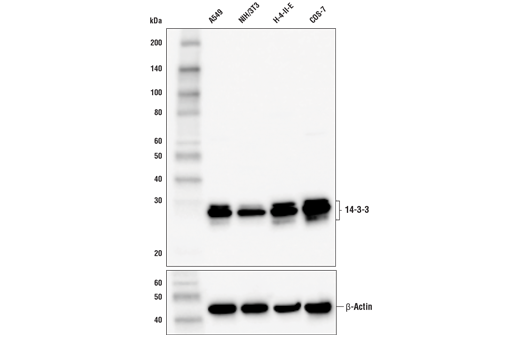


 用小程序,查商品更便捷





产品介绍
产品介绍
产品信息
荧光素标记
Unconjugated

来源纯化
Monoclonal antibody is produced by immunizing animals with a synthetic peptide corresponding to residues surrounding Gln221 of human 14-3-3 β/α protein.
宿主
Rabbit
商品描述
Product Usage Information
| Application | Dilution |
|---|---|
| Western Blotting | 1:1000 |
同种型
Rabbit IgG
分子量
27-29
应用
目标/特异性
Specificity/Sensitivity
14-3-3 (pan) (E9S9M) Rabbit mAb recognizes endogenous levels of total 14-3-3 protein. This antibody detects all known isoforms of mammalian 14-3-3 proteins (β/α, γ, ε, η, ζ/δ, θ/τ and σ).
Species Reactivity:
Human, Mouse, Rat, Monkey
敏感性
Endogenous
背景
背景
The 14-3-3 family of proteins plays a key regulatory role in signal transduction, checkpoint control, apoptotic and nutrient-sensing pathways (1,2). 14-3-3 proteins are highly conserved and ubiquitously expressed. There are at least seven isoforms, β, γ, ε, σ, ζ, τ, and η that have been identified in mammals. The initially described α and δ isoforms are confirmed to be phosphorylated forms of β and ζ, respectively (3). Through their amino-terminal α helical region, 14-3-3 proteins form homo- or heterodimers that interact with a wide variety of proteins: transcription factors, metabolic enzymes, cytoskeletal proteins, kinases, phosphatases, and other signaling molecules (3,4). The interaction of 14-3-3 proteins with their targets is primarily through a phospho-Ser/Thr motif. However, binding to divergent phospho-Ser/Thr motifs, as well as phosphorylation independent interactions has been observed (4). 14-3-3 binding masks specific sequences of the target protein, and therefore, modulates target protein localization, phosphorylation state, stability, and molecular interactions (1-4). 14-3-3 proteins may also induce target protein conformational changes that modify target protein function (4,5). Distinct temporal and spatial expression patterns of 14-3-3 isoforms have been observed in development and in acute response to extracellular signals and drugs, suggesting that 14-3-3 isoforms may perform different functions despite their sequence similarities (4). Several studies suggest that 14-3-3 isoforms are differentially regulated in cancer and neurological syndromes (2,3).
1.Muslin, A.J. and Xing, H. (2000) Cell Signal 12, 703-9.
2.Mackintosh, C. (2004) Biochem J 381, 329-42.
3.Dougherty, M.K. and Morrison, D.K. (2004) J Cell Sci 117, 1875-84.
4.Yaffe, M.B. (2002) FEBS Lett 513, 53-7.
5.Bridges, D. and Moorhead, G.B. (2004) Sci STKE 2004, re10.
研究领域
细胞生物学,神经科学,
翻译后修饰
unmodified
制备和贮存
保存方式
Supplied in 10 mM sodium HEPES (pH 7.5), 150 mM NaCl, 100 µg/ml BSA, 50% glycerol and less than 0.02% sodium azide. Store at –20°C. Do not aliquot the antibody.
数据库链接
Entrez-Gene ID
7531,7532,7529,10971,7533,2810,7534
UniProt ID
P62258,P61981,P31946,P27348,Q04917,P31947,P63104
声明 :本官网所有报价均为常温或者蓝冰运输价格,如有产品需要干冰运输,需另外加收干冰运输费。