




 全部商品分类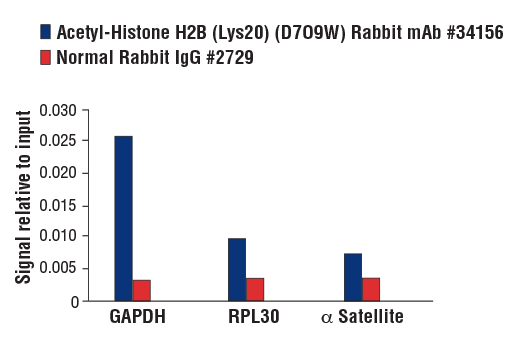


1/8


 用小程序,查商品更便捷





产品介绍
产品介绍
产品信息
荧光素标记
Unconjugated

来源纯化
Monoclonal antibody is produced by immunizing animals with a synthetic acetylated peptide corresponding to residues surrounding Lys20 of human histone H2B protein.
宿主
Rabbit
商品描述
Product Usage Information
For optimal ChIP results, use 10 μl of antibody and 10 μg of chromatin (approximately 4 x 10⁶ cells) per IP. This antibody has been validated using SimpleChIP® Enzymatic Chromatin IP Kits.
| Application | Dilution |
|---|---|
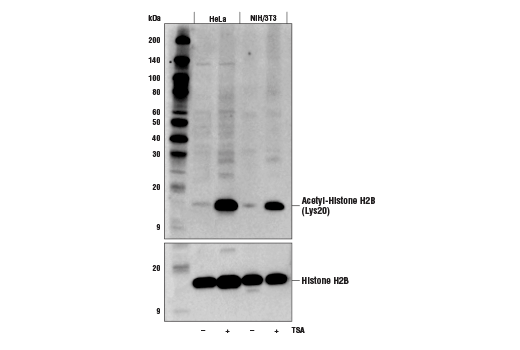
| Western Blotting | 1:1000 |
| Immunoprecipitation | 1:200 |
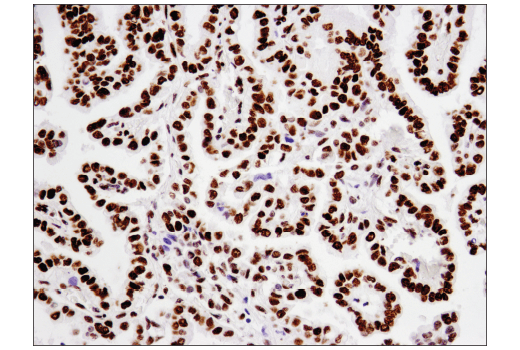
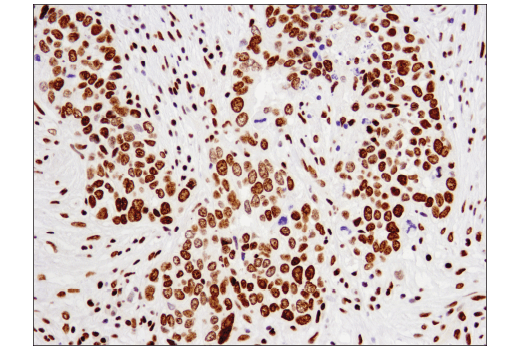
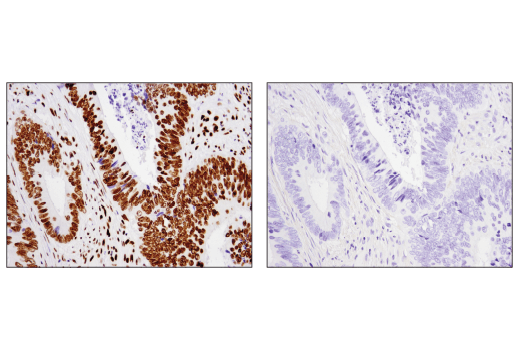
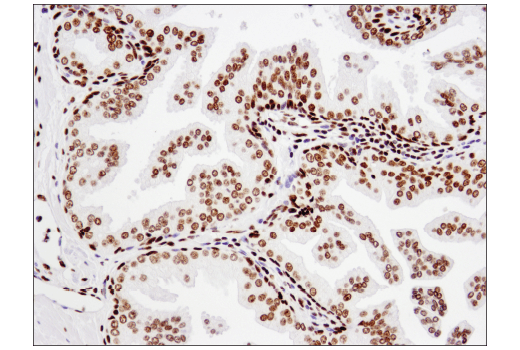
| Immunohistochemistry (Paraffin) | 1:1600 |
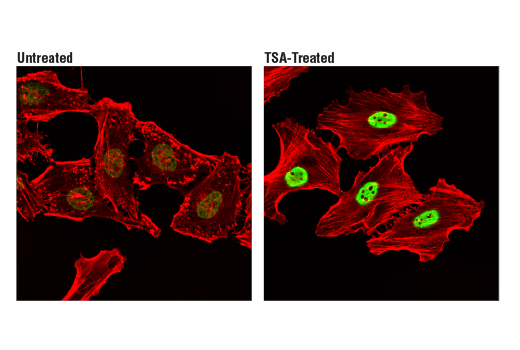
| Immunofluorescence (Immunocytochemistry) | 1:800 |
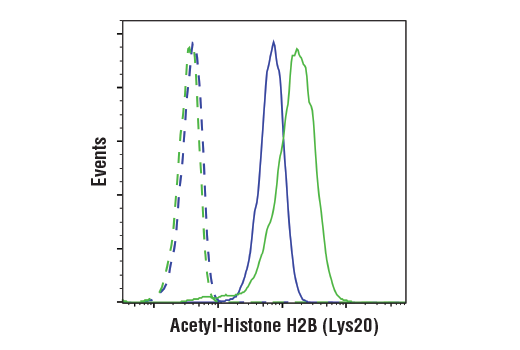
| Flow Cytometry (Fixed/Permeabilized) | 1:50 |
| Chromatin IP | 1:50 |
同种型
Rabbit IgG
分子量
14
应用
目标/特异性
Specificity/Sensitivity
Acetyl-Histone H2B (Lys20) (D7O9W) Rabbit mAb recognizes endogenous levels of histone H2B protein when acetylated at Lys20. This antibody shows very slight cross-reactivity with histone H2B acetylated at Lys12.
Species Reactivity:
Human, Mouse, Rat
敏感性
Endogenous
背景
背景
The nucleosome, made up of four core histone proteins (H2A, H2B, H3, and H4), is the primary building block of chromatin. Originally thought to function as a static scaffold for DNA packaging, histones have now been shown to be dynamic proteins, undergoing multiple types of post-translational modifications, including acetylation, phosphorylation, methylation, and ubiquitination (1,2). Histone acetylation occurs mainly on the amino-terminal tail domains of histones H2A (Lys5), H2B (Lys5, 12, 15, and 20), H3 (Lys9, 14, 18, 23, 27, 36, and 56), and H4 (Lys5, 8, 12, and 16) and is important for the regulation of histone deposition, transcriptional activation, DNA replication, recombination, and DNA repair (1-3). Hyper-acetylation of the histone tails neutralizes the positive charge of these domains and is believed to weaken histone-DNA and nucleosome-nucleosome interactions, thereby destabilizing chromatin structure and increasing the accessibility of DNA to various DNA-binding proteins (4,5). In addition, acetylation of specific lysine residues creates docking sites for a protein module called the bromodomain, which binds to acetylated lysine residues (6). Many transcription and chromatin regulatory proteins contain bromodomains and may be recruited to gene promoters, in part, through binding of acetylated histone tails. Histone acetylation is mediated by histone acetyltransferases (HATs), such as CBP/p300, GCN5L2, PCAF, and Tip60, which are recruited to genes by DNA-bound protein factors to facilitate transcriptional activation (3). Deacetylation, which is mediated by histone deacetylases (HDAC and sirtuin proteins), reverses the effects of acetylation and generally facilitates transcriptional repression (7,8).
1.Peterson, C.L. and Laniel, M.A. (2004) Curr Biol 14, R546-51.
2.Jaskelioff, M. and Peterson, C.L. (2003) Nat Cell Biol 5, 395-9.
3.Roth, S.Y. et al. (2001) Annu Rev Biochem 70, 81-120.
4.Workman, J.L. and Kingston, R.E. (1998) Annu Rev Biochem 67, 545-79.
5.Hansen, J.C. et al. (1998) Biochemistry 37, 17637-41.
6.Yang, X.J. (2004) Bioessays 26, 1076-87.
7.Haberland, M. et al. (2009) Nat Rev Genet 10, 32-42.
8.Haigis, M.C. and Sinclair, D.A. (2010) Annu Rev Pathol 5, 253-95.
研究领域
癌症,发育生物学与干细胞研究,表观遗传学,神经科学,
翻译后修饰
acetylate
制备和贮存
保存方式
Supplied in 10 mM sodium HEPES (pH 7.5), 150 mM NaCl, 100 µg/ml BSA, 50% glycerol and less than 0.02% sodium azide. Store at –20°C. Do not aliquot the antibody.
数据库链接
Entrez-Gene ID
3018
UniProt ID
P33778
声明 :本官网所有报价均为常温或者蓝冰运输价格,如有产品需要干冰运输,需另外加收干冰运输费。