




 全部商品分类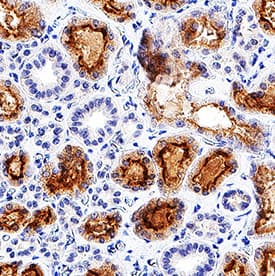


Human Adrenomedullin/ADM MAb (Clone 1003019) (25 UG)


 用小程序,查商品更便捷



 收藏
收藏
 对比
对比 咨询
咨询
Human Adrenomedullin/ADM Antibody Summary
Accession # P35318
Applications
Please Note: Optimal dilutions should be determined by each laboratory for each application. General Protocols are available in the Technical Information section on our website.
Scientific Data
 View Larger
Adrenomedullin/ADM in Human Kidney. Adrenomedullin/ADM was detected in immersion fixed sections of human kidney tissue using Mouse Anti-Human Adrenomedullin/ADM Monoclonal Antibody (Catalog # MAB61081) at 5 µg/mL for 1 hour at room temperature followed by incubation with the Anti-Mouse IgG VisUCyte™ HRP Polymer Antibody (Catalog # VC001). Before incubation with the primary antibody, tissue was subjected to heat-induced epitope retrieval using Antigen Retrieval Reagent-Basic (Catalog # CTS013). Tissue was stained using DAB (brown) and counterstained with hematoxylin (blue). Specific staining was localized to plasma membrane and secreted molecule. View our protocol for IHC Staining with VisUCyte HRP Polymer Detection Reagents.
Reconstitution Calculator
Preparation and Storage
- 12 months from date of receipt, -20 to -70 °C as supplied.
- 1 month, 2 to 8 °C under sterile conditions after reconstitution.
- 6 months, -20 to -70 °C under sterile conditions after reconstitution.
Background: Adrenomedullin/ADM
Adrenomedullin (ADM) is a secreted, monomeric, 6 kDa member of the adrenomedullin family of molecules. It is widely expressed, being found in smooth muscle cells, endothelium, adrenal medulla chromaffin cells, fibroblasts and keratinocytes. Adrenomedullin has multiple functions including vasodilation, the maintenance of vascular integrity, and the suppression of inflammatory mediator secretion. The human Adrenomedullin preproprecursor is 185 amino acids (aa) in length. It contains a 21 aa signal sequence, a processed 20 aa peptide termed PAMP (aa 22-41), an N-terminal propeptide (aa 45-92), the Adrenomedullin precursor (amidation is required for maturation) (aa 95-147), and a C-terminal propeptide (aa 148-185). The Adrenomedullin precursor with a terminal Gly147 circulates naturally with bioactive, mature amidated Adrenomedullin (aa 95-146). Depending upon the tissue, truncated forms of Adrenomedullin likely also occur, including variants spanning aa 120-146 and 128-146. Over aa 22-147, the human Adrenomedullin proprecursor shares 70% aa identity with mouse Adrenomedullin proprecursor.
Product Datasheets
Background: Adrenomedullin/ADM
Adrenomedullin (ADM) is a secreted, monomeric, 6 kDa member of the adrenomedullin family of molecules. It is widely expressed, being found in smooth muscle cells, endothelium, adrenal medulla chromaffin cells, fibroblasts and keratinocytes. Adrenomedullin has multiple functions including vasodilation, the maintenance of vascular integrity, and the suppression of inflammatory mediator secretion. The human Adrenomedullin preproprecursor is 185 amino acids (aa) in length. It contains a 21 aa signal sequence, a processed 20 aa peptide termed PAMP (aa 22-41), an N-terminal propeptide (aa 45-92), the Adrenomedullin precursor (amidation is required for maturation) (aa 95-147), and a C-terminal propeptide (aa 148-185). The Adrenomedullin precursor with a terminal Gly147 circulates naturally with bioactive, mature amidated Adrenomedullin (aa 95-146). Depending upon the tissue, truncated forms of Adrenomedullin likely also occur, including variants spanning aa 120-146 and 128-146. Over aa 22-147, the human Adrenomedullin proprecursor shares 70% aa identity with mouse Adrenomedullin proprecursor.
Preparation and Storage
- 12 months from date of receipt, -20 to -70 °C as supplied.
- 1 month, 2 to 8 °C under sterile conditions after reconstitution.
- 6 months, -20 to -70 °C under sterile conditions after reconstitution.