




 全部商品分类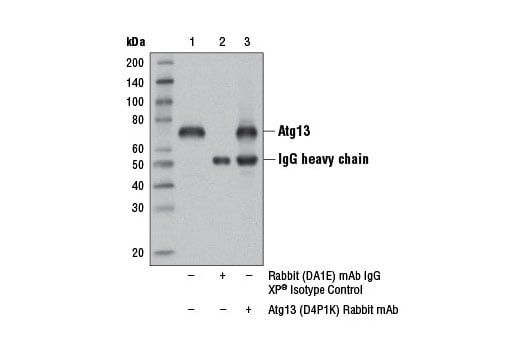


1/4


 用小程序,查商品更便捷





产品介绍
产品介绍
产品信息
荧光素标记
Unconjugated

来源纯化
Monoclonal antibody is produced by immunizing animals with a synthetic peptide corresponding to residues surrounding Asp462 of human Atg13 protein.
宿主
Rabbit
商品描述
Product Usage Information
| Application | Dilution |
|---|---|
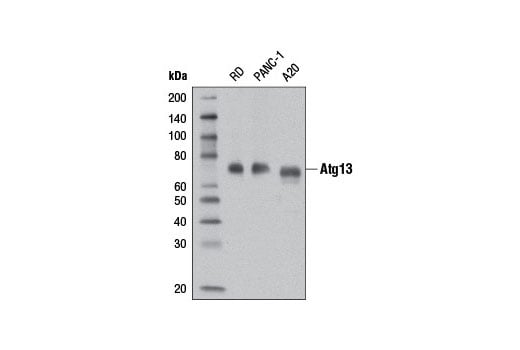
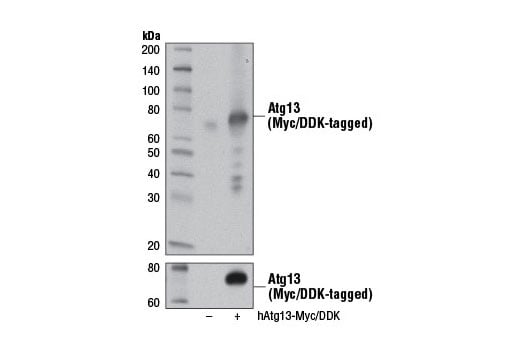
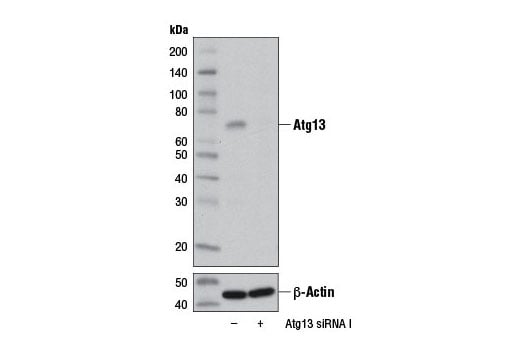
| Western Blotting | 1:1000 |
| Immunoprecipitation | 1:50 |
同种型
Rabbit IgG
分子量
72
应用
目标/特异性
Specificity/Sensitivity
Atg13 (D4P1K) Rabbit mAb recognizes endogenous levels of total Atg13 protein.
Species Reactivity:
Human, Mouse, Rat
敏感性
Endogenous
背景
背景
Autophagy is a catabolic process for the autophagosomic-lysosomal degradation of bulk cytoplasmic contents (1,2). Autophagy is generally activated by conditions of nutrient deprivation but has also been associated with a number of physiological processes including development, differentiation, neurodegeneration, infection, and cancer (3). The molecular machinery of autophagy was largely discovered in yeast and referred to as autophagy-related (Atg) genes.Atg13/Apg13 was originally identified in yeast as a constitutively expressed protein that was genetically linked to Atg1/Apg1, a protein kinase required for autophagy (4). Overexpression of Atg1 suppresses the defects in autophagy observed in Atg13 mutants (4). Autophagy requires a direct association between Atg1 and Atg13, and is inhibited by TOR-dependent phosphorylation of Atg13 under high-nutrient conditions (5). Similarly, mammalian Atg13 forms a complex with the Atg1 homologues ULK1/2, along with FIP200, which localizes to autophagic isolation membranes and regulates autophagosome biogenesis (6-8). mTOR phosphorylates both Atg13 and ULK1, suppressing ULK1 kinase activity and autophagy (7-9). ULK1 can directly phosphorylate Atg13 at a yet unidentified site, presumably to promote autophagy (7,8). Additional studies suggest that Atg13 and FIP200 can function independently of ULK1 and ULK2 to induce autophagy through an unknown mechanism (10).
1.Reggiori, F. and Klionsky, D.J. (2002) Eukaryot Cell 1, 11-21.
2.Codogno, P. and Meijer, A.J. (2005) Cell Death Differ 12 Suppl 2, 1509-18.
3.Levine, B. and Yuan, J. (2005) J Clin Invest 115, 2679-88.
4.Funakoshi, T. et al. (1997) Gene 192, 207-13.
5.Kamada, Y. et al. (2000) J Cell Biol 150, 1507-13.
6.Ganley, I.G. et al. (2009) J Biol Chem 284, 12297-305.
7.Hosokawa, N. et al. (2009) Mol Biol Cell 20, 1981-91.
8.Jung, C.H. et al. (2009) Mol Biol Cell 20, 1992-2003.
9.Kim, J. et al. (2011) Nat Cell Biol 13, 132-41.
10.Alers, S. et al. (2011) Autophagy 7, 1423-33.
研究领域
癌症,细胞生物学,纤维化,代谢,神经科学
翻译后修饰
unmodified
制备和贮存
保存方式
Supplied in 10 mM sodium HEPES (pH 7.5), 150 mM NaCl, 100 µg/ml BSA, 50% glycerol and less than 0.02% sodium azide. Store at –20°C. Do not aliquot the antibody.
For a carrier free (BSA and azide free) version of this product see product #41634.
数据库链接
Entrez-Gene ID
9776
UniProt ID
O75143
声明 :本官网所有报价均为常温或者蓝冰运输价格,如有产品需要干冰运输,需另外加收干冰运输费。