




 全部商品分类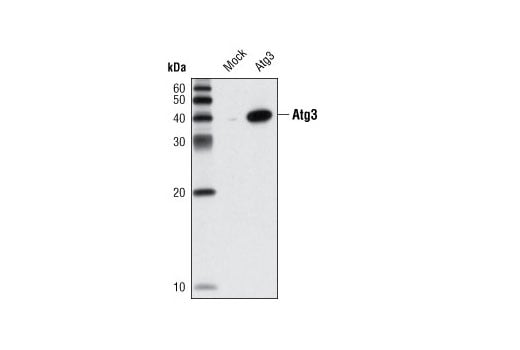


1/2


 用小程序,查商品更便捷





产品介绍
产品介绍
产品信息
荧光素标记
Unconjugated

抗原名称
Atg3
来源纯化
Polyclonal antibodies are produced by immunizing animals with a synthetic peptide corresponding to residues near the amino terminus of Atg3. Antibodies are purified by protein A and peptide affinity chromatography.
宿主
Rabbit
商品描述
Product Usage Information
| Application | Dilution |
|---|---|
| Western Blotting | 1:1000 |
分子量
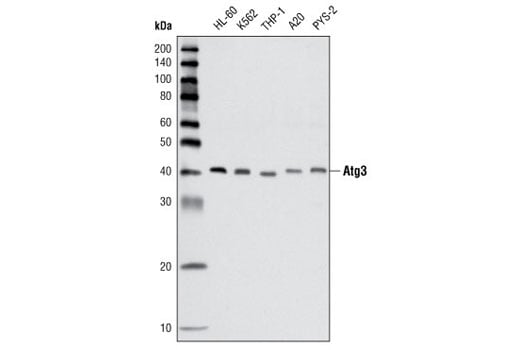
40
内毒素水平
鸡 , 非洲爪蟾蜍, 牛 , 犬
研究领域
癌症,细胞生物学,纤维化,代谢,神经科学
应用
反应种属
Human,Mouse,Rat,Monkey,
目标/特异性
Specificity/Sensitivity
Atg3 Antibody detects endogenous levels of total Atg3 protein.
Species Reactivity:
Human, Mouse, Rat, Monkey
敏感性
Endogenous
背景
背景
Autophagy is a catabolic process for the autophagosomic-lysosomal degradation of bulk cytoplasmic contents (1). The molecular machinery of autophagy was largely discovered in yeast and referred to as autophagy-related genes (Atg). Formation of the autophagic vesicles involves two ubiquitin-like conjugation systems, Atg12-Atg5 and Atg8-phosphatidylethanolamine (Atg8-PE), which are essential for autophagy and widely conserved in eukaryotes (2). There are at least three Atg8 homologs in mammalian cells, GATE-16, GABARAP, and LC3, that are conjugated by lipids (3,4). Lipid conjugation of Atg8 and its mammalian homologs requires Atg3 (Apg3p/Aut1p in yeast), an ubiquitously expressed E2-like enzyme (5-7). Following C-terminal cleavage by the cysteine protease Atg4, the exposed glycine residue of Atg8 binds to the E1-like enzyme Atg7, is transferred to Atg3, and then conjugated to phophatidylethanolamine. Atg3-deficient mice die within 1 day after birth and are completely defective for the conjugation of Atg8 homlogs and autophagome formation (8).
1.Reggiori, F. and Klionsky, D.J. (2002) Eukaryot Cell 1, 11-21.
2.Ohsumi, Y. (2001) Nat Rev Mol Cell Biol 2, 211-6.
3.Kabeya, Y. et al. (2000) EMBO J 19, 5720-8.
4.Kabeya, Y. et al. (2004) J Cell Sci 117, 2805-12.
5.Tanida, I. et al. (2002) J Biol Chem 277, 13739-44.
6.Ichimura, Y. et al. (2000) Nature 408, 488-92.
7.Schlumpberger, M. et al. (1997) J Bacteriol 179, 1068-76.
8.Sou, Y.S. et al. (2008) Mol Biol Cell 19, 4762-75.
研究领域
癌症,细胞生物学,纤维化,代谢,神经科学
翻译后修饰
unmodified
制备和贮存
保存方式
Supplied in 10 mM sodium HEPES (pH 7.5), 150 mM NaCl, 100 µg/ml BSA and 50% glycerol. Store at –20°C. Do not aliquot the antibody.
数据库链接
Entrez-Gene ID
64422
UniProt ID
Q9NT62
声明 :本官网所有报价均为常温或者蓝冰运输价格,如有产品需要干冰运输,需另外加收干冰运输费。