




 全部商品分类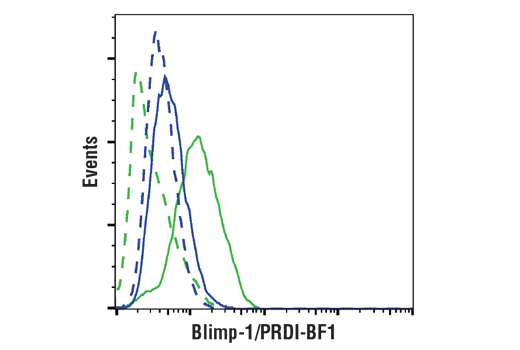


1/3


 用小程序,查商品更便捷





产品介绍
产品介绍
产品信息
荧光素标记
Unconjugated

抗原名称
Blimp-1PRDI-BF1
来源纯化
Monoclonal antibody is produced by immunizing animals with a synthetic peptide corresponding to residues surrounding Val90 of human PRDI-BF1 isoform 2.
宿主
Rabbit
商品描述
Product Usage Information
| Application | Dilution |
|---|---|
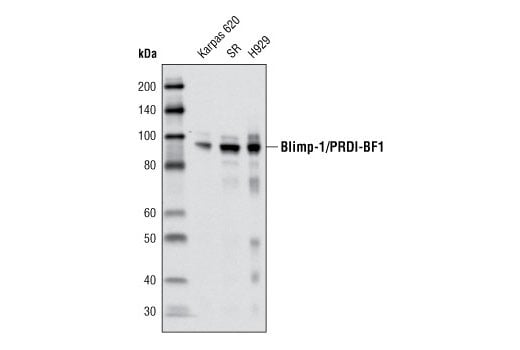
| Western Blotting | 1:1000 |
| Immunoprecipitation | 1:100 |
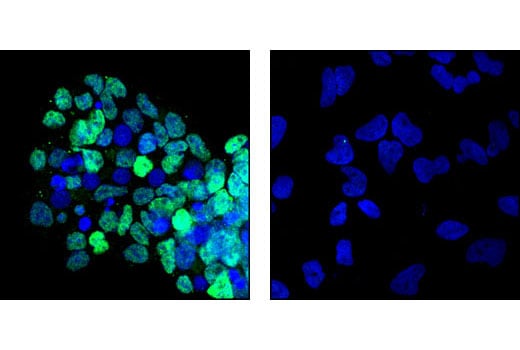
| Immunofluorescence (Immunocytochemistry) | 1:100 |
| Flow Cytometry (Fixed/Permeabilized) | 1:50 |
同种型
Rabbit IgG
分子量
95-100
内毒素水平
猴
研究领域
神经科学
应用
反应种属
Human,Mouse,
预测反应种属
Monkey
目标/特异性
Specificity/Sensitivity
Blimp-1/PRDI-BF1 (C14A4) Rabbit mAb detects endogenous levels of total Blimp-1/PRDI-BF1 protein.
Species Reactivity:
Human, Mouse
敏感性
Endogenous
背景
背景
Blimp-1 (B lymphocyte-induced maturation protein) is a nuclear zinc-finger containing transcriptional repressor that is considered a master regulator of terminal B cell development (1). The human homolog, PRDI-BF1, was identified by its ability to bind to the PRDI element on the IFN-β promoter and can inhibit virus-mediated IFN-β production (2). Expression of Blimp-1 is sufficient to drive terminal differentiation of BCL1 lymphoma cells into antibody secreting plasma cells, increasing the expression of the cell surface marker Syndecan-1 (1). In the B cell lineage, Blimp-1 is specifically expressed in antibody-secreting cells including activated B and plasma cells. In addition, Blimp-1 has been found during macrophage differentiation (3) and in a subset of T cells (4,5), suggesting it may play a wider role in homeostasis and differentiation (6). Mechanistically, Blimp-1 is thought to act by recruiting chromatin-modifying enzymes including histone deacetylases (7) and methyltransferases (8,9). Target genes of Blimp-1 transcriptional repression with potential roles in differentiation include c-Myc (10), CIITA (11), Pax5 (12), Spi-B, and Id3 (13).
1.Turner, C.A. et al. (1994) Cell 77, 297-306.
2.Keller, A.D. and Maniatis, T. (1991) Genes Dev 5, 868-79.
3.Chang, D.H. et al. (2000) Nat Immunol 1, 169-76.
4.Kallies, A. et al. (2006) Nat Immunol 7, 466-74.
5.Martins, G.A. et al. (2006) Nat Immunol 7, 457-65.
6.Kallies, A. and Nutt, S.L. (2007) Curr Opin Immunol 19, 156-62.
7.Yu, J. et al. (2000) Mol Cell Biol 20, 2592-603.
8.Gyory, I. et al. (2004) Nat Immunol 5, 299-308.
9.Ancelin, K. et al. (2006) Nat Cell Biol 8, 623-30.
10.Lin, Y. et al. (1997) Science 276, 596-9.
11.Chen, H. et al. (2007) Mol Immunol 44, 1461-70.
12.Lin, K.I. et al. (2002) Mol Cell Biol 22, 4771-80.
13.Shaffer, A.L. et al. (2006) Immunol Rev 210, 67-85.
研究领域
神经科学
翻译后修饰
unmodified
制备和贮存
保存方式
Supplied in 10 mM sodium HEPES (pH 7.5), 150 mM NaCl, 100 µg/ml BSA, 50% glycerol and less than 0.02% sodium azide. Store at –20°C. Do not aliquot the antibody.
For a carrier free (BSA and azide free) version of this product see product #89036.
数据库链接
Entrez-Gene ID
639
UniProt ID
O75626
声明 :本官网所有报价均为常温或者蓝冰运输价格,如有产品需要干冰运输,需另外加收干冰运输费。