




 全部商品分类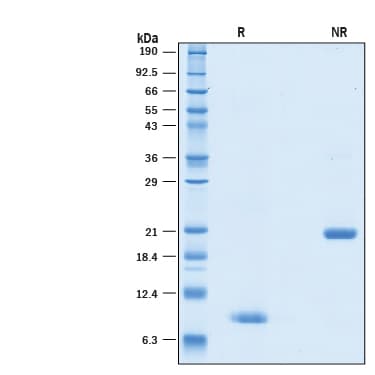


Recombinant Human BMP-4 GMP Protein, CF (50 ug)


 用小程序,查商品更便捷



 收藏
收藏
 对比
对比 咨询
咨询Recombinant Human BMP-4 GMP Protein, CF Summary
Product Specifications
Lys303-Arg408
Produced in an animal-free laboratory. Manufactured and tested under cGMP guidelines
Analysis
Product Datasheets
314E-GMP
Carrier Free
CF stands for Carrier Free (CF). We typically add Bovine Serum Albumin (BSA) as a carrier protein to our recombinant proteins. Adding a carrier protein enhances protein stability, increases shelf-life, and allows the recombinant protein to be stored at a more dilute concentration. The carrier free version does not contain BSA.
In general, we advise purchasing the recombinant protein with BSA for use in cell or tissue culture, or as an ELISA standard. In contrast, the carrier free protein is recommended for applications, in which the presence of BSA could interfere.
314E-GMP
| Formulation | Lyophilized from a 0.2 μm filtered solution in Acetonitrile and TFA. |
| Reconstitution | Reconstitute at 50-200 μg/mL in sterile 4 mM HCl. |
| Shipping | The product is shipped with polar packs. Upon receipt, store it immediately at the temperature recommended below. |
| Stability & Storage: | Use a manual defrost freezer and avoid repeated freeze-thaw cycles.
|
Scientific Data
 View Larger
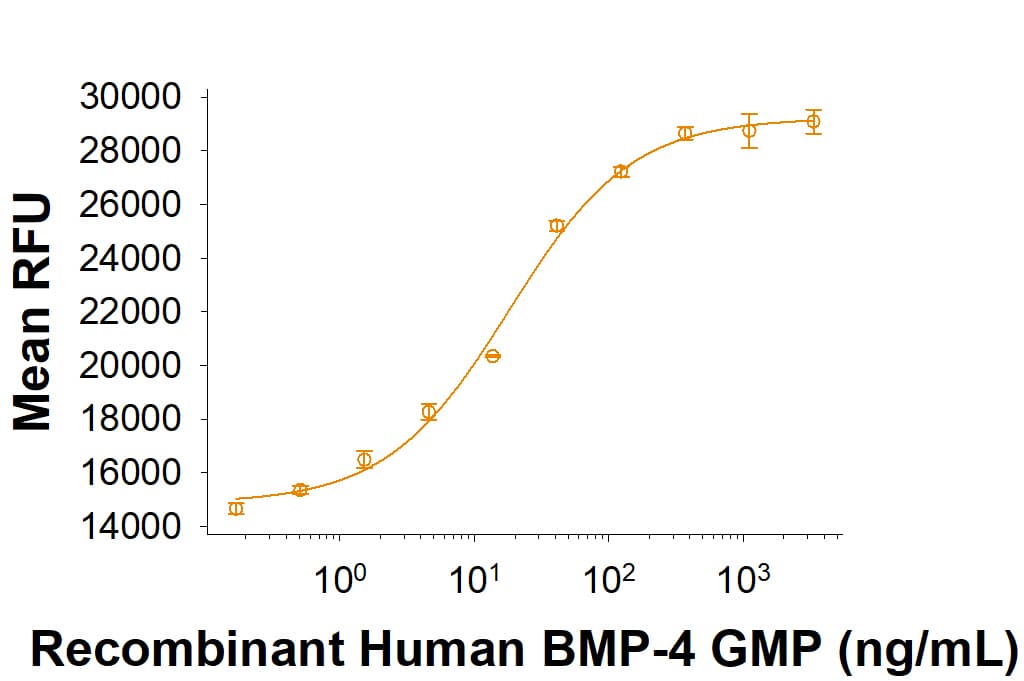
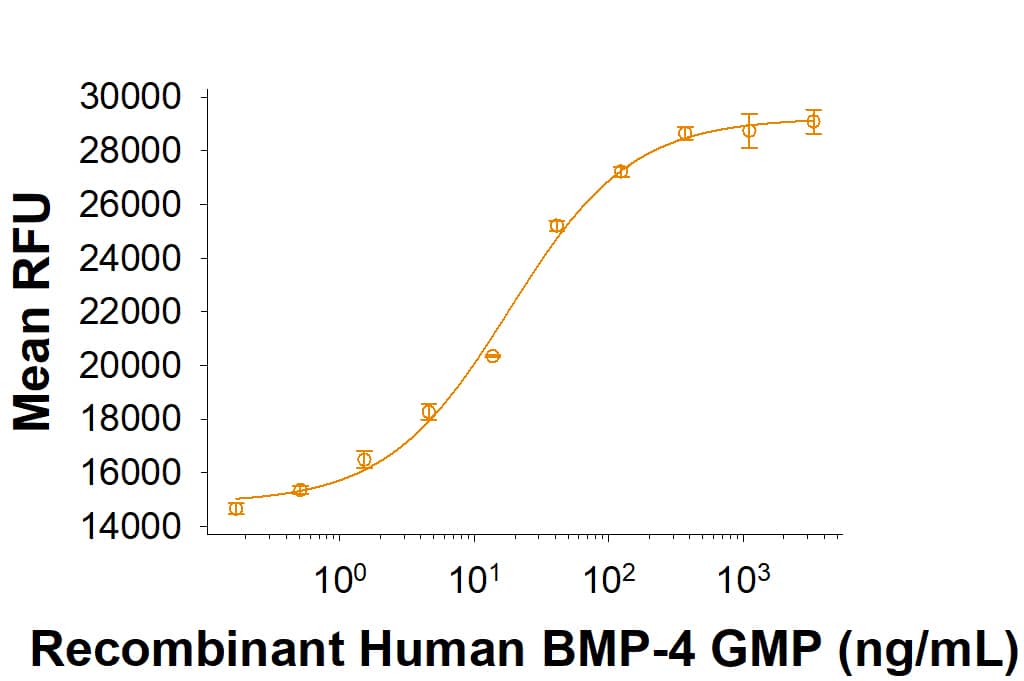
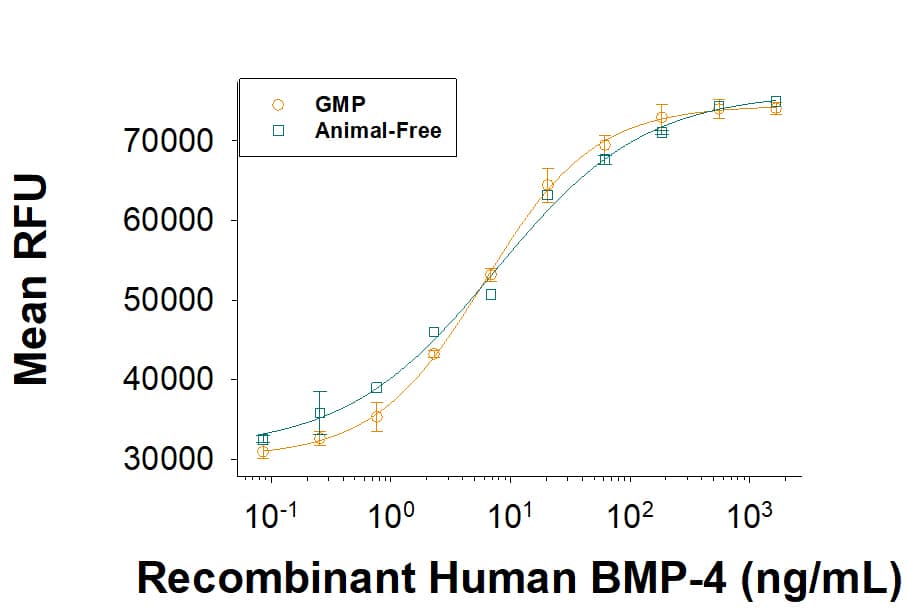
GMP-grade Recombinant Human BMP-4 (Catalog # 314E-GMP) induces BMP responsive SEAP reporter activity in HEK293 human embryonic kidney cells. The ED50 for this effect is 3-21 ng/mL.
 View Larger
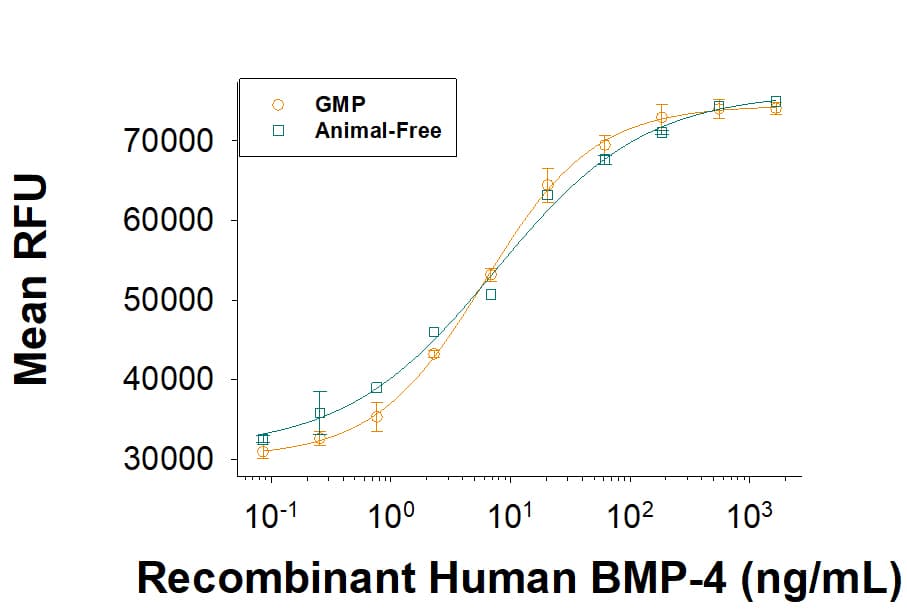
Equivalent bioactivity of GMP (Catalog # 314E-GMP) and Animal-Free (AFL314E) grades of Recombinant Human BMP-4 as measured by its ability to induce BMP responsive SEAP reporter activity in HEK293 human embryonic kidney cells (orange and green respectively).
 View Larger
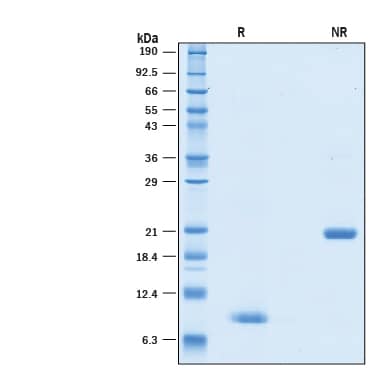
2 μg/lane of GMP-grade Recombinant Human BMP-4 Protein (314E-GMP) was resolved with SDS-PAGE under reducing (R) and non-reducing (NR) conditions and visualized by Coomassie® Blue staining, showing bands at 8-9 kDa and 20-22 kDa, respectively.
Reconstitution Calculator
Background: BMP-4
Bone morphogenetic protein 4 (BMP-4) is a TGF-beta superfamily ligand that is widely expressed from early embryogenesis through adulthood. It plays an important role in mesenchyme formation, epidermal determination, suppression of neural induction, the development of multiple organs, and tissue repair (1-5). It is an integral part of many stem cell differentiation pathways, including lung tissue, (6), adipogenesis (7) and osteogenesis (8, 9). The human BMP-4 precursor contains a 273 amino acid (aa) propeptide and a 116 amino acid (aa) mature protein (10). Processing of the propeptide by furin or proprotein convertase 6 enables the formation of the mature disulfide-linked homodimeric BMP-4 and facilitates its secretion. Similar intracellular processes may lead to the formation and recreation of BMP4/BMP7 disulfide-linked heterodimer (11-13). Mature human and mouse BMP-4 share 98% aa sequence identity. Human BMP-4 shares 85% aa sequence identity with human BMP-2 and less than 50% with other human BMPs. In Xenopus, BMP-4 dimers provide ventralizing signals for existing mesoderm (14). BMP-4 signals through tetrameric complexes composed of type I (primarily Activin RIA or BMPR-IA) and type II (primarily Activin RIIA or BMPR-II) receptors (15, 16). The bioavailability of BMP-4 is regulated by its interaction with multiple proteins and glycosaminoglycans (17-19).
- Zhang, P. et al. (2008) Blood 111:1933.
- Gambaro, K. et al. (2006) Cell Death Differ. 13:1075.
- Simic, P. and S. Vukicevic (2005) Cytokine Growth Factor Rev. 16:299.
- Sadlon, T.J. et al. (2004) Stem Cells 22:457.
- Frank, D.B. et al. (2005) Circ. Res. 97:496.
- Lee, J-H. et al. (2014) Cell. 156:440.
- Tang, QQ. et Lane MD. (2012) Annu Rev. Biochem. 81:715.
- Urist, MR. (1965). Science. 150:893.
- Bandyopadhyay, A. et al. (2006) Plos Genetics. 2:e216.
- Wozney, J. et al. (1988) Science 242:1528.
- Cui, Y. et al. (1998) EMBO J. 17:4735.
- Cui, Y. et al. (2001) Genes Dev. 15:2797.
- Aono, A. et al. (1995) Biochem. Biophys. Res. Commun. 210:670.
- Nishimatsu, S. and G.H. Thomsen (1998) Mech. Dev. 74:75.
- Chen, D. et al. (2004) Growth Factors 22:233.
- Lavery, K. et al. (2008) J. Biol. Chem. April 24 epub.
- Rosen, V. (2006) Ann. N.Y. Acad. Sci. 1068:19.
- Jones, C.M. and J.C. Smith (1998) Dev. Biol. 194:12.
- Takada, T. et al. (2003) J. Biol. Chem. 278:43229.
Manufacturing Specifications
GMP ProteinsR&D Systems, a Bio-Techne Brand's GMP proteins are produced according to relevant sections of the following documents: USP Chapter 1043, Ancillary Materials for Cell, Gene and Tissue-Engineered Products and Eu. Ph. 5.2.12, Raw Materials of Biological Origin for the Production of Cell-based and Gene Therapy Medicinal Products.
R&D Systems' quality focus includes:
- Manufactured and tested under an ISO 9001:2015 and ISO 13485:2016 certified quality system
- Documented processes and QA control of documentation and process changes
- Personnel training programs
- Raw material testing and vendor qualification/monitoring
- Fully validated equipment, processes and test methods
- Equipment calibration schedules using a computerized calibration program
- Facility maintenance, safety programs and pest control
- Material review process for variances
- Monitoring of stability over product shelf-life
R&D Systems strives to provide our customers with the analytical characteristics of each product so that customers may determine whether our products are appropriate for their research. The Certificate of Analysis provided contains the following lot specific information:
- N-terminal amino acid analysis, SDS-PAGE analysis, and endotoxin level (as determined by LAL assay) performed on each bulk QC lot, not on individual bottlings of each QC lot
- Post-bottling lot-specific bioassay results (compliance with an established range) and results of microbial testing according to USP <71>
- Host Cell Protein testing performed by ELISA
- Mycoplasma testing by ribosomal RNA hybridization assay
Additional testing and documentation requested by the customer can be arranged at an additional cost.
Production records and facilities are available for examination by appropriate personnel on-site at R&D Systems in Minneapolis, Minnesota USA.
R&D Systems sells GMP grade products for preclinical or clinical ex vivo cell therapy applications. They are not for in vivo use. Please read the following End User Terms prior to using this product.
Animal-Free Manufacturing Conditions
Our dedicated controlled-access animal-free laboratories ensure that at no point in production are the products exposed to potential contamination by animal components or byproducts. Every stage of manufacturing is conducted in compliance with R&D Systems' stringent Standard Operating Procedures (SOPs). Production and purification procedures use equipment and media that are confirmed animal-free.
Production
- All molecular biology procedures use animal-free media and dedicated labware.
- Dedicated fermentors are utilized in committed animal-free areas.
- Protein purification columns are animal-free.
- Bulk proteins are filtered using animal-free filters.
- Purified proteins are stored in animal-free containers in a dedicated cold storage room.
Quality Assurance
- Low Endotoxin Level.
- No impairment of biological activity.
- High quality product obtained under stringent conditions.
Product Specific Notices
Full terms and conditions of sale can be found online in the Protein Sciences Segment T&Cs at: Terms & Conditions.
Background: BMP-4
Bone morphogenetic protein 4 (BMP-4) is a TGF-beta superfamily ligand that is widely expressed from early embryogenesis through adulthood. It plays an important role in mesenchyme formation, epidermal determination, suppression of neural induction, the development of multiple organs, and tissue repair (1-5). It is an integral part of many stem cell differentiation pathways, including lung tissue, (6), adipogenesis (7) and osteogenesis (8, 9). The human BMP-4 precursor contains a 273 amino acid (aa) propeptide and a 116 amino acid (aa) mature protein (10). Processing of the propeptide by furin or proprotein convertase 6 enables the formation of the mature disulfide-linked homodimeric BMP-4 and facilitates its secretion. Similar intracellular processes may lead to the formation and recreation of BMP4/BMP7 disulfide-linked heterodimer (11-13). Mature human and mouse BMP-4 share 98% aa sequence identity. Human BMP-4 shares 85% aa sequence identity with human BMP-2 and less than 50% with other human BMPs. In Xenopus, BMP-4 dimers provide ventralizing signals for existing mesoderm (14). BMP-4 signals through tetrameric complexes composed of type I (primarily Activin RIA or BMPR-IA) and type II (primarily Activin RIIA or BMPR-II) receptors (15, 16). The bioavailability of BMP-4 is regulated by its interaction with multiple proteins and glycosaminoglycans (17-19).
- Zhang, P. et al. (2008) Blood 111:1933.
- Gambaro, K. et al. (2006) Cell Death Differ. 13:1075.
- Simic, P. and S. Vukicevic (2005) Cytokine Growth Factor Rev. 16:299.
- Sadlon, T.J. et al. (2004) Stem Cells 22:457.
- Frank, D.B. et al. (2005) Circ. Res. 97:496.
- Lee, J-H. et al. (2014) Cell. 156:440.
- Tang, QQ. et Lane MD. (2012) Annu Rev. Biochem. 81:715.
- Urist, MR. (1965). Science. 150:893.
- Bandyopadhyay, A. et al. (2006) Plos Genetics. 2:e216.
- Wozney, J. et al. (1988) Science 242:1528.
- Cui, Y. et al. (1998) EMBO J. 17:4735.
- Cui, Y. et al. (2001) Genes Dev. 15:2797.
- Aono, A. et al. (1995) Biochem. Biophys. Res. Commun. 210:670.
- Nishimatsu, S. and G.H. Thomsen (1998) Mech. Dev. 74:75.
- Chen, D. et al. (2004) Growth Factors 22:233.
- Lavery, K. et al. (2008) J. Biol. Chem. April 24 epub.
- Rosen, V. (2006) Ann. N.Y. Acad. Sci. 1068:19.
- Jones, C.M. and J.C. Smith (1998) Dev. Biol. 194:12.
- Takada, T. et al. (2003) J. Biol. Chem. 278:43229.