




 全部商品分类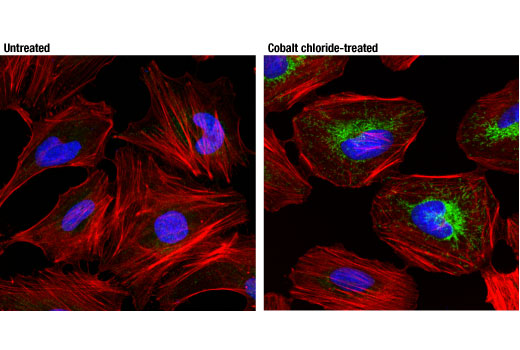


1/8


 用小程序,查商品更便捷





产品介绍
产品介绍
产品信息
荧光素标记
Unconjugated

抗原名称
BNIP3
来源纯化
Monoclonal antibody is produced by immunizing animals with a synthetic peptide corresponding to residues near the amino terminus of human BNIP3 protein.
宿主
Rabbit
商品描述
Product Usage Information
| Application | Dilution |
|---|---|
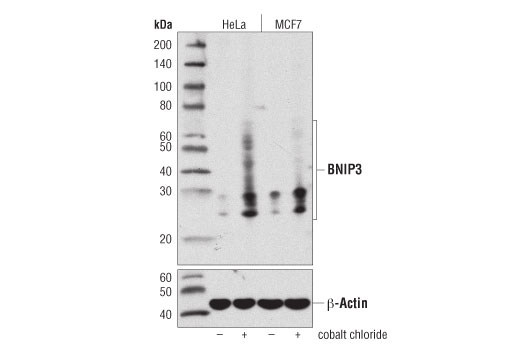
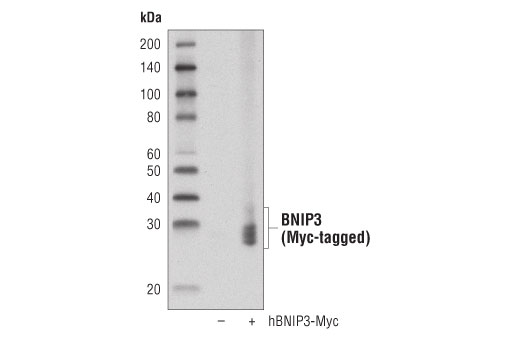
| Western Blotting | 1:1000 |
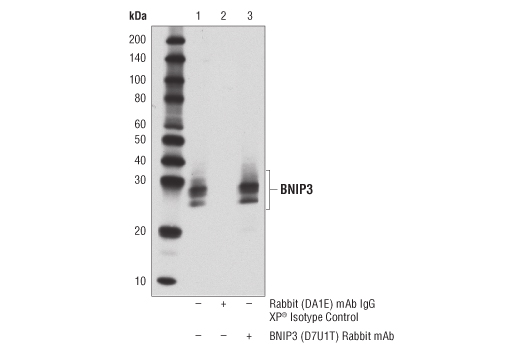
| Immunoprecipitation | 1:100 |
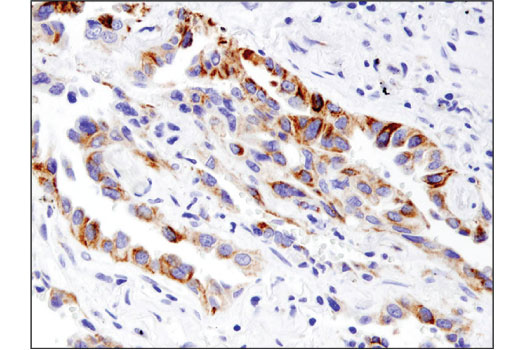
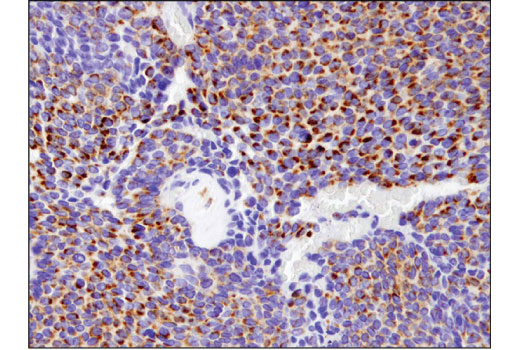
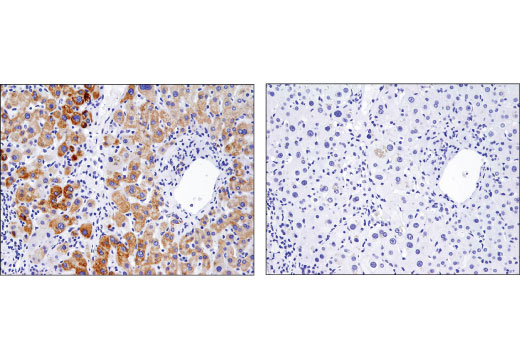
| Immunohistochemistry (Paraffin) | 1:50 - 1:200 |
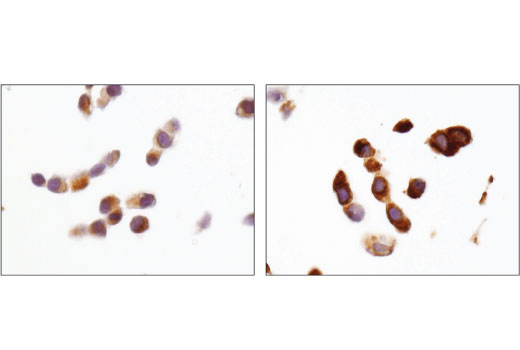
| Immunofluorescence (Immunocytochemistry) | 1:800 |
同种型
Rabbit IgG
分子量
22-28, 50-55
研究领域
癌症,细胞生物学,纤维化,代谢,神经科学
应用
反应种属
Human
目标/特异性
Specificity/Sensitivity
BNIP3 (D7U1T) Rabbit mAb recognizes endogenous levels of total BNIP3 protein.
Species Reactivity:
Human
敏感性
Endogenous
背景
背景
BNIP3 (Bcl-2/E1B-19kDa interacting protein 3) is a pro-apoptotic mitochondrial protein and Bcl-2 family member that contains a Bcl-2 homology 3 (BH3) domain and a carboxyl-terminal transmembrane (TM) domain (1-3). While BNIP3 has a predicted molecular weight of about 22 kDa, it runs anomalously on SDS-PAGE and includes a band of around 60 kDa that may be a dimeric form that is not reduced (2). BNIP3 associates with anti-apoptotic family members Bcl-2, Bcl-xL, and the adenovirus homologue E1B-19kDa. BNIP3 is distinct from other Bcl-2 family members that contain only the BH3 domain in that the TM domain, and not the BH3 domain, is required for mitochondrial targeting and pro-apoptotic activity (4). In addition to apoptosis, BNIP3 has been implicated in necrosis (5) and autophagy (6-11). In hypoxic conditions, BNIP3 can induce mitochondrial autophagy (mitophagy) by disrupting the Bcl-2-Beclin-1 complex (9). BNIP3 can also promote mitophagy by triggering the translocation of the E3 ubiquitin ligase Parkin to the mitochondria (10) or by directly binding LC3 on the autophagosome (11). BNIP3 may also localize to the endoplasmic reticulum (ER) where it can selectively induce the autophagic clearance of ER (ERphagy) (11). Increased expression of BNIP3 under hypoxic conditions is mainly regulated by the transcription factor HIF-1α (12-14). Silencing of the BNIP3 promoter by methylation has been observed in several types of cancer cells and may play an important role in their survival (14-18).
1.Boyd, J.M. et al. (1994) Cell 79, 341-51.
2.Chen, G. et al. (1997) J Exp Med 186, 1975-83.
3.Yasuda, M. et al. (1998) J Biol Chem 273, 12415-21.
4.Ray, R. et al. (2000) J Biol Chem 275, 1439-48.
5.Vande Velde, C. et al. (2000) Mol Cell Biol 20, 5454-68.
6.Daido, S. et al. (2004) Cancer Res 64, 4286-93.
7.Tracy, K. et al. (2007) Mol Cell Biol 27, 6229-42.
8.Quinsay, M.N. et al. (2010) Autophagy 6, 855-62.
9.Bellot, G. et al. (2009) Mol Cell Biol 29, 2570-81.
10.Lee, Y. et al. (2011) Am J Physiol Heart Circ Physiol 301, H1924-31.
11.Hanna, R.A. et al. (2012) J Biol Chem 287, 19094-104.
12.Bruick, R.K. (2000) Proc Natl Acad Sci USA 97, 9082-7.
13.Guo, K. et al. (2001) Cell Death Differ 8, 367-76.
14.Sowter, H.M. et al. (2001) Cancer Res 61, 6669-73.
15.de Angelis, P.M. et al. (2004) Int J Oncol 24, 1279-88.
16.Okami, J. et al. (2004) Cancer Res 64, 5338-46.
17.Murai, M. et al. (2005) Clin Cancer Res 11, 1021-7.
18.Murai, M. et al. (2005) Br J Cancer 92, 1165-72.
研究领域
癌症,细胞生物学,纤维化,代谢,神经科学
翻译后修饰
unmodified
制备和贮存
保存方式
Supplied in 10 mM sodium HEPES (pH 7.5), 150 mM NaCl, 100 µg/ml BSA, 50% glycerol and less than 0.02% sodium azide. Store at –20°C. Do not aliquot the antibody.
For a carrier free (BSA and azide free) version of this product see product #34048.
数据库链接
Entrez-Gene ID
664
UniProt ID
Q12983
声明 :本官网所有报价均为常温或者蓝冰运输价格,如有产品需要干冰运输,需另外加收干冰运输费。