



 全部商品分类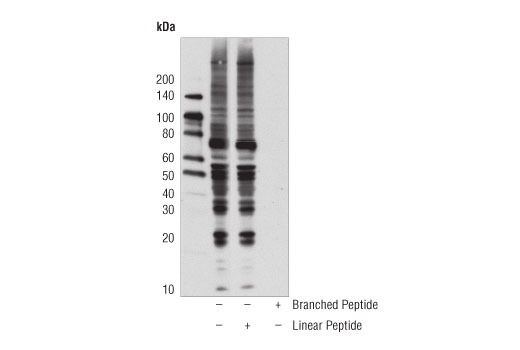




1/12
Branched Ubiquitin Antibody Sampler Kit


品牌: CST
 用小程序,查商品更便捷



 收藏
收藏
 对比
对比 咨询
咨询
产品介绍
产品介绍
产品信息
荧光素标记
Unconjugated

抗原名称
Branched Ubiquitin
简单描述
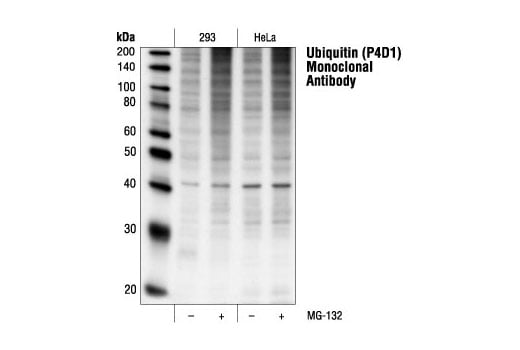
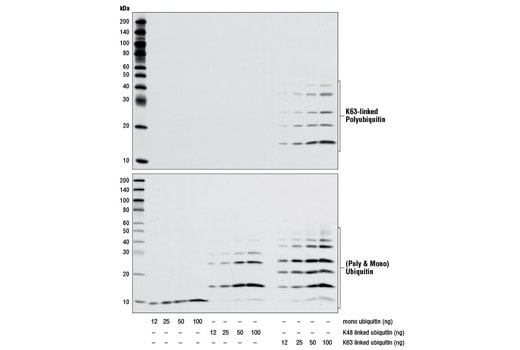
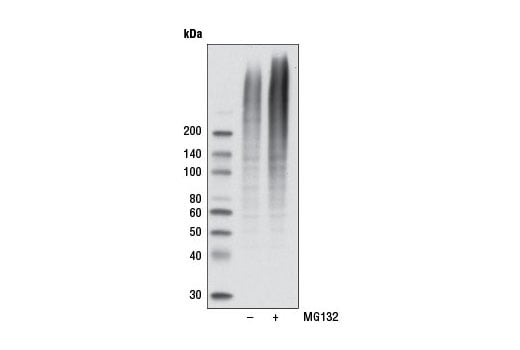
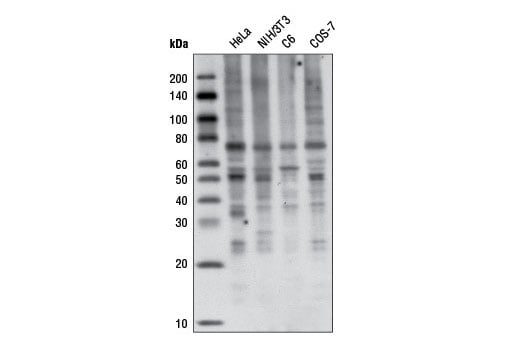
Branched Ubiquitin Antibody Sampler Kit provides an economical means of detecting total and common branch specific forms of ubiquitin. The kit includes enough antibody to perform two western blot experiments with each primary antibody.
背景
背景
Ubiquitin is a conserved polypeptide unit that plays an important role in the ubiquitin-proteasome pathway. Ubiquitin can be covalently linked to many cellular proteins by the ubiquitination process, which targets proteins for degradation by the 26S proteasome. Three components are involved in the target protein-ubiquitin conjugation process. Ubiquitin is first activated by forming a thiolester complex with the activation component E1; the activated ubiquitin is subsequently transferred to the ubiquitin-carrier protein E2, then from E2 to ubiquitin ligase E3 for final delivery to the epsilon-NH2 of the target protein lysine residue (1-3). The ubiquitin-proteasome pathway has been implicated in a wide range of normal biological processes and in disease-related abnormalities. Several proteins such as IκB, p53, cdc25A, and Bcl-2 have been shown to be targets for the ubiquitin-proteasome process as part of regulation of cell cycle progression, differentiation, cell stress response, and apoptosis (4-7).Substrate proteins are linked to ubiquitin using seven distinct ubiquitin lysine residues (Lys6, Lys11, Lys27, Lys29, Lys33, Lys48 and Lys63). Formation of a polyubiquitin chain occurs when a lysine residue of ubiquitin is linked to the carboxy-terminal glycine of another ubiquitin. Proteins polyubiquinated at specific lysine residues display a tendency to be targeted for different processes; K48-linked polyubiquitin chains mainly target proteins for proteasomal degradation while K63-linked polyubiquitin regulates protein function, subcellular localization, or protein-protein interactions (8). K63-linked polyubiquitin chains exert nonproteolytic functions in vivo, such as protein trafficking, kinase/phosphatase activation, and DNA damage control, all of which might be important in regulation of cancer survival and development (9,10).
1.Ciechanover, A. (1998) EMBO J 17, 7151-60.
2.Hochstrasser, M. (2000) Nat Cell Biol 2, E153-7.
3.Hochstrasser, M. (2000) Science 289, 563-4.
4.Bernardi, R. et al. (2000) Oncogene 19, 2447-54.
5.Aberle, H. et al. (1997) EMBO J 16, 3797-804.
6.Salomoni, P. and Pandolfi, P.P. (2002) Nat Cell Biol 4, E152-3.
7.Jesenberger, V. and Jentsch, S. (2002) Nat Rev Mol Cell Biol 3, 112-21.
8.Komander, D. (2009) Biochem Soc Trans 37, 937-53.
9.Chen, Z.J. and Sun, L.J. (2009) Mol Cell 33, 275-86.
10.Yang, W.L. et al. (2010) Oncogene 29, 4493-503.
翻译后修饰
unmodified
数据库链接
Entrez-Gene ID
7311,7316,7314,6233
UniProt ID
P62987,P0CG48,P0CG47,P62979
声明 :本官网所有报价均为常温或者蓝冰运输价格,如有产品需要干冰运输,需另外加收干冰运输费。