




 全部商品分类


Recombinant Mouse BST-2/Tetherin Protein, CF (50 UG)


 用小程序,查商品更便捷



 收藏
收藏
 对比
对比 咨询
咨询Recombinant Mouse BST-2/Tetherin Protein, CF Summary
- R&D Systems E. coli-derived Recombinant Mouse BST-2/Tetherin Protein (9940-BS)
- Quality control testing to verify active proteins with lot specific assays by in-house scientists
- All R&D Systems proteins are covered with a 100% guarantee
Product Specifications
Thr52-Ser152, with a C-Terminal 6-His tag
Analysis
Product Datasheets
9940-BS
Carrier Free
CF stands for Carrier Free (CF). We typically add Bovine Serum Albumin (BSA) as a carrier protein to our recombinant proteins. Adding a carrier protein enhances protein stability, increases shelf-life, and allows the recombinant protein to be stored at a more dilute concentration. The carrier free version does not contain BSA.
In general, we advise purchasing the recombinant protein with BSA for use in cell or tissue culture, or as an ELISA standard. In contrast, the carrier free protein is recommended for applications, in which the presence of BSA could interfere.
9940-BS
| Formulation | Lyophilized from a 0.2 μm filtered solution in MES and NaCl with Trehalose. |
| Reconstitution | Reconstitute at 400 μg/mL in water. |
| Shipping | The product is shipped at ambient temperature. Upon receipt, store it immediately at the temperature recommended below. |
| Stability & Storage: | Use a manual defrost freezer and avoid repeated freeze-thaw cycles.
|
Scientific Data
 View Larger
When Recombinant Mouse BST-2/Tetherin (Catalog # 9940-BS) is immobilized at 1 µg/mL (100 µL/well), Recombinant Viral Dengue Virus 4 Envelope Fc Chimera binds with an ED50 of 0.2-1.6 μg/mL.
 View Larger
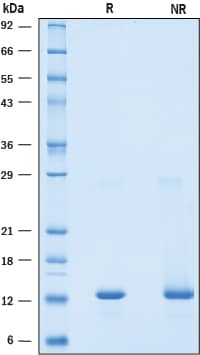
2 μg/lane of Recombinant Mouse BST-2/Tetherin (Catalog # 9940-BS) was resolved with SDS-PAGE under reducing (R) and non-reducing (NR) conditions and visualized by Coomassie® blue staining, showing bands at 13 kDa and 28 kDa.
Reconstitution Calculator
Background: BST-2/Tetherin
BST-2, also known as tetherin or CD317, is a type II transmembrane protein that is constitutively expressed in several cell types including T cells, B cells, monocytes and macrophages, as well as on several cancer cell lines including the B cell lineage in multiple myeloma (1, 2). Originally named bone marrow stromal cell antigen 2, BST-2 was identified to inhibit viral replication due to its unusual topology (3-5). The extracellular C-terminus of the protein is modified with GPI (glycosylphosphatidylinositol) membrane anchor, which enables BST-2 to interact at each of its ends with the cell or the viral membrane. The ectodomain of the protein also contains three cysteine residues that can form intermolecular disulfide bonds to form parallel dimers (2). Mouse BST-2 consists of a 30 amino acid (aa) cytoplasmic domain, a 21 aa transmembrane segment, and a 101 aa extracellular domain (ECD). Within the ECD, mouse BST-2 shares 41% and 71% aa sequence identity with human and rat BST-2, respectively. BST-2 was identified as a major mediator of the innate immune defense against enveloped viruses. BST-2 was shown to interact with formed viral particles tethering them to surface of infected cells, thereby reducing viral release (6). BST-2 inhibits the release of diverse group of enveloped viruses including members of the retrovirus, togavirus, filovirus, arenavirus, flavivirus, rhabdovirus, orthohepadnavirus, orthomyxovirus, poxvirus, paramyxovirus, and herpesvirus families (7-9). The mechanism BST-2 inhibition of viral budding was suggested to be through directly bridging the host and viral membranes through simultaneous embedding of its two opposing membrane anchors (9). To counteract BST-2 functions, many viruses have evolved to develop strategies to antagonize BST-2 function (9, 10). In addition to inhibiting viral release, BST-2 can act as an innate immune sensor of viral infections by acting as a pattern recognition receptor that activates NF-kappa B to induce inflammatory responses through interactions with the immunoglobulin-like transcript 7 (ILT7/LILRA4) (10, 11).
- Evans, D.T. et al. (2010) Trens Microbiol. 18:388.
- Ohtomo, T. et al. (1999) Biochem. Biophys. Res. Commun. 258:583.
- Ishikawa, J. et al. (1995) Genomics. 26:527.
- Neil, S.J. et al. (2008) Nature. 451:425.
- Kupzig, S. et al. (2003) Traffic. 4:694.
- Janvier K. et al. (2012) Curr HIV Res. 10:315.
- Evans D.T. et al. (2010) Trends Microbiol. 18:388.
- Mahauad-Fernandez W.D. et al. (2012) Immun Inflamm Dis. 4:4.
- Swiecki M. et al. (2013) Mol Immunol. 54:132.
- Sauter D. (2014) Front Microbiol. 5:163.
- Hotter D. et al. (2013) J Mol Biol. 425:4956.

Background: BST-2/Tetherin
BST-2, also known as tetherin or CD317, is a type II transmembrane protein that is constitutively expressed in several cell types including T cells, B cells, monocytes and macrophages, as well as on several cancer cell lines including the B cell lineage in multiple myeloma (1, 2). Originally named bone marrow stromal cell antigen 2, BST-2 was identified to inhibit viral replication due to its unusual topology (3-5). The extracellular C-terminus of the protein is modified with GPI (glycosylphosphatidylinositol) membrane anchor, which enables BST-2 to interact at each of its ends with the cell or the viral membrane. The ectodomain of the protein also contains three cysteine residues that can form intermolecular disulfide bonds to form parallel dimers (2). Mouse BST-2 consists of a 30 amino acid (aa) cytoplasmic domain, a 21 aa transmembrane segment, and a 101 aa extracellular domain (ECD). Within the ECD, mouse BST-2 shares 41% and 71% aa sequence identity with human and rat BST-2, respectively. BST-2 was identified as a major mediator of the innate immune defense against enveloped viruses. BST-2 was shown to interact with formed viral particles tethering them to surface of infected cells, thereby reducing viral release (6). BST-2 inhibits the release of diverse group of enveloped viruses including members of the retrovirus, togavirus, filovirus, arenavirus, flavivirus, rhabdovirus, orthohepadnavirus, orthomyxovirus, poxvirus, paramyxovirus, and herpesvirus families (7-9). The mechanism BST-2 inhibition of viral budding was suggested to be through directly bridging the host and viral membranes through simultaneous embedding of its two opposing membrane anchors (9). To counteract BST-2 functions, many viruses have evolved to develop strategies to antagonize BST-2 function (9, 10). In addition to inhibiting viral release, BST-2 can act as an innate immune sensor of viral infections by acting as a pattern recognition receptor that activates NF-kappa B to induce inflammatory responses through interactions with the immunoglobulin-like transcript 7 (ILT7/LILRA4) (10, 11).
- Evans, D.T. et al. (2010) Trens Microbiol. 18:388.
- Ohtomo, T. et al. (1999) Biochem. Biophys. Res. Commun. 258:583.
- Ishikawa, J. et al. (1995) Genomics. 26:527.
- Neil, S.J. et al. (2008) Nature. 451:425.
- Kupzig, S. et al. (2003) Traffic. 4:694.
- Janvier K. et al. (2012) Curr HIV Res. 10:315.
- Evans D.T. et al. (2010) Trends Microbiol. 18:388.
- Mahauad-Fernandez W.D. et al. (2012) Immun Inflamm Dis. 4:4.
- Swiecki M. et al. (2013) Mol Immunol. 54:132.
- Sauter D. (2014) Front Microbiol. 5:163.
- Hotter D. et al. (2013) J Mol Biol. 425:4956.