




 全部商品分类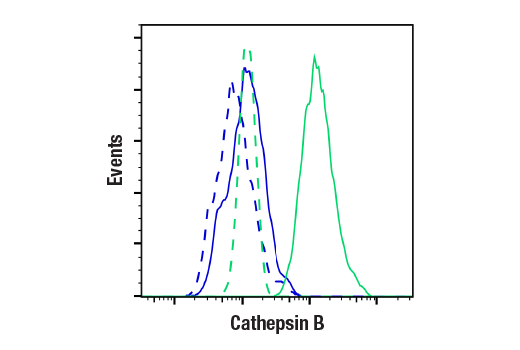



1/7


 用小程序,查商品更便捷





产品介绍
产品介绍
产品信息
荧光素标记
Unconjugated

抗原名称
Cathepsin B
来源纯化
Monoclonal antibody is produced by immunizing animals with recombinant protein specific to the heavy chain subunit of human cathepsin B protein.
宿主
Rabbit
商品描述
Product Usage Information
| Application | Dilution |
|---|---|
| Western Blotting | 1:1000 |
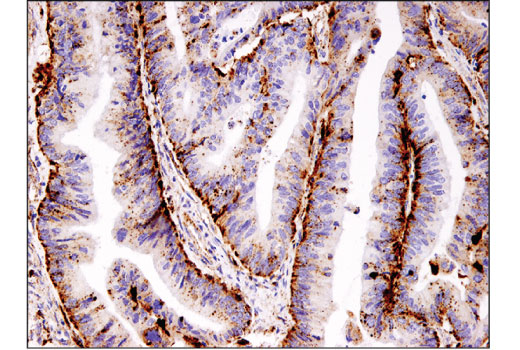
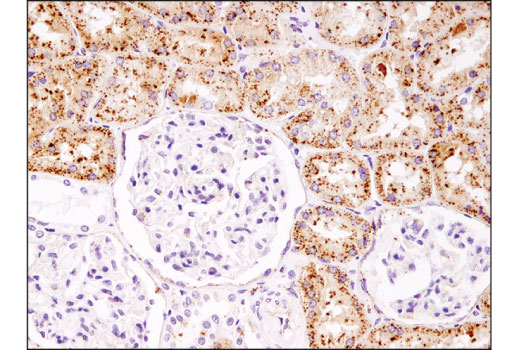
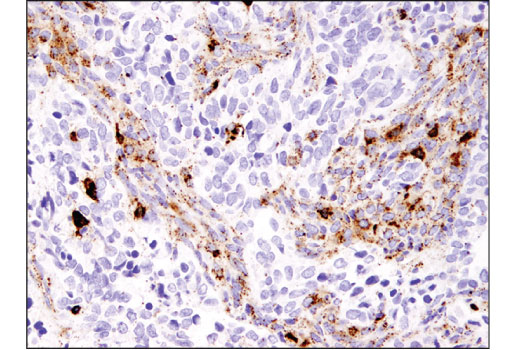
| Immunohistochemistry (Paraffin) | 1:1000 - 1:4000 |
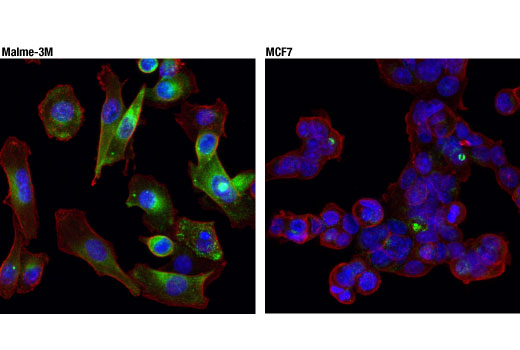
| Immunofluorescence (Immunocytochemistry) | 1:400 - 1:1600 |
| Flow Cytometry (Fixed/Permeabilized) | 1:1600 - 1:6400 |
同种型
Rabbit IgG
分子量
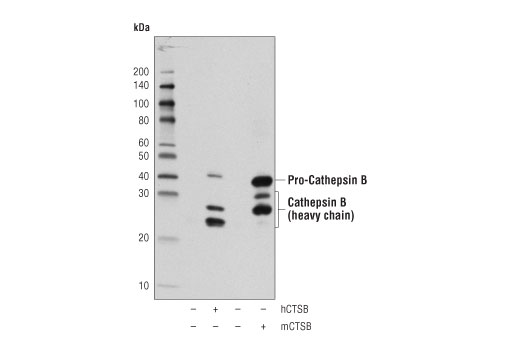
44, 27, 24
研究领域
癌症,细胞生物学,纤维化,神经科学,
应用
反应种属
Human,Mouse,Rat,
目标/特异性
Specificity/Sensitivity
Cathepsin B (D1C7Y) XP Rabbit mAb recognizes endogenous levels of total cathepsin B protein. This antibody detects the heavy chain subunit of cathepsin B.
Species Reactivity:
Human, Mouse, Rat
敏感性
Endogenous
背景
背景
Cathepsin B (CSTB), part of the papain family of proteases, is a widely expressed lysosomal cysteine endopeptidase (1,2). Cathepsin B is produced from a larger precursor form, pro-cathepsin B, which runs at approximately 44 kDa on SDS-PAGE, and is proteolytically processed and glycosylated to form a mature two-chain protein containing a heavy chain (running at 27 and 24 kDa) and a light chain (5 kDa). High levels of cathepsin B are found in macrophages and osteoclasts, as well as various types of cancer cells, including lung, colon, prostate, breast, and stomach. In addition, expression of cathepsin B has been associated with multiple sclerosis (3), rheumatoid arthritis (4), and pancreatitis (5). While generally localized to lysosomes, in cancer alterations can lead to its secretion (6). Its role in tumor progression is thought to involve promotion of basement membrane degradation, invasion and metastasis (7,8). Expression can correlate with poor prognosis for a variety of forms of cancer (9-13).This product detects a SARS-CoV-2-related target for research into the mechanisms of the Novel Coronavirus, which has caused the COVID-19 pandemic.
1.Chan, S.J. et al. (1986) Proc Natl Acad Sci USA 83, 7721-5.
2.Fong, D. et al. (1986) Proc Natl Acad Sci USA 83, 2909-13.
3.Bever, C.T. et al. (1994) Neurology 44, 745-8.
4.Hashimoto, Y. et al. (2001) Biochem Biophys Res Commun 283, 334-9.
5.Halangk, W. et al. (2000) J Clin Invest 106, 773-81.
6.Berquin, I.M. and Sloane, B.F. (1996) Adv Exp Med Biol 389, 281-94.
7.Yan, S. et al. (1998) Biol Chem 379, 113-23.
8.Vasiljeva, O. et al. (2006) Cancer Res 66, 5242-50.
9.Campo, E. et al. (1994) Am J Pathol 145, 301-9.
10.Foekens, J.A. et al. (1998) J Clin Oncol 16, 1013-21.
11.Werle, B. et al. (1999) Br J Cancer 81, 510-9.
12.Lah, T.T. et al. (2000) Clin Cancer Res 6, 578-84.
13.Werle, B. et al. (2000) Cancer 89, 2282-91.
研究领域
癌症,细胞生物学,纤维化,神经科学,
翻译后修饰
unmodified
制备和贮存
保存方式
Supplied in 10 mM sodium HEPES (pH 7.5), 150 mM NaCl, 100 µg/ml BSA, 50% glycerol and less than 0.02% sodium azide. Store at –20°C. Do not aliquot the antibody.
数据库链接
Entrez-Gene ID
1508
UniProt ID
P07858
声明 :本官网所有报价均为常温或者蓝冰运输价格,如有产品需要干冰运输,需另外加收干冰运输费。