



 全部商品分类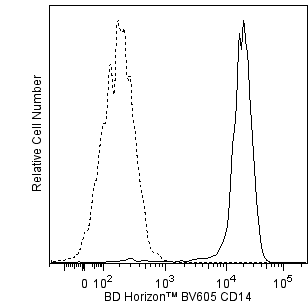


Hu CD14 BV605 M5E2 100Tst


品牌: BD Pharmingen
 用小程序,查商品更便捷



 收藏
收藏
 对比
对比 咨询
咨询反应种属:
Human (QC Testing)
来源宿主:
Mouse IgG2a, κ
产品介绍
产品使用步骤推荐 产品介绍
产品信息
荧光素标记
BV605()

抗原名称
CD14
宿主
Mouse IgG2a, κ
免疫原
Human CD14 Protein
简单描述
The M5E2 monoclonal antibody specifically binds to CD14, a 53–55 kDa glycosylphosphatidylinositol (GPI)-anchored single chain glycoprotein expressed at high levels on monocytes. Additionally, the anti-CD14 antibody reacts with interfollicular macrophages, reticular dendritic cells, and some Langerhans cells. CD14 has been identified as a high affinity cell-surface receptor for complexes of lipopolysaccharide (LPS) and serum LPS-binding protein, LPB.
This antibody is conjugated to BD Horizon BV605 which is part of the BD Horizon Brilliant™ Violet family of dyes. With an Ex Max of 407-nm and Em Max of 602-nm, BD Horizon BV605 can be excited by a violet laser and detected with a standard 610/20-nm filter set. BD Horizon BV605 is a tandem fluorochrome of BD Horizon BV421 and an acceptor dye with an Em max at 605-nm. Due to the excitation of the acceptor dye by the green (532 nm) and yellow-green (561 nm) lasers, there will be significant spillover into the PE and BD Horizon PE-CF594 detectors off the green or yellow-green lasers. BD Horizon BV605 conjugates are very bright, often exhibiting brightness equivalent to PE conjugates and can be used as a third color off of the violet laser.
For optimal and reproducible results, BD Horizon Brilliant Stain Buffer should be used anytime two or more BD Horizon Brilliant dyes are used in the same experiment. Fluorescent dye interactions may cause staining artifacts which may affect data interpretation. The BD Horizon Brilliant Stain Buffer was designed to minimize these interactions. More information can be found in the Technical Data Sheet of the BD Horizon Brilliant Stain Buffer (Cat. No. 563794).
商品描述
M5E2
The M5E2 monoclonal antibody specifically binds to CD14, a 53–55 kDa glycosylphosphatidylinositol (GPI)-anchored single chain glycoprotein expressed at high levels on monocytes. Additionally, the anti-CD14 antibody reacts with interfollicular macrophages, reticular dendritic cells, and some Langerhans cells. CD14 has been identified as a high affinity cell-surface receptor for complexes of lipopolysaccharide (LPS) and serum LPS-binding protein, LPB.
This antibody is conjugated to BD Horizon BV605 which is part of the BD Horizon Brilliant™ Violet family of dyes. With an Ex Max of 407-nm and Em Max of 602-nm, BD Horizon BV605 can be excited by a violet laser and detected with a standard 610/20-nm filter set. BD Horizon BV605 is a tandem fluorochrome of BD Horizon BV421 and an acceptor dye with an Em max at 605-nm. Due to the excitation of the acceptor dye by the green (532 nm) and yellow-green (561 nm) lasers, there will be significant spillover into the PE and BD Horizon PE-CF594 detectors off the green or yellow-green lasers. BD Horizon BV605 conjugates are very bright, often exhibiting brightness equivalent to PE conjugates and can be used as a third color off of the violet laser.
For optimal and reproducible results, BD Horizon Brilliant Stain Buffer should be used anytime two or more BD Horizon Brilliant dyes are used in the same experiment. Fluorescent dye interactions may cause staining artifacts which may affect data interpretation. The BD Horizon Brilliant Stain Buffer was designed to minimize these interactions. More information can be found in the Technical Data Sheet of the BD Horizon Brilliant Stain Buffer (Cat. No. 563794).
同种型
Mouse IgG2a, κ
克隆号
克隆 M5E2 (RUO)
产品详情
BV605
The BD Horizon Brilliant Violet™ 605 (BV605) dye is part of the BD Horizon Brilliant Violet™ family of dyes. This tandem fluorochrome is comprised of a BV421 donor with an excitation maximum (Ex Max) of 407-nm and an acceptor dye with an emission maximum (Em Max) at 605-nm. BV605, driven by BD innovation, is designed to be excited by the violet laser (405-nm) and detected using an optical filter centered near 610-nm (e.g., a 610/20-nm bandpass filter). The acceptor dye can be excited by the yellow-green (561-nm) laser resulting in cross-laser excitation and fluorescence spillover. Please ensure that your instrument’s configurations (lasers and optical filters) are appropriate for this dye.

BV605
407 nm
605 nm
BD化合物表
{}
应用
实验应用
Flow cytometry (Routinely Tested)
推荐用量
5 µl
反应种属
Human (QC Testing)
目标/特异性
CD14
背景
别名
LPS receptor; LPS-R; Myeloid cell-specific leucine-rich glycoprotein
制备和贮存
存储溶液
Aqueous buffered solution containing ≤0.09% sodium azide.
保存方式
Aqueous buffered solution containing BSA and ≤0.09% sodium azide.
文献
文献
研发参考(5)
1. Bernstein ID, Self S. Joint report of the Myeloid Section of the Second International Workshop on Human Leukocyte Differentiation Antigens. In: Reinherz EL, Haynes BF, Nadler LM, Bernstein ID, ed. Leukocyte Typing II: Human Myeloid and Hematopoietic Cells. New York, NY: Springer-Verlag; 1986:1-25.
2. Knapp W. W. Knapp .. et al., ed. Leucocyte typing IV : white cell differentiation antigens. Oxford New York: Oxford University Press; 1989:1-1182.
3. McMichael AJ. A.J. McMichael .. et al., ed. Leucocyte typing III : white cell differentiation antigens. Oxford New York: Oxford University Press; 1987:1-1050.
4. Schlossman SF. Stuart F. Schlossman .. et al., ed. Leucocyte typing V : white cell differentiation antigens : proceedings of the fifth international workshop and conference held in Boston, USA, 3-7 November, 1993. Oxford: Oxford University Press; 1995.
5. Wright SD, Ramos RA, Tobias PS, Ulevitch RJ, Mathison JC. CD14, a receptor for complexes of lipopolysaccharide (LPS) and LPS binding protein. Science. 1990; 249(4975):1431-1433. (Biology).
声明 :本官网所有报价均为常温或者蓝冰运输价格,如有产品需要干冰运输,需另外加收干冰运输费。