




 全部商品分类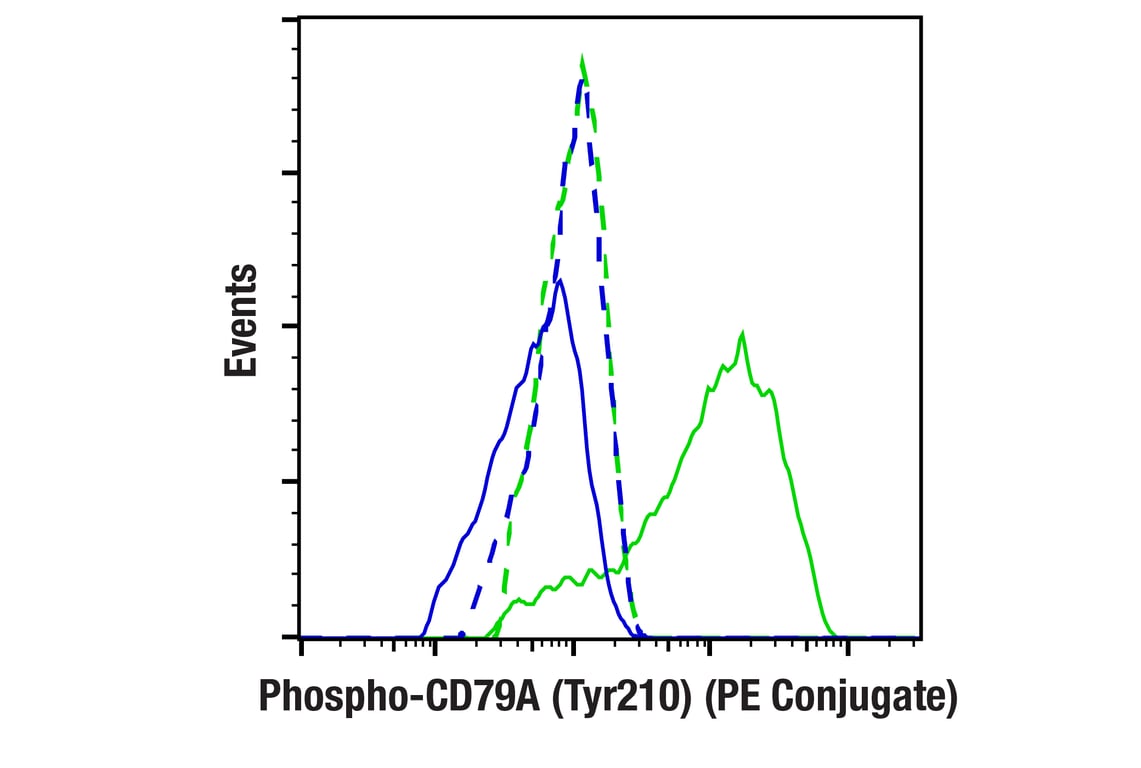


 用小程序,查商品更便捷





产品介绍
产品介绍
产品信息
荧光素标记
来源纯化
Monoclonal antibody is produced by immunizing animals with a synthetic phosphopeptide corresponding to residues surrounding Tyr210 of human CD79A protein.

宿主
Rabbit
简单描述
This Cell Signaling Technology® antibody is conjugated to phycoerythrin (PE) fluorescent dye under optimal conditions and tested in-house for direct flow cytometric analysis in human cells. This antibody conjugate is expected to exhibit the same species cross-reactivity as the unconjugated Phospho-CD79A (Tyr210) (E8E9Z) Rabbit mAb #89660.
商品描述
Product Usage Information
| Application | Dilution |
|---|---|
| Flow Cytometry (Fixed/Permeabilized) | 1:50 |
同种型
Rabbit IgG
克隆号
E8E9Z
应用
目标/特异性
Specificity/Sensitivity
Phospho-CD79A (Tyr210) (E8E9Z) Rabbit mAb (PE Conjugate) recognizes endogenous levels of CD79A protein only when phosphorylated at Tyr210.
Species Reactivity:
Human
敏感性
Endogenous
背景
背景
Antigen receptors found on the surface of B cells contain a heterodimeric signaling component composed of CD79A and CD79B, also known as Ig α and Ig β, respectively (1,2). Presence of this receptor complex is essential for B cell development and function (3). Together these two proteins and the associated B cell receptor (BCR) initiate intracellular signaling following antigen binding (4,5). An immunoreceptor tyrosine-based activation motif (ITAM) found in the CD79A intracellular region appears to be important for its function (6). Antigen binding precedes formation of the CD79A and CD79B heterodimer and subsequent activation of receptor associated kinases (7). Research has shown that CD79A is a marker for B-lineage lymphoblastic leukemia (8). Additionally, investigators have found that mutations in the CD79A (MB1) gene are associated with abnormally low levels of functional B cell receptors in some cases of chronic B cell lymphocytic leukemia (9).Tyrosine 210 is an evolutionarily conserved non-ITAM tyrosine residue that lies within the cytoplasmic domain of CD79A/Ig-α. Research studies have shown that ligation of the BCR induces phosphorylation of tyrosine 210, which facilitates both the recruitment of BLNK to the BCR signaling complex and the activation of downstream Syk-dependent signaling (10,11). Collectively, these molecular events drive B cell activation and proliferation (12).
1.van Noesel, C.J. et al. (1991) J Immunol 146, 3881-8.
2.Minegishi, Y. et al. (1999) J Clin Invest 104, 1115-21.
3.Yu, L.M. and Chang, T.W. (1992) J Immunol 148, 633-7.
4.Storch, B. et al. (2007) Eur J Immunol 37, 252-60.
5.Mason, D.Y. et al. (1995) Blood 86, 1453-9.
6.Luisiri, P. et al. (1996) J Biol Chem 271, 5158-63.
7.Pike, K.A. et al. (2004) J Immunol 172, 2210-8.
8.Astsaturov, I.A. et al. (1996) Leukemia 10, 769-73.
9.Vuillier, F. et al. (2005) Blood 105, 2933-40.
10.Engels, N. et al. (2001) Eur J Immunol 31, 2126-34.
11.Kabak, S. et al. (2002) Mol Cell Biol 22, 2524-35.
12.Patterson, H.C. et al. (2006) Immunity 25, 55-65.
翻译后修饰
phosphate
制备和贮存
保存方式
Supplied in PBS (pH 7.2), less than 0.1% sodium azide, and 2 mg/mL BSA. Store at 4°C. Do not aliquot the antibody. Protect from light. Do not freeze.
数据库链接
Entrez-Gene ID
973
UniProt ID
P11912
声明 :本官网所有报价均为常温或者蓝冰运输价格,如有产品需要干冰运输,需另外加收干冰运输费。