




 全部商品分类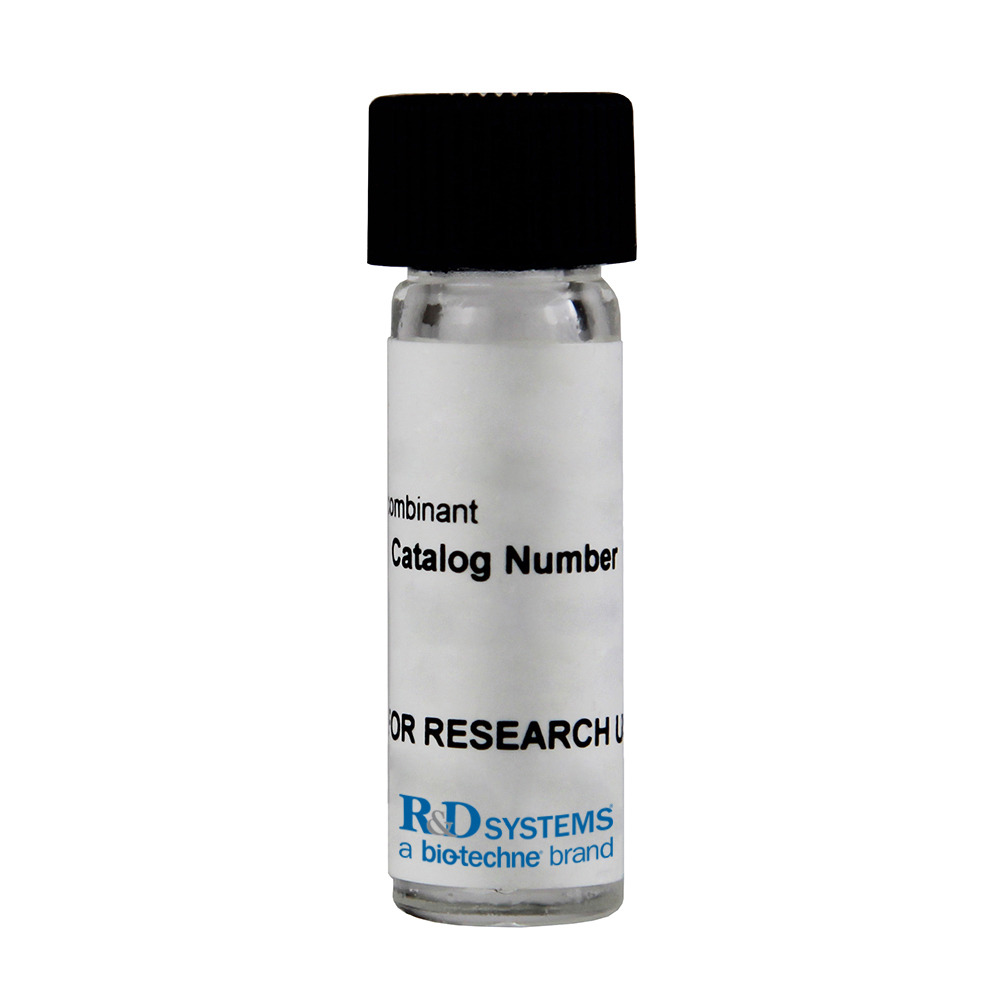


Recombinant Mouse CHST3 Protein, CF (20 ug)


 用小程序,查商品更便捷



 收藏
收藏
 对比
对比 咨询
咨询Recombinant Mouse CHST3 Protein, CF Summary
- R&D Systems CHO-derived Recombinant Mouse CHST3 Protein (5356-ST)
- Quality control testing to verify active proteins with lot specific assays by in-house scientists
- All R&D Systems proteins are covered with a 100% guarantee
Product Specifications
Glu39-Thr472, with an N-terminal 6-His tag
Analysis
Product Datasheets
5356-ST
Carrier Free
CF stands for Carrier Free (CF). We typically add Bovine Serum Albumin (BSA) as a carrier protein to our recombinant proteins. Adding a carrier protein enhances protein stability, increases shelf-life, and allows the recombinant protein to be stored at a more dilute concentration. The carrier free version does not contain BSA.
In general, we advise purchasing the recombinant protein with BSA for use in cell or tissue culture, or as an ELISA standard. In contrast, the carrier free protein is recommended for applications, in which the presence of BSA could interfere.
5356-ST
| Formulation | Supplied as a 0.2 μm filtered solution in Tris and NaCl. |
| Shipping | The product is shipped with dry ice or equivalent. Upon receipt, store it immediately at the temperature recommended below. |
| Stability & Storage: | Use a manual defrost freezer and avoid repeated freeze-thaw cycles.
|
Assay Procedure
- Assay Buffer: 50 mM Tris, 125 mM NaCl, 50 mM MgCl2, pH 7.5
- Recombinant Mouse Carbohydrate Sulfotransferase 3/CHST3 (rmCHST3) (Catalog # 5356-ST)
- Donor Substrate: Adenosine 3’-phosphate 5’-phosphosulfate (PAPS) (Catalog # ES019)
- Acceptor Substrate: Chondroitin Sulfate (Sigma, Catalog # C6737), 50 mg/mL stock in deionized water
- Universal Sulfotransferase Activity Kit (Catalog # EA003)
- 96-well Clear Plate (Costar, Catalog # 92592)
- Plate Reader (Model: SpectraMax Plus by Molecular Devices) or equivalent
- Dilute Phosphate Standard by adding 40 µL of the 1 mM Phosphate Standard to 360 µL of Assay Buffer for a 100 µM stock. This is the first point of the standard curve.
- Continue standard curve by performing six one-half serial dilutions of the 100 µM Phosphate stock in Assay Buffer. The standard curve has a range of 0.078 to 5.0 nmol per well.
- Prepare a reaction mixture containing 0.571 mM PAPS, 14.3 mg/mL chondroitin sulfate, and 14.3 μg/mL Coupling Phosphatase 3.
- Dilute rmCHST3 to 4.17 µg/mL in Assay Buffer.
- Load 50 µL of each dilution of the standard curve into a plate. Include a curve blank containing 50 μL of Assay Buffer.
- Load 15 µL of the 4.17 µg/mL rmCHST3 into the plate. Include a Control containing 15 µL of Assay Buffer.
- Add 35 µL of reaction mixture to the wells, excluding the standard curve.
- Cover the plate with a plate sealer and incubate at 37 °C for 20 minutes.
- Add 30 µL of the Malachite Green Reagent A to all wells. Mix briefly.
- Add 100 µL of deionized water to all wells. Mix briefly.
- Add 30 µL of the Malachite Green Reagent B to all wells. Mix and incubate for 20 minutes at room temperature.
- Read plate at 620 nm (absorbance) in endpoint mode.
- Calculate specific activity:
|
Specific Activity (pmol/min/µg) = |
Phosphate released* (nmol) x (1000 pmol/nmol) |
| Incubation time (min) x amount of enzyme (µg) |
*Derived from the phosphate standard curve using linear or 4-parameter fitting and adjusted for Control.
Per Reaction:- rmCHST3: 0.0625 μg
- Coupling Phosphatase 3: 0.500 μg
- PAPS: 0.4 mM
- Chondrointin Sulfate: 500 μg
Reconstitution Calculator
Background: Carbohydrate Sulfotransferase 3/CHST3
The mouse CHST family is comprised of 13 enzymes. All members of this family are Golgi‑localized type II membrane proteins. Only the luminal and enzymatic domain is expressed in each of our recombinant CHST proteins. These enzymes transfer sulfate (i.e., sulfonate) onto the 6-O or 4-O positions of GalNAc, Gal and GlcNAc residues on glycoproteins, proteoglycans and glycolipids (1). This sulfation often creates specific epitopes that can be recognized by extracellular matrix proteins, cell surface receptors and viruses (2). CHST3, also known as chondroitin 6-O-sulfotransferase, transfers sulfate to position 6 of GalNAc residues on chondroitin sulfate (3). Chondroitin sulfate constitutes the predominant proteoglycan present in cartilage and is distributed on the surfaces of many cells and extracellular matrices. Loss of CHST3 function in human results in severe chondrodysplasia (4). CHST3 can also sulfate Gal residues of keratan sulfate and Gal residues in sialyl N-acetyllactosamine (sialyl LacNAc) oligosaccharides (5). Mouse CHST3 shares 85% amino acid sequence identity to the human ortholog.
- Hemmerich, S. and Rosen, S. (2000) Glycobiology 10:849.
- Bowman, K. G. and Bertozzi, C. R. (1999) Chem. Biol. 5:447.
- Uchimura, K. et al. (2002) J. Biol. Chem. 277:1443.
- Thiele, H. et al. (2004) Proc. Natl. Acad. Sci. U. S. A. 101:10155.
- Yusa, A. et al. (2006) J. Biol. Chem. 281: 20393.

Background: Carbohydrate Sulfotransferase 3/CHST3
The mouse CHST family is comprised of 13 enzymes. All members of this family are Golgi‑localized type II membrane proteins. Only the luminal and enzymatic domain is expressed in each of our recombinant CHST proteins. These enzymes transfer sulfate (i.e., sulfonate) onto the 6-O or 4-O positions of GalNAc, Gal and GlcNAc residues on glycoproteins, proteoglycans and glycolipids (1). This sulfation often creates specific epitopes that can be recognized by extracellular matrix proteins, cell surface receptors and viruses (2). CHST3, also known as chondroitin 6-O-sulfotransferase, transfers sulfate to position 6 of GalNAc residues on chondroitin sulfate (3). Chondroitin sulfate constitutes the predominant proteoglycan present in cartilage and is distributed on the surfaces of many cells and extracellular matrices. Loss of CHST3 function in human results in severe chondrodysplasia (4). CHST3 can also sulfate Gal residues of keratan sulfate and Gal residues in sialyl N-acetyllactosamine (sialyl LacNAc) oligosaccharides (5). Mouse CHST3 shares 85% amino acid sequence identity to the human ortholog.
- Hemmerich, S. and Rosen, S. (2000) Glycobiology 10:849.
- Bowman, K. G. and Bertozzi, C. R. (1999) Chem. Biol. 5:447.
- Uchimura, K. et al. (2002) J. Biol. Chem. 277:1443.
- Thiele, H. et al. (2004) Proc. Natl. Acad. Sci. U. S. A. 101:10155.
- Yusa, A. et al. (2006) J. Biol. Chem. 281: 20393.