



 全部商品分类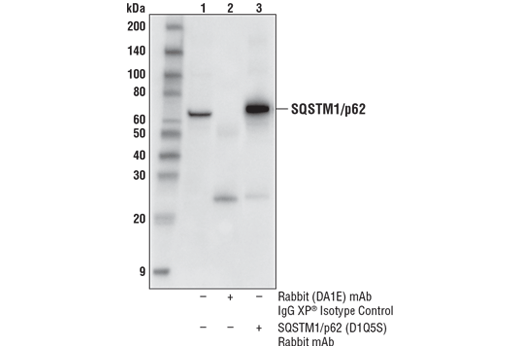


1/5


 用小程序,查商品更便捷





产品介绍
产品介绍
产品信息
荧光素标记
Unconjugated

抗原名称
SQSTM1p62
来源纯化
Monoclonal antibody is produced by immunizing animals with a synthetic peptide corresponding to residues near the carboxy terminus of human SQSTM1 protein.
宿主
Rabbit
商品描述
Product Usage Information
| Application | Dilution |
|---|---|
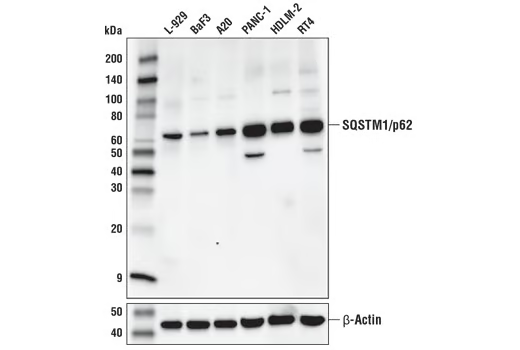
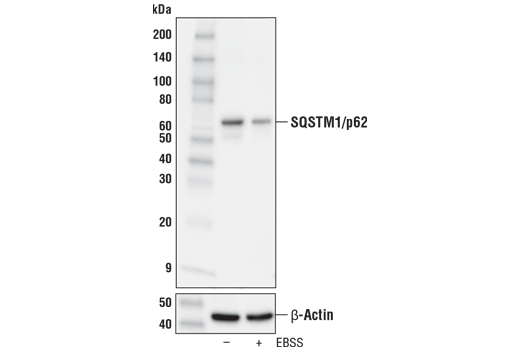
| Western Blotting | 1:1000 |
| Immunoprecipitation | 1:200 |
同种型
Rabbit IgG
分子量
62
研究领域
癌症,细胞生物学,纤维化,代谢,神经科学
应用
反应种属
Human,Mouse,Rat,
目标/特异性
Specificity/Sensitivity
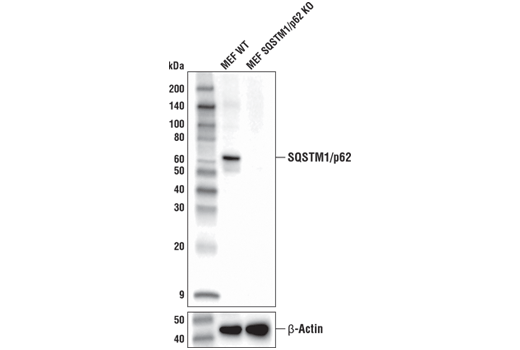
SQSTM1/p62 (D1Q5S) Rabbit mAb recognizes endogenous levels of total SQSTM1/p62 protein.
Species Reactivity:
Human, Mouse, Rat, Monkey
敏感性
Endogenous
背景
背景
Sequestosome 1 (SQSTM1, p62) is a ubiquitin binding protein involved in cell signaling, oxidative stress, and autophagy (1-4). It was first identified as a protein that binds to the SH2 domain of p56Lck (5) and independently found to interact with PKCζ (6,7). SQSTM1 was subsequently found to interact with ubiquitin, providing a scaffold for several signaling proteins and triggering degradation of proteins through the proteasome or lysosome (8). Interaction between SQSTM1 and TRAF6 leads to the K63-linked polyubiquitination of TRAF6 and subsequent activation of the NF-κB pathway (9). Protein aggregates formed by SQSTM1 can be degraded by the autophagosome (4,10,11). SQSTM1 binds autophagosomal membrane protein LC3/Atg8, bringing SQSTM1-containing protein aggregates to the autophagosome (12). Lysosomal degradation of autophagosomes leads to a decrease in SQSTM1 levels during autophagy; conversely, autophagy inhibitors stabilize SQSTM1 levels. Studies have demonstrated a link between SQSTM1 and oxidative stress. SQSTM1 interacts with KEAP1, which is a cytoplasmic inhibitor of NRF2, a key transcription factor involved in cellular responses to oxidative stress (3). Thus, accumulation of SQSTM1 can lead to an increase in NRF2 activity.
1.Kirkin, V. et al. (2009) Mol Cell 34, 259-69.
2.Seibenhener, M.L. et al. (2007) FEBS Lett 581, 175-9.
3.Komatsu, M. et al. (2010) Nat Cell Biol 12, 213-23.
4.Bjørkøy, G. et al. (2006) Autophagy 2, 138-9.
5.Joung, I. et al. (1996) Proc Natl Acad Sci USA 93, 5991-5.
6.Sanchez, P. et al. (1998) Mol Cell Biol 18, 3069-80.
7.Puls, A. et al. (1997) Proc Natl Acad Sci USA 94, 6191-6.
8.Vadlamudi, R.K. et al. (1996) J Biol Chem 271, 20235-7.
9.Wooten, M.W. et al. (2005) J Biol Chem 280, 35625-9.
10.Bjørkøy, G. et al. (2005) J Cell Biol 171, 603-14.
11.Komatsu, M. et al. (2007) Cell 131, 1149-63.
12.Pankiv, S. et al. (2007) J Biol Chem 282, 24131-45.
研究领域
癌症,细胞生物学,纤维化,代谢,神经科学
翻译后修饰
unmodified
制备和贮存
保存方式
Supplied in 10 mM sodium HEPES (pH 7.5), 150 mM NaCl, 100 µg/mL BSA, 50% glycerol, and less than 0.02% sodium azide. Store at –20°C. Do not aliquot the antibody.
For a carrier free (BSA and azide free) version of this product see product #41813.
数据库链接
Entrez-Gene ID
18412
UniProt ID
Q64337
声明 :本官网所有报价均为常温或者蓝冰运输价格,如有产品需要干冰运输,需另外加收干冰运输费。