




 全部商品分类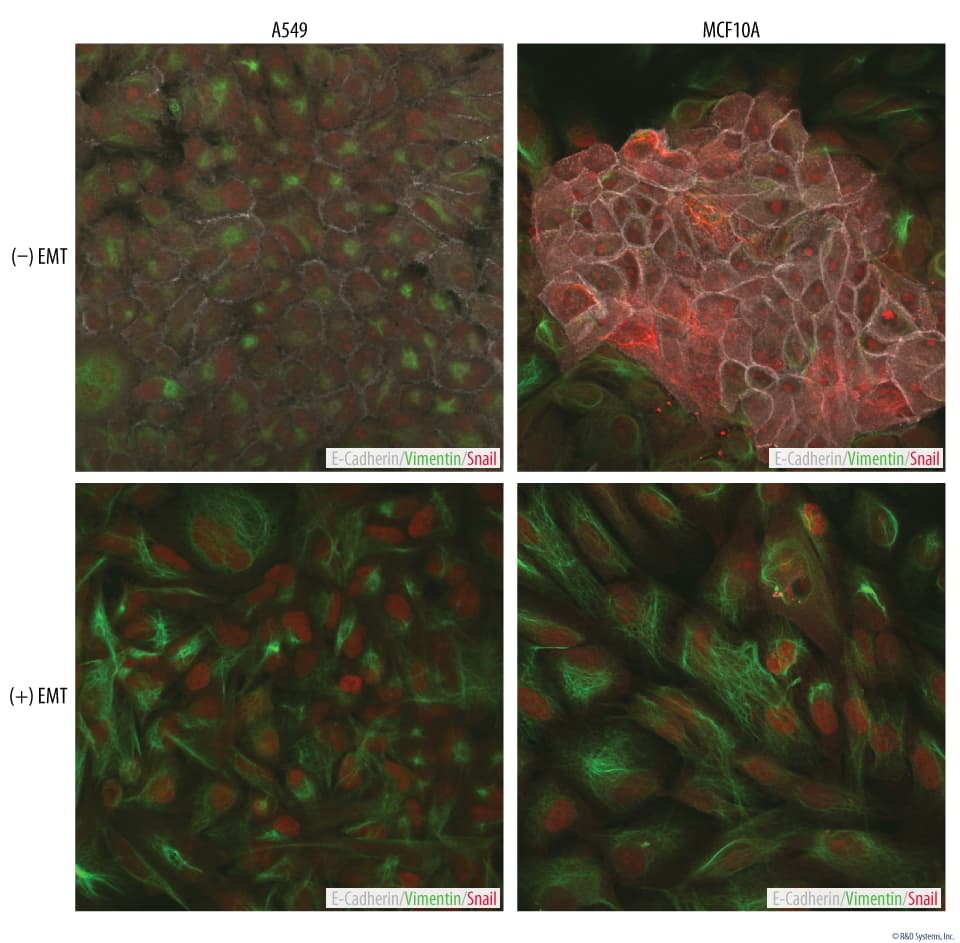


Human EMT 3-Color Immunocytochemistry Kit (1 Kit)


 用小程序,查商品更便捷



 收藏
收藏
 对比
对比 咨询
咨询This kit contains the following fluorochrome-conjugated antibodies to analyze EMT status in human cells:
- NL557-conjugated Goat Anti-Human Snail
- NL637-conjugated Goat Anti-Human E-Cadherin
- NL493-conjugated Goat Anti-Human Vimentin

Human EMT 3-Color Immunocytochemistry Kit Summary
To assess epithelial to mesenchymal transition (EMT) status in human cells using single-step ICC.
Key Benefits
- Provides a straightforward readout of EMT status
- Utilizes single-step, fluorescent ICC staining of EMT markers
- Simultaneous analysis of 3 EMT markers increases confidence in EMT status
Why Assess EMT Status in Human Cells Using Established Markers?
Epithelial to mesenchymal transition (EMT) is centrally important during embryonic development and is implicated in tissue fibrosis and cancer cell metastasis. The ability to quickly and reliably assess EMT status is critical for developing a greater understanding of the mechanisms that regulate EMT.
The downregulation of epithelial markers, including E-Cadherin, and upregulation of mesenchymal markers, including Snail and Vimentin, can be used to assess EMT status.
Assessing EMT status using 3-color ICC:
- Increases confidence in EMT status by combining 3 different fluorochrome-conjugated antibodies for simultaneous staining.
- Allows researchers to evaluate changes in relative protein levels and subcellular localization of EMT markers.
- Ensures efficient use of time and reagents via single-step staining.
This kit contains the following fluorochrome-conjugated antibodies to analyze EMT status in human cells:
- NL557-conjugated Goat Anti-Human Snail
- NL637-conjugated Goat Anti-Human E-Cadherin
- NL493-conjugated Goat Anti-Human Vimentin
Each antibody is supplied as a 10X stock; enough for 25 assays when used in a 50 µL staining volume per assay.
Stability and Storage
Reagents are stable for 12 months from date of receipt when stored in the dark at 2° C to 8°.
Specifications
Product Datasheets
Scientific Data
 View Larger
Upregulation of the Mesenchymal Markers, Snail and Vimentin, in EMT-induced Cells A549 human lung carcinoma and MCF 10A human breast epithelial cells were either untreated or cultured with the StemXVivo®EMT Inducing Media Supplement (Catalog # CCM017) for five days. The cells were analyzed for an epithelial to mesenchymal transition (EMT) by simultaneously staining with the antibodies contained in the Human EMT 3-Color Immunocytochemistry Kit (Catalog # SC026): NorthernLights™ (NL)637-conjugated Goat Anti-Human E-Cadherin (pseudocolored white), NL557-conjugated Goat Anti-Human Snail (red), and NL493-conjugated Rat Anti-Human Vimentin (green). Cells cultured with the EMT Inducing Media Supplement showed downregulation of the epithelial marker, E-Cadherin, and concurrent upregulation of the mesenchymal markers, Snail and Vimentin, compared to control cells.