




 全部商品分类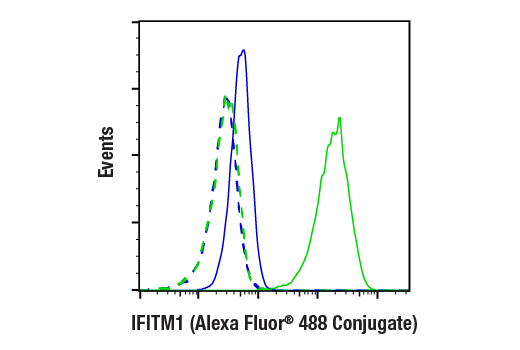


IFITM1 (D5P5J) Rabbit mAb (Alexa Fluor 488 Conjugate)


品牌: CST
 用小程序,查商品更便捷



 收藏
收藏
 对比
对比 咨询
咨询CAS号:
无
来源宿主:
Rabbit
产品介绍
产品使用步骤推荐 产品介绍
产品信息
荧光素标记
来源纯化
Monoclonal antibody is produced by immunizing animals with a synthetic peptide corresponding to residues surrounding Pro20 of human IFITM1 protein.

宿主
Rabbit
简单描述
This Cell Signaling Technology antibody is conjugated to Alexa Fluor® 488 fluorescent dye under optimal conditions and tested in-house for direct flow cytometric analysis in human cells. This antibody conjugate is expected to exhibit the same species cross-reactivity as the unconjugated IFITM1 (D5P5J) Rabbit mAb #99969.
商品描述
Product Usage Information
| Application | Dilution |
|---|---|
| Flow Cytometry (Fixed/Permeabilized) | 1:50 |
同种型
Rabbit IgG
克隆号
D5P5J
应用
目标/特异性
Specificity/Sensitivity
IFITM1 (D5P5J) Rabbit mAb (Alexa Fluor 488 Conjugate) recognizes endogenous levels of total IFITM1 protein. This antibody does not cross-react with IFITM2 or IFITM3 protein.
Species Reactivity:
Human
敏感性
Endogenous
背景
背景
Interferon-induced transmembrane protein (IFITM) family members are composed of short amino- and carboxy-termini, two transmembrane domains, and a cytoplasmic domain (1). There are four family members in humans: IFITM1, IFITM2, IFITM3, and IFITM5 (2,3). Mice have two additional family members, IFITM6 and IFITM7 (2,3). Basal expression of IFITM proteins is observed in some cells and expression can also be induced by type I and type II interferons (4-6). The primary function of IFITM family proteins appears to be viral restriction, as IFITM proteins inhibit cytosolic entry of viruses by preventing fusion of viral and host membranes (7,8). The mechanism by which IFITM proteins inhibit fusion is unclear. Although IFITM proteins are present on both the plasma membrane and intracellular membranes, they most effectively restrict viral fusion in late endosomes and lysosomes (8,9). In addition, different family members exhibit specific viral preferences (9). For example, IFITM3 is most effective at restricting influenza A infection, while IFITM1 is more successful in controlling filoviruses and SARS (9,10).
1.Diamond, M.S. and Farzan, M. (2013) Nat Rev Immunol 13, 46-57.
2.Lange, U.C. et al. (2003) BMC Dev Biol 3, 1.
3.Hickford, D. et al. (2012) BMC Genomics 13, 155.
4.Reid, L.E. et al. (1989) Proc Natl Acad Sci U S A 86, 840-4.
5.Lewin, A.R. et al. (1991) Eur J Biochem 199, 417-23.
6.Friedman, R.L. et al. (1984) Cell 38, 745-55.
7.Brass, A.L. et al. (2009) Cell 139, 1243-54.
8.Feeley, E.M. et al. (2011) PLoS Pathog 7, e1002337.
9.Huang, I.C. et al. (2011) PLoS Pathog 7, e1001258.
10.Everitt, A.R. et al. (2012) Nature 484, 519-23.
翻译后修饰
unmodified
CAS号
无
制备和贮存
保存方式
Supplied in PBS (pH 7.2), less than 0.1% sodium azide, and 2 mg/mL BSA. Store at 4°C. Do not aliquot the antibody. Protect from light. Do not freeze.
数据库链接
Entrez-Gene ID
8519
UniProt ID
P13164
声明 :本官网所有报价均为常温或者蓝冰运输价格,如有产品需要干冰运输,需另外加收干冰运输费。