




 全部商品分类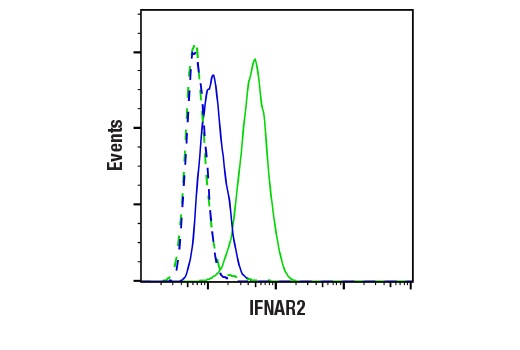


1/5


 用小程序,查商品更便捷





产品介绍
产品介绍
产品信息
荧光素标记
Unconjugated

抗原名称
IFNAR2
来源纯化
Monoclonal antibody is produced by immunizing animals with recombinant protein specific to the extracellular domain of human IFNAR2 protein.
宿主
Rabbit
商品描述
Product Usage Information
| Application | Dilution |
|---|---|
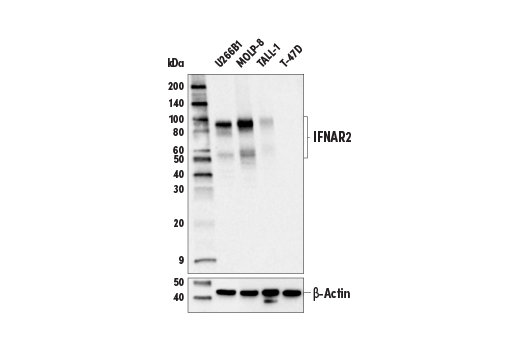
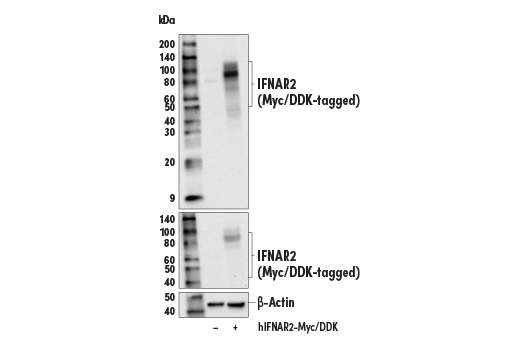
| Western Blotting | 1:1000 |
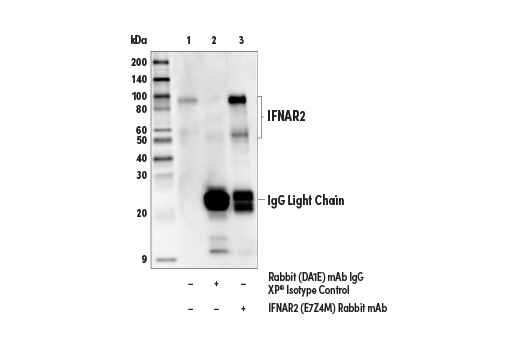
| Immunoprecipitation | 1:200 |
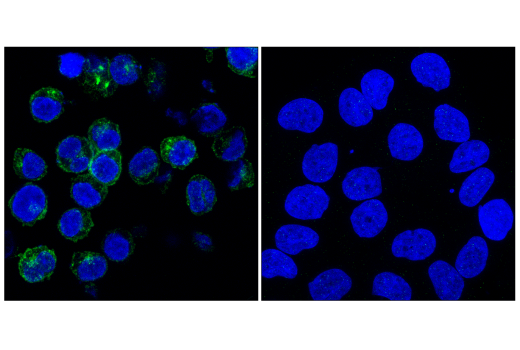
| Immunofluorescence (Immunocytochemistry) | 1:200 - 1:400 |
| Flow Cytometry (Live) | 1:100 - 1:400 |
同种型
Rabbit IgG
分子量
95
应用
反应种属
Human
目标/特异性
Specificity/Sensitivity
IFNAR2 (E7Z4M) Rabbit mAb recognizes endogenous levels of total IFNAR2 protein.
Species Reactivity:
Human
敏感性
Endogenous
背景
背景
Interferon alpha/beta receptor 2 (IFNAR2) is one of the two protein subunits that comprise the type I interferon (IFN-I) surface receptor. IFNAR2 is a class II helical cytokine receptor with an ectodomain composed of two fibronectin type III-like subdomains, D1 and D2, and an unstructured intracellular domain (ICD) (1,2). IFNAR2 is expressed on most nucleated cells (3). IFN-Is bind the IFN receptor, leading to the dimerization of IFNAR2 and IFNAR1 subunits, and the activation of Janus family kinase (JAK) and signal transducer and activator of transcription (STAT) signaling pathways (4,5). JAK1 is associated with IFNAR2, and STAT1 and STAT2 are constitutively bound to the intracellular domain (ICD) of IFNAR2 (6,7). The formation of the transcription factor IFN-stimulated gene factor 3 (ISGF3), which is a complex made up of the pSTAT1-pSTAT2 heterodimer and interferon regulatory factor 9 (IRF-9), leads to the transcription of interferon-stimulated genes (ISGs) (8). IFN-I subtypes have differential binding affinity toward IFNAR2, contributing to differences in response potency (9). In contrast, IFN-αs all bind IFNAR1 with a low affinity and only IFN-β binds IFNAR1 with a relatively higher affinity (10). IFN-I signaling mediates various cellular responses, including antiviral responses, immunomodulatory responses, and antiproliferative effects (3). In the tumor microenvironment (TME), the presence of IFN-I signaling is associated with “hot” tumors in which key effector immune cells are present and is predictive of therapeutic response, whereas suppressed IFN-I signaling in the TME is associated with tumor progression and poorer outcomes (11,12). IFN-I signaling is being investigated as a therapeutic target for cancer, autoimmunity, sepsis, and viral infection (13,14).
1.Bazan, J.F. (1990) Proc Natl Acad Sci U S A 87, 6934-8.
2.Novick, D. et al. (1994) Cell 77, 391-400.
3.Platanias, L.C. (2005) Nat Rev Immunol 5, 375-86.
4.Cohen, B. et al. (1995) Mol Cell Biol 15, 4208-14.
5.Shuai, K. et al. (1992) Science 258, 1808-12.
6.Saleh, A.Z. et al. (2002) Biochemistry 41, 11261-8.
7.Arimoto, K.I. et al. (2017) Nat Struct Mol Biol 24, 279-289.
8.Schreiber, G. (2017) J Biol Chem 292, 7285-7294.
9.Lavoie, T.B. et al. (2011) Cytokine 56, 282-9.
10.Lamken, P. et al. (2004) J Mol Biol 341, 303-18.
11.Katlinski, K.V. et al. (2017) Cancer Cell 31, 194-207.
12.Katlinskaya, Y.V. et al. (2016) Cell Rep 15, 171-180.
13.Trinchieri, G. (2010) J Exp Med 207, 2053-63.
14.Schreiber, G. (2020) Front Immunol 11, 595739.
翻译后修饰
unmodified
制备和贮存
保存方式
Supplied in 10 mM sodium HEPES (pH 7.5), 150 mM NaCl, 100 µg/mL BSA, 50% glycerol, and less than 0.02% sodium azide. Store at –20°C. Do not aliquot the antibody.
数据库链接
Entrez-Gene ID
3455
UniProt ID
P48551
声明 :本官网所有报价均为常温或者蓝冰运输价格,如有产品需要干冰运输,需另外加收干冰运输费。