




 全部商品分类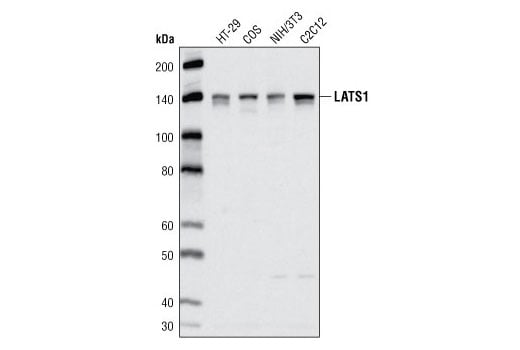


 用小程序,查商品更便捷





产品介绍
产品介绍
产品信息
荧光素标记
Unconjugated

抗原名称
LATS1
来源纯化
Monoclonal antibody is produced by immunizing animals with synthetic peptide corresponding to amino acids surrounding Gly180 of human LATS1.
宿主
Rabbit
商品描述
Product Usage Information
| Application | Dilution |
|---|---|
| Western Blotting | 1:1000 |
| Immunoprecipitation | 1:100 |
同种型
Rabbit IgG
分子量
140
研究领域
癌症,发育生物学与干细胞研究,纤维化,神经科学,
应用
反应种属
Human,Mouse,Monkey,
目标/特异性
Specificity/Sensitivity
LATS1 (C66B5) Rabbit mAb detects endogenous levels of total LATS1 protein.
Species Reactivity:
Human, Mouse, Monkey
敏感性
Endogenous
背景
背景
The Large tumor suppressor (LATS) proteins (LATS1, LATS2) are serine/threonine kinases that belong to the NDR family (1). The Drosophila homolog (warts) was first identified as a tumor suppressor protein that plays a role in the maintenance of ploidy. Human LATS1 was shown to localize to the centrosome and the mitotic spindle and control G2/M transition by negatively regulating cdc2 kinase activity (2,3). LATS1 is also reported to play a role in the G1 tetraploidy checkpoint, via control of p53 expression (4). LATS1 affects cytokinesis by regulating actin polymerization through negative modulation of LIMK1 (5). LATS1 also binds the phosphorylated form of zyxin, a regulator of actin filament assembly. This interaction promotes localization of zyxin to the mitotic spindle, suggesting a role for actin regulatory proteins during mitosis (6). Decreased expression of LATS1 is associated with breast tumor aggressiveness (7), and mutations perturbing LATS1 have been associated with human sarcomas and ovarian sarcomas (8,9). LATS1 knockout mice develop soft-tissue sarcomas, ovarian stromal cell tumor, and display a high sensitivity to carcinogenic treatments (10). LATS1 and LATS2 have also been identified as key members of the Hippo signaling pathway, a conserved kinase cascade that functions to regulate cell growth and apoptosis (11). Phosphorylation of LATS by Mammalian Sterile-20-like proteins (e.g., MST1) results in LATS-mediated phosphorylation of the transcriptional co-activators YAP and TAZ (12, 13). LATS-mediated phosphorylation of YAP and TAZ promotes their cytoplasmic sequestration and association with 14-3-3 proteins, and subsequent proteasomal degradation, leading to downregulation of YAP/TAZ target genes that promote cell growth (11, 14).
1.Tao, W. et al. (1999) Nat Genet 21, 177-81.
2.Yang, X. et al. (2001) Oncogene 20, 6516-23.
3.Xia, H. et al. (2002) Oncogene 21, 1233-41.
4.Iida, S. et al. (2004) Oncogene 23, 5266-74.
5.Yang, X. et al. (2004) Nat Cell Biol 6, 609-17.
6.Hirota, T. et al. (2000) J Cell Biol 149, 1073-86.
7.Morinaga, N. et al. (2000) Int J Oncol 17, 1125-9.
8.Hansen, L.L. et al. (2002) Cancer Genet Cytogenet 139, 1-8.
9.Hisaoka, M. et al. (2002) Lab Invest 82, 1427-35.
10.St John, M.A. et al. (1999) Nat Genet 21, 182-6.
11.Guo, C. et al. (2007) Curr Biol 17, 700-5.
12.Hergovich, A. et al. (2006) Biochem Biophys Res Commun 345, 50-8.
13.Hirabayashi, S. et al. (2008) Oncogene 27, 4281-92.
14.Zhao, B. et al. (2010) J Cell Sci 123, 4001-6.
研究领域
癌症,发育生物学与干细胞研究,纤维化,神经科学,
翻译后修饰
unmodified
制备和贮存
保存方式
Supplied in 10 mM sodium HEPES (pH 7.5), 150 mM NaCl, 100 µg/ml BSA, 50% glycerol and less than 0.02% sodium azide. Store at –20°C. Do not aliquot the antibody.
数据库链接
Entrez-Gene ID
9113
UniProt ID
O95835
声明 :本官网所有报价均为常温或者蓝冰运输价格,如有产品需要干冰运输,需另外加收干冰运输费。