




 全部商品分类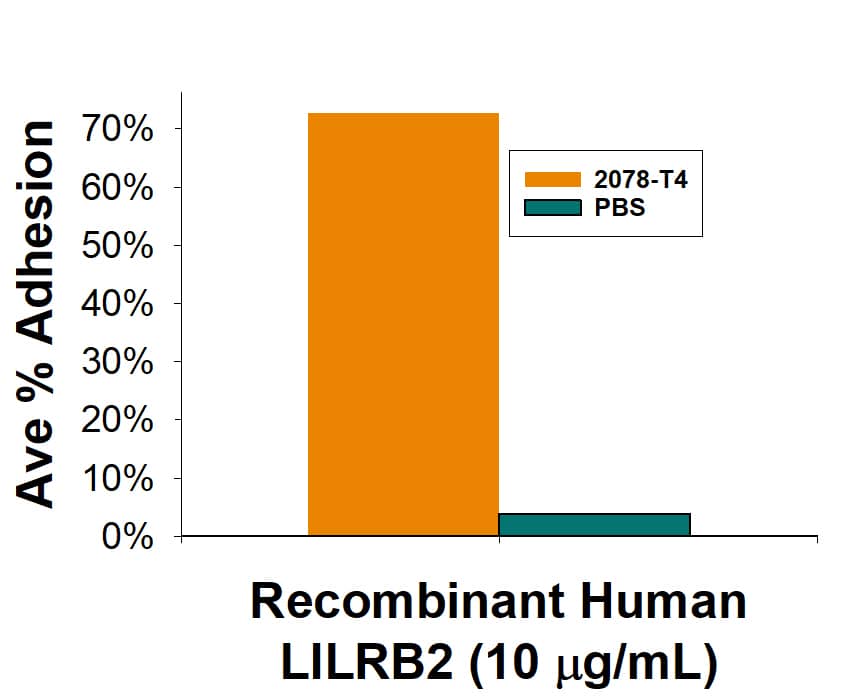


Recombinant Human LILRB2/CD85d/ILT4 Fc Chimera Protein, CF (50 ug)


 用小程序,查商品更便捷



 收藏
收藏
 对比
对比 咨询
咨询Recombinant Human LILRB2/CD85d/ILT4 Fc Chimera Protein, CF Summary
- R&D Systems NS0-derived Recombinant Human LILRB2/CD85d/ILT4 Fc Chimera Protein (2078-T4)
- Quality control testing to verify active proteins with lot specific assays by in-house scientists
- All R&D Systems proteins are covered with a 100% guarantee
Product Specifications
| Human LILRB2/CD85d/ILT4 (Gly24-His458) Accession # AAH36827.1 |
IEGRMD | Human IgG1 (Pro100-Lys330) |
| N-terminus | C-terminus | |
Analysis
Product Datasheets
2078-T4
Carrier Free
CF stands for Carrier Free (CF). We typically add Bovine Serum Albumin (BSA) as a carrier protein to our recombinant proteins. Adding a carrier protein enhances protein stability, increases shelf-life, and allows the recombinant protein to be stored at a more dilute concentration. The carrier free version does not contain BSA.
In general, we advise purchasing the recombinant protein with BSA for use in cell or tissue culture, or as an ELISA standard. In contrast, the carrier free protein is recommended for applications, in which the presence of BSA could interfere.
2078-T4
| Formulation | Lyophilized from a 0.2 μm filtered solution in PBS. |
| Reconstitution | Reconstitute at 100 μg/mL in sterile PBS. |
| Shipping | The product is shipped at ambient temperature. Upon receipt, store it immediately at the temperature recommended below. |
| Stability & Storage: | Use a manual defrost freezer and avoid repeated freeze-thaw cycles.
|
Scientific Data
 View Larger
Recombinant Human LILRB2/CD85d/ILT4 Fc Chimera (Catalog # 2078-T4) supports the adhesion of HSB2 human peripheral blood acute lymphoblastic leukemia cells. Recombinant Human LILRB2/CD85d/ILT4 Fc Chimera immobilized at 35 µg/mL, 100 µL/well, will mediate >40% HSB-2 cell adhesion (105cells/well).
Reconstitution Calculator
Background: LILRB2/CD85d/ILT4
The immunoglobulin-like transcript (ILT) comprise a family of activating and inhibitory type immunoreceptors whose genes are located in the same locus that encodes killer cell Ig-like receptors (KIR) (1-3). ILT4, also known as LIR-2 and LILRB2, is a type I transmembrane protein expressed primarily on monocytes and dendritic cells (DC) (4). Human ILT4 is produced as a 598 amino acid (aa) precursor including a 21 aa signal sequence, a 440 aa extracellular domain (ECD), a 21 aa transmembrane segment, and a 116 aa cytoplasmic domain. The ECD contains four Ig-like domains, and the cytoplasmic domain contains three immunoreceptor tyrosine-based inhibitory motifs (ITIM) (5). The ECD of human ILT4 shares 76% aa identity with chimpanzee ILT4 and 74%, 81%, 33%, 52%, 77%, 61%, and 64 % aa identity with human ILT1, 2, 3, 5, 6, 7, and 8, respectively. ILT4 binds to classical MHC I proteins as well as the non-classical HLA-G1 and HLA-F molecules (5-9). It competes with CD8 alpha for MHC I binding but does not compete with KIR2DL1 (7). Ligation of ILT4 induces Tyr phosphorylation within its cytoplasmic ITIMs, a requirement for association with SHP-1 (4, 6). Activation of ILT4 inhibits signaling through Fc gamma RI (4) and Fc epsilon RI (6) and causes DC to become tolerogenic by down-regulation of co‑stimulatory molecules (10, 11). ILT4 mediates tolerogenic DC‑induced CD4+ T cell energy in vitro and in vivo (10-12).
- Suciu-Foca, N. et al. (2005) Int. Immunopharmacol. 5:7.
- Hofmeister, V. and E.H. Weiss (2003) Semin. Canc. Biol. 13:317.
- Hunt, J.S. et al. (2005) FASEB J. 19:681.
- Finger, N.A. et al. (1998) Eur. J. Immunol. 28:3423.
- Borges, L. et al. (1997) J. Immunol. 159:5192.
- Colonna, M. et al. (1998) J. Immunol. 160:3096.
- Shiroishi, M. et al. (2003) Proc. Natl. Acad. Sci. 100:8856.
- Lepin, E.J.M. et al. (2000) Eur. J. Immunol. 30:3552.
- Allen, R.L. et al. (2001) J. Immunol. 167:5543.
- Chang, C.C. et al. (2002) Nat. Immunol. 3:237.
- Ristich, V. et al. (2005) Eur. J. Immunol. 35:1133.
- Manavalan, J.S. et al. (2003) Transpl. Immunol. 11:245.

Background: LILRB2/CD85d/ILT4
The immunoglobulin-like transcript (ILT) comprise a family of activating and inhibitory type immunoreceptors whose genes are located in the same locus that encodes killer cell Ig-like receptors (KIR) (1-3). ILT4, also known as LIR-2 and LILRB2, is a type I transmembrane protein expressed primarily on monocytes and dendritic cells (DC) (4). Human ILT4 is produced as a 598 amino acid (aa) precursor including a 21 aa signal sequence, a 440 aa extracellular domain (ECD), a 21 aa transmembrane segment, and a 116 aa cytoplasmic domain. The ECD contains four Ig-like domains, and the cytoplasmic domain contains three immunoreceptor tyrosine-based inhibitory motifs (ITIM) (5). The ECD of human ILT4 shares 76% aa identity with chimpanzee ILT4 and 74%, 81%, 33%, 52%, 77%, 61%, and 64 % aa identity with human ILT1, 2, 3, 5, 6, 7, and 8, respectively. ILT4 binds to classical MHC I proteins as well as the non-classical HLA-G1 and HLA-F molecules (5-9). It competes with CD8 alpha for MHC I binding but does not compete with KIR2DL1 (7). Ligation of ILT4 induces Tyr phosphorylation within its cytoplasmic ITIMs, a requirement for association with SHP-1 (4, 6). Activation of ILT4 inhibits signaling through Fc gamma RI (4) and Fc epsilon RI (6) and causes DC to become tolerogenic by down-regulation of co‑stimulatory molecules (10, 11). ILT4 mediates tolerogenic DC‑induced CD4+ T cell energy in vitro and in vivo (10-12).
- Suciu-Foca, N. et al. (2005) Int. Immunopharmacol. 5:7.
- Hofmeister, V. and E.H. Weiss (2003) Semin. Canc. Biol. 13:317.
- Hunt, J.S. et al. (2005) FASEB J. 19:681.
- Finger, N.A. et al. (1998) Eur. J. Immunol. 28:3423.
- Borges, L. et al. (1997) J. Immunol. 159:5192.
- Colonna, M. et al. (1998) J. Immunol. 160:3096.
- Shiroishi, M. et al. (2003) Proc. Natl. Acad. Sci. 100:8856.
- Lepin, E.J.M. et al. (2000) Eur. J. Immunol. 30:3552.
- Allen, R.L. et al. (2001) J. Immunol. 167:5543.
- Chang, C.C. et al. (2002) Nat. Immunol. 3:237.
- Ristich, V. et al. (2005) Eur. J. Immunol. 35:1133.
- Manavalan, J.S. et al. (2003) Transpl. Immunol. 11:245.