




 全部商品分类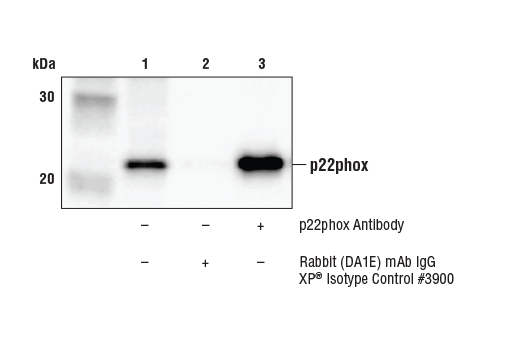


1/2


 用小程序,查商品更便捷





产品介绍
产品介绍
产品信息
荧光素标记
Unconjugated

抗原名称
p22phox
来源纯化
Polyclonal antibodies are produced by immunizing animals with a synthetic peptide corresponding to residues near the carboxy terminus of human p22phox protein. Antibodies are purified by peptide affinity chromatography.
宿主
Rabbit
商品描述
Product Usage Information
| Application | Dilution |
|---|---|
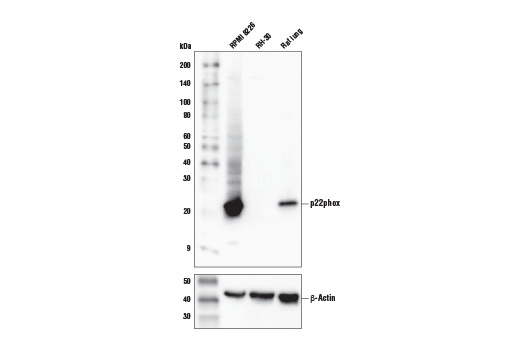
| Western Blotting | 1:1000 |
| Immunoprecipitation | 1:50 |
分子量
22
研究领域
纤维化,免疫学和肿瘤学,神经科学
应用
反应种属
Human,Rat,
目标/特异性
Specificity/Sensitivity
p22phox Antibody recognizes endogenous levels of total p22phox protein.
Species Reactivity:
Human, Rat
敏感性
Endogenous
背景
背景
The p22phox protein is a critical component of the membrane-bound NADPH Oxidase of phagocytes that generate superoxide anion and alter the redox states in cells. p22phox associates with the catalytic subunit gp91phox (NOX2), NOX1, NOX3, or NOX4 to form the active NADPH Oxidase. The enzymatic complex includes cytosolic subunits p40phox, p47phox, p67phox, and Rac2 that are recruited to the membrane-bound subunits, subsequently generating superoxide anion as the final product, serving as a microbial killing system (1,2). Multiple phosphorylation sites in each subunit of these oxidases potentiate its activation, including the phosphorylation of p22phox at Thr147 epitope facing the cytoplasmic space (3-5). NADPH Oxidase is associated with several diseases, including hyperglycemia, cancer, inflammation and vascular cases, as well as neurodegenerative diseases (6), including its activation by SOD1 mutants in Amyotrophic Lateral Sclerosis (7), and in Alzheimer's disease where NADPH Oxidase activation exacerbates the effects of fibrillary tangles and β-amyloid plaques, causing neuronal death (8,9).
1.Nauseef, W.M. (2019) Curr Opin Immunol 60, 130-140.
2.Brandes, R.P. et al. (2014) Free Radic Biol Med 76, 208-26.
3.Belambri, S.A. et al. (2018) Eur J Clin Invest 48 Suppl 2, e12951.
4.Lewis, E.M. et al. (2010) J Biol Chem 285, 2959-67.
5.Boillée, S. and Cleveland, D.W. (2008) J Clin Invest 118, 474-8.
6.Rastogi, R. et al. (2016) Front Cell Neurosci 10, 301.
7.Shiose, A. and Sumimoto, H. (2000) J Biol Chem 275, 13793-801.
8.Bianca, V.D. et al. (1999) J Biol Chem 274, 15493-9.
9.Chay, K.O. et al. (2017) Chonnam Med J 53, 196-202.
研究领域
纤维化,免疫学和肿瘤学,神经科学
翻译后修饰
unmodified
制备和贮存
保存方式
Supplied in 10 mM sodium HEPES (pH 7.5), 150 mM NaCl, 100 µg/ml BSA and 50% glycerol. Store at –20°C. Do not aliquot the antibody.
数据库链接
Entrez-Gene ID
1535
UniProt ID
P13498
声明 :本官网所有报价均为常温或者蓝冰运输价格,如有产品需要干冰运输,需另外加收干冰运输费。