

老带新
PathScan P-Smad2 (Ser465/467)/Smad3 Sandwich ELISA Kit
1/2

PathScan P-Smad2 (Ser465/467)/Smad3 Sandwich ELISA Kit

分享
品牌: CST
用小程序,查商品更便捷
收藏
对比对比
咨询咨询
分子量:
52, 60
反应种属:
Human,Mouse,Mink,
产品介绍
产品介绍
产品信息
简单描述

The PathScan® Phospho-SMAD2 (Ser465/467)/SMAD3 (Ser423/425) Sandwich ELISA Kit is a solid phase sandwich enzyme-linked immunosorbent assay (ELISA) that recognizes endogenous levels of phospho-SMAD2 (Ser465/467) and SMAD3 (Ser423/425) proteins. A SMAD2/3 Mouse Antibody has been coated on the microwells. After incubation with cell lysates, SMAD2/3 proteins (phospho and nonphospho) are captured by the coated antibody. Following extensive washing, a Phospho-SMAD2 (Ser465/467)/SMAD3 (Ser423/425) Detection Antibody is added to detect captured phospho-SMAD2 (Ser465/467) and phospho-SMAD3 (Ser423/425) proteins. Anti-rabbit IgG, HRP-linked Antibody is then used to recognize the bound detection antibody. HRP substrate, TMB, is added to develop color. The magnitude of the absorbance for this developed color is proportional to the quantity of phospho-SMAD2 (Ser465/467) and phospho-SMAD3 (Ser423/425) proteins.

*Antibodies in this kit are custom formulations specific to kit.

分子量
52, 60
组合货号
9803S&12001CA
研究领域
发育生物学与干细胞研究,纤维化,神经科学
应用
反应种属
Human,Mouse,Mink,
目标/特异性

Specificity/Sensitivity

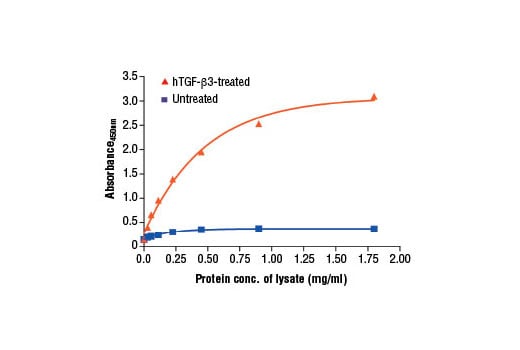
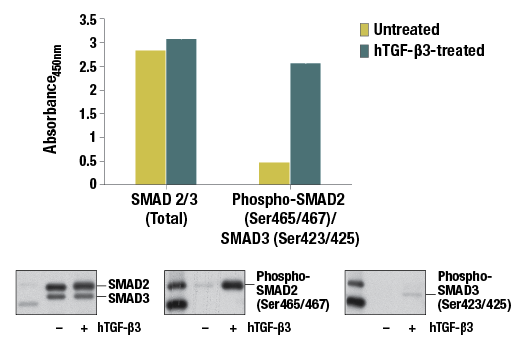
PathScan Phospho-SMAD2 (Ser465/467)/SMAD3 (Ser423/425) Sandwich ELISA Kit recognizes endogenous levels of phospho-SMAD2 (Ser465/467) and SMAD3 (Ser423/425) proteins in human cells, as shown in Figure 1. The kit sensitivity is shown in Figure 2. This kit detects proteins from the indicated species, as determined through in-house testing, but may also detect homologous proteins from other species.

Species Reactivity:

Human, Mouse, Mink

背景
背景
Members of the SMAD family of signal transduction molecules are components of a critical intracellular pathway that transmit TGF-β signals from the cell surface into the nucleus. Three distinct classes of SMADs have been defined: the receptor-regulated SMADs (R-SMADs), which include SMAD1, 2, 3, 5, and 9; the common-mediator SMAD (co-SMAD), SMAD4; and the antagonistic or inhibitory SMADs (I-SMADs), SMAD6 and 7 (1-5). Activated type I receptors associate with specific R-SMADs and phosphorylate them on a conserved carboxy-terminal SSXS motif. The phosphorylated R-SMADs dissociate from the receptor and form a heteromeric complex with SMAD4, initiating translocation of the heteromeric SMAD complex to the nucleus. Once in the nucleus, SMADs recruit a variety of DNA binding proteins that function to regulate transcriptional activity (6-8). 1.Heldin, C.H. et al. (1997) Nature 390, 465-71. 2.Attisano, L. and Wrana, J.L. (1998) Curr Opin Cell Biol 10, 188-94. 3.Derynck, R. et al. (1998) Cell 95, 737-40. 4.Massagué, J. (1998) Annu Rev Biochem 67, 753-91. 5.Whitman, M. (1998) Genes Dev 12, 2445-62. 6.Wrana, J.L. (2000) Sci STKE 2000, re1. 7.Attisano, L. and Wrana, J.L. (2002) Science 296, 1646-7. 8.Moustakas, A. et al. (2001) J Cell Sci 114, 4359-69.
研究领域
发育生物学与干细胞研究,纤维化,神经科学
翻译后修饰
phosphate
数据库链接
Entrez-Gene ID
4088,4087
UniProt ID
P84022,Q15796
声明 :本官网所有报价均为常温或者蓝冰运输价格,如有产品需要干冰运输,需另外加收干冰运输费。
货号:
12001C
一键复制
询价
供应商现货
1 Kit
5 Kit
10 Kit
20 Kit
50 Kit
选择数量
当前规格1件起购 
配送至
预计5-6个工作日送达,快递: 免运费,若需干冰额外收费