




 全部商品分类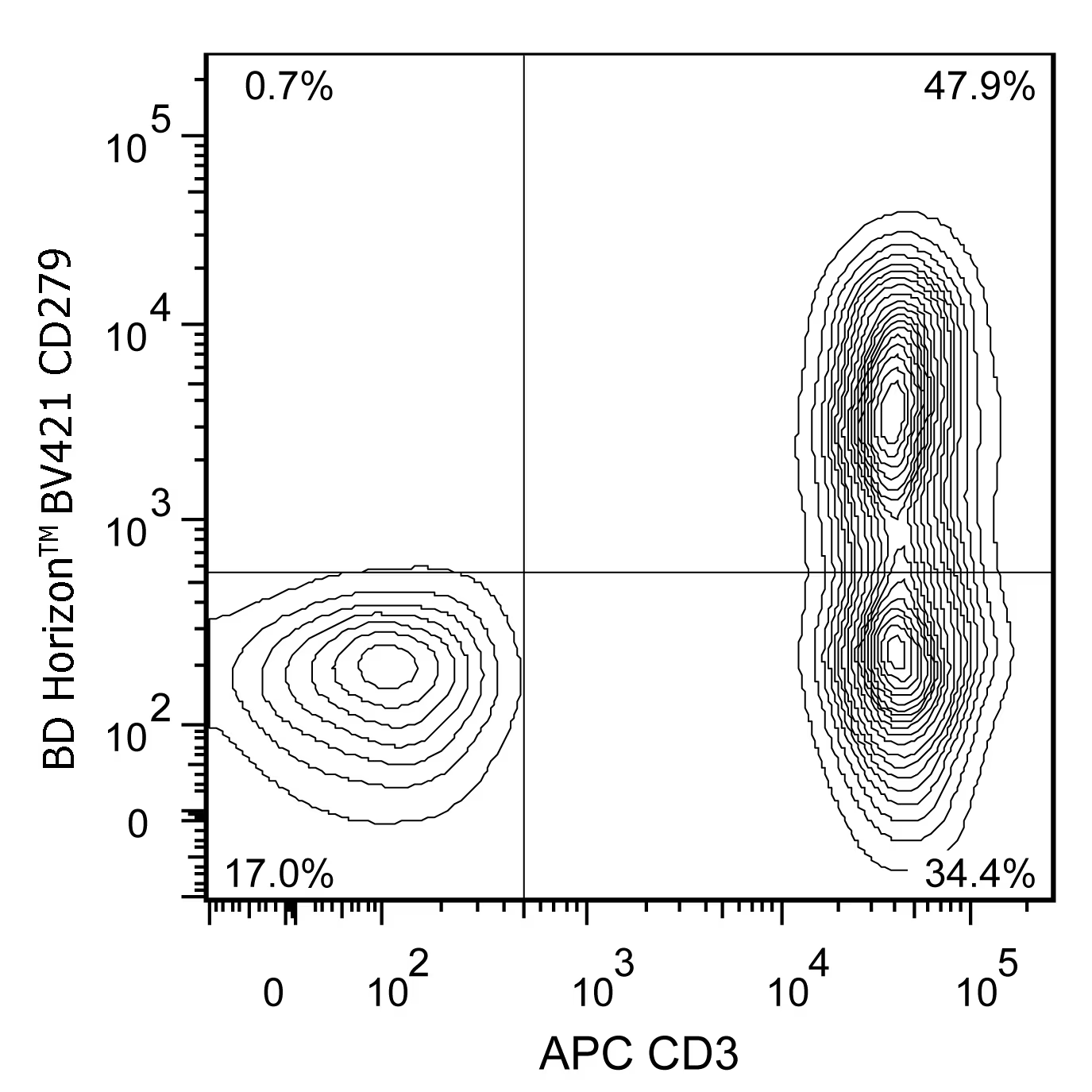


Hu CD279 (PD-1) BV421 EH12.1 25Tst


品牌: BD Pharmingen
 用小程序,查商品更便捷



 收藏
收藏
 对比
对比 咨询
咨询反应种属:
Human (QC Testing)
来源宿主:
Mouse IgG1, κ
产品介绍
产品使用步骤推荐 产品介绍
产品信息
荧光素标记
BV421()

抗原名称
CD279
宿主
Mouse IgG1, κ
免疫原
Human PD-1 Recombinant Protein
简单描述
The EH12.1 monoclonal antibody specifically binds to CD279 which is also known as Programmed cell death 1 (PD1). CD279 is an immunoregulatory receptor expressed on activated T cells, B cells, and myeloid cells. It contains an immunoreceptor tyrosine-based inhibitory motif (ITIM) in the cytoplasmic region. Mice deficient in CD279 show a breakdown of peripheral tolerance and manifest multiple autoimmune symptoms. PD-L1 and PD-L2 are ligands of CD279 and members of the B7 gene family. CD279:PD-Ligands interaction inhibits T cell proliferation and cytokine secretion. Reports suggest that the B7/CTLA-4 pathway primarily attenuates, limits, and/or terminates naïve T-cell activation in secondary lymphoid organs. The PD-ligand:CD279 pathway, on the other hand, may primarily attenuate, limit, and/or terminate T-, B-, and myeloid cell activation/effector function at sites of inflammation in the periphery.
The antibody was conjugated to BD Horizon™ BV421 which is part of the BD Horizon Brilliant™ Violet family of dyes. With an Ex Max of 407-nm and Em Max at 421-nm, BD Horizon™ BV421 can be excited by the violet laser and detected in the standard Pacific Blue™ filter set (eg, 450/50-nm filter). BD Horizon™ BV421 conjugates are very bright, often exhibiting a 10 fold improvement in brightness compared to Pacific Blue™ conjugates.
商品描述
EH12.1
The EH12.1 monoclonal antibody specifically binds to CD279 which is also known as Programmed cell death 1 (PD1). CD279 is an immunoregulatory receptor expressed on activated T cells, B cells, and myeloid cells. It contains an immunoreceptor tyrosine-based inhibitory motif (ITIM) in the cytoplasmic region. Mice deficient in CD279 show a breakdown of peripheral tolerance and manifest multiple autoimmune symptoms. PD-L1 and PD-L2 are ligands of CD279 and members of the B7 gene family. CD279:PD-Ligands interaction inhibits T cell proliferation and cytokine secretion. Reports suggest that the B7/CTLA-4 pathway primarily attenuates, limits, and/or terminates naïve T-cell activation in secondary lymphoid organs. The PD-ligand:CD279 pathway, on the other hand, may primarily attenuate, limit, and/or terminate T-, B-, and myeloid cell activation/effector function at sites of inflammation in the periphery.
The antibody was conjugated to BD Horizon™ BV421 which is part of the BD Horizon Brilliant™ Violet family of dyes. With an Ex Max of 407-nm and Em Max at 421-nm, BD Horizon™ BV421 can be excited by the violet laser and detected in the standard Pacific Blue™ filter set (eg, 450/50-nm filter). BD Horizon™ BV421 conjugates are very bright, often exhibiting a 10 fold improvement in brightness compared to Pacific Blue™ conjugates.
同种型
Mouse IgG1, κ
克隆号
克隆 EH12.1 (also known as EH12) (RUO)
产品详情
BV421
The BD Horizon Brilliant Violet™ 421 (BV421) Dye is part of the BD Horizon Brilliant Violet™ family of dyes. This polymer-technology based dye has an excitation maximum (Ex Max) of 407-nm and an emission maximum (Em Max) at 423-nm. Driven by BD innovation, BV421 is designed to be excited by the violet laser (405-nm) and detected using an optical filter centered near 420-nm (e.g., a 431/28-nm or 450/50-nm bandpass filter). BV421 is an ideal alternative for V450 as it is approximately ten times brighter with less spillover into the BV510/V500 detector. Please ensure that your instrument’s configurations (lasers and optical filters) are appropriate for this dye.
BD化合物表
{}
应用
实验应用
Flow cytometry (Routinely Tested)
推荐用量
5 µl
反应种属
Human (QC Testing)
目标/特异性
CD279 (PD-1)
背景
别名
PD1; hPD-1; hPD-l; PDCD1; PDC1; Programmed cell death 1; SLEB2; hSLE1
制备和贮存
存储溶液
Aqueous buffered solution containing BSA and ≤0.09% sodium azide.
保存方式
Aqueous buffered solution containing BSA and ≤0.09% sodium azide.
文献
文献
研发参考(9)
1. Bennett F, Luxenberg D, Ling V, et al. Program death-1 engagement upon TCR activation has distinct effects on costimulation and cytokine-driven proliferation: attenuation of ICOS, IL-4, and IL-21, but not CD28, IL-7, and IL-15 responses. J Immunol. 2003; 170(2):711-718. (Biology).
2. Carter L, Fouser LA, Jussif J, et al. PD-1:PD-L inhibitory pathway affects both CD4(+) and CD8(+) T cells and is overcome by IL-2. Eur J Immunol. 2002; 32:634-643. (Biology).
3. Dorfman DM, Brown JA, Shahsafaei A, Freeman GJ. Programmed death-1 (PD-1) is a marker of germinal center-associated T cells and angioimmunoblastic T-cell lymphoma. Am J Surg Pathol. 2006; 30:802-810. (Biology).
4. Freeman GJ, Long AJ, Iwai Y, et al. Engagement of PD-1 immunoinhibitory receptor by a novel B7 family member leads to negative regulation of lymphocyte activation. J Exp Med. 2000; 192:1027-1034. (Biology).
5. Kanai T, Totsuka T, Uraushihara K, et al. Blockade of B7-H1 suppresses the development of chronic intestinal inflammation. J Immunol. 2003; 171(8):4156-4163. (Biology).
6. Latchman Y, Wood CR, Chernova T, et al. PD-L2 is a second ligand for PD-1 and inhibits T cell activation. Nat Immunol. 2001; 2(3):261-268. (Biology).
7. Nishimura H, Minato N, Nakano T, Honjo T. Immunological studies on PD-1 deficient mice: implication of PD-1 as a negative regulator for B cell responses. Int Immunol. 1998; 10(10):1563-1572. (Immunogen: Immunoprecipitation).
8. Pauken KE, Wherry EJ. Overcoming T cell exhaustion in infection and cancer. Trends Immunol. 2015; 36(4):265-273. (Biology).
9. Velu V, Kannanganat S, Ibegbu C, et al. Elevated expression levels of inhibitory receptor programmed death 1 on simian immunodeficiency virus-specific CD8 T cells during chronic infection but not after vaccination. J Virol. 2007; 81(11):5819-5828. (Clone-specific: Blocking).
声明 :本官网所有报价均为常温或者蓝冰运输价格,如有产品需要干冰运输,需另外加收干冰运输费。