



 全部商品分类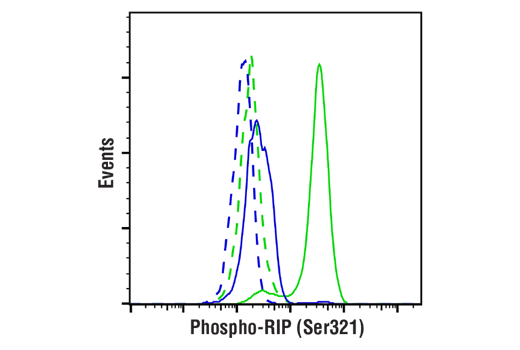



1/5


 用小程序,查商品更便捷





产品介绍
产品介绍
产品信息
荧光素标记
Unconjugated

来源纯化
Monoclonal antibody is produced by immunizing animals with a synthetic phosphopeptide corresponding to residues surrounding Ser321 of mouse RIP protein.
宿主
Rabbit
商品描述
Product Usage Information
| Application | Dilution |
|---|---|
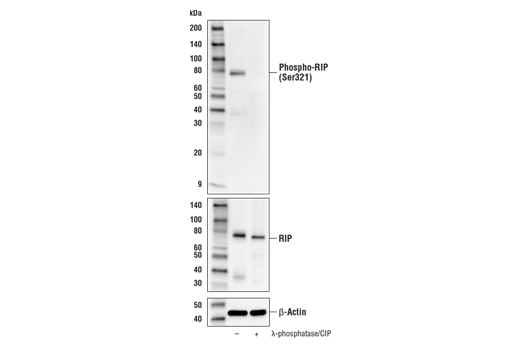
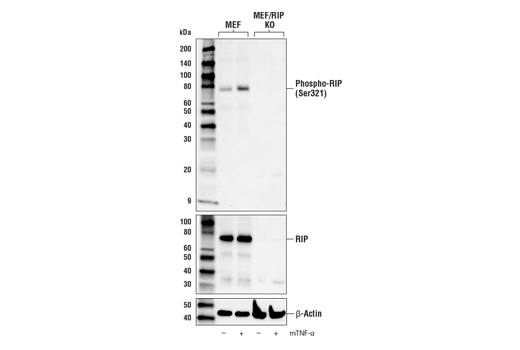
| Western Blotting | 1:1000 |
| Immunofluorescence (Immunocytochemistry) | 1:400 - 1:800 |
| Flow Cytometry (Fixed/Permeabilized) | 1:400 - 1:1600 |
同种型
Rabbit IgG
分子量
78
应用
目标/特异性
Specificity/Sensitivity
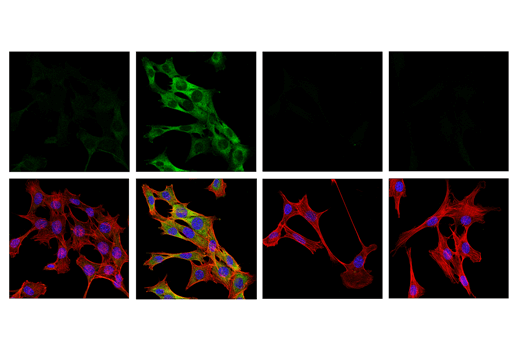
Phospho-RIP (Ser321) (E9K2A) Rabbit mAb recognizes endogenous levels of mouse RIP protein only when phosphorylated at Ser321.
Species Reactivity:
Mouse
敏感性
Endogenous
背景
背景
The receptor-interacting protein (RIP) family of serine-threonine kinases (RIP, RIP2, RIP3, and RIP4) are important regulators of cellular stress that trigger pro-survival and inflammatory responses through the activation of NF-κB, as well as pro-apoptotic pathways (1). In addition to the kinase domain, RIP contains a death domain responsible for interaction with the death domain receptor Fas and recruitment to TNF-R1 through interaction with TRADD (2,3). RIP-deficient cells show a failure in TNF-mediated NF-κB activation, making the cells more sensitive to apoptosis (4,5). RIP also interacts with TNF-receptor-associated factors (TRAFs) and can recruit IKKs to the TNF-R1 signaling complex via interaction with NEMO, leading to IκB phosphorylation and degradation (6,7). Overexpression of RIP induces both NF-κB activation and apoptosis (2,3). Caspase-8-dependent cleavage of the RIP death domain can trigger the apoptotic activity of RIP (8).Necroptosis, a regulated pathway for necrotic cell death, is triggered by a number of inflammatory signals, including cytokines in the tumor necrosis factor (TNF) family, pathogen sensors such as toll-like receptors (TLRs), and ischemic injury (9,10). The process is negatively regulated by caspases and is initiated through a complex containing the RIP and RIP3 kinases, typically referred to as the necrosome. Necroptosis is inhibited by a small molecule inhibitor of RIP, necrostatin-1 (Nec-1) (11). Research studies show that necroptosis contributes to a number of pathological conditions, and Nec-1 has been shown to provide neuroprotection in models such as ischemic brain injury (12). RIP is phosphorylated at several sites within the kinase domain that are sensitive to Nec-1, including Ser14, Ser15, Ser161, and Ser166 (13).RIP is also phosphorylated at Ser321(mouse)/Ser320(human) by MAPKAPK-2 (MK-2) and TAK1 in response to inflammatory signals such as TNF-α and LPS (14-17). Phosphorylation at this site suppresses RIP mediated apoptosis by inhibiting its interaction with FADD and caspase-8 (14-17).
1.Meylan, E. and Tschopp, J. (2005) Trends Biochem Sci 30, 151-9.
2.Hsu, H. et al. (1996) Immunity 4, 387-96.
3.Stanger, B.Z. et al. (1995) Cell 81, 513-23.
4.Ting, A.T. et al. (1996) EMBO J 15, 6189-96.
5.Kelliher, M.A. et al. (1998) Immunity 8, 297-303.
6.Devin, A. et al. (2000) Immunity 12, 419-29.
7.Zhang, S.Q. et al. (2000) Immunity 12, 301-11.
8.Lin, Y. et al. (1999) Genes Dev 13, 2514-26.
9.Christofferson, D.E. and Yuan, J. (2010) Curr Opin Cell Biol 22, 263-8.
10.Kaczmarek, A. et al. (2013) Immunity 38, 209-23.
11.Degterev, A. et al. (2008) Nat Chem Biol 4, 313-21.
12.Degterev, A. et al. (2005) Nat Chem Biol 1, 112-9.
13.Ofengeim, D. and Yuan, J. (2013) Nat Rev Mol Cell Biol 14, 727-36.
14.Jaco, I. et al. (2017) Mol Cell 66, 698-710.e5.
15.Geng, J. et al. (2017) Nat Commun 8, 359.
16.Dondelinger, Y. et al. (2017) Nat Cell Biol 19, 1237-47.
17.Menon, M.B. et al. (2017) Nat Cell Biol 19, 1248-59.
研究领域
癌症,细胞生物学,纤维化,神经科学,
翻译后修饰
phosphate
制备和贮存
保存方式
Supplied in 10 mM sodium HEPES (pH 7.5), 150 mM NaCl, 100 µg/ml BSA, 50% glycerol and less than 0.02% sodium azide. Store at –20°C. Do not aliquot the antibody.
For a carrier free (BSA and azide free) version of this product see product #33527.
数据库链接
Entrez-Gene ID
19766
UniProt ID
Q60855
声明 :本官网所有报价均为常温或者蓝冰运输价格,如有产品需要干冰运输,需另外加收干冰运输费。