




 全部商品分类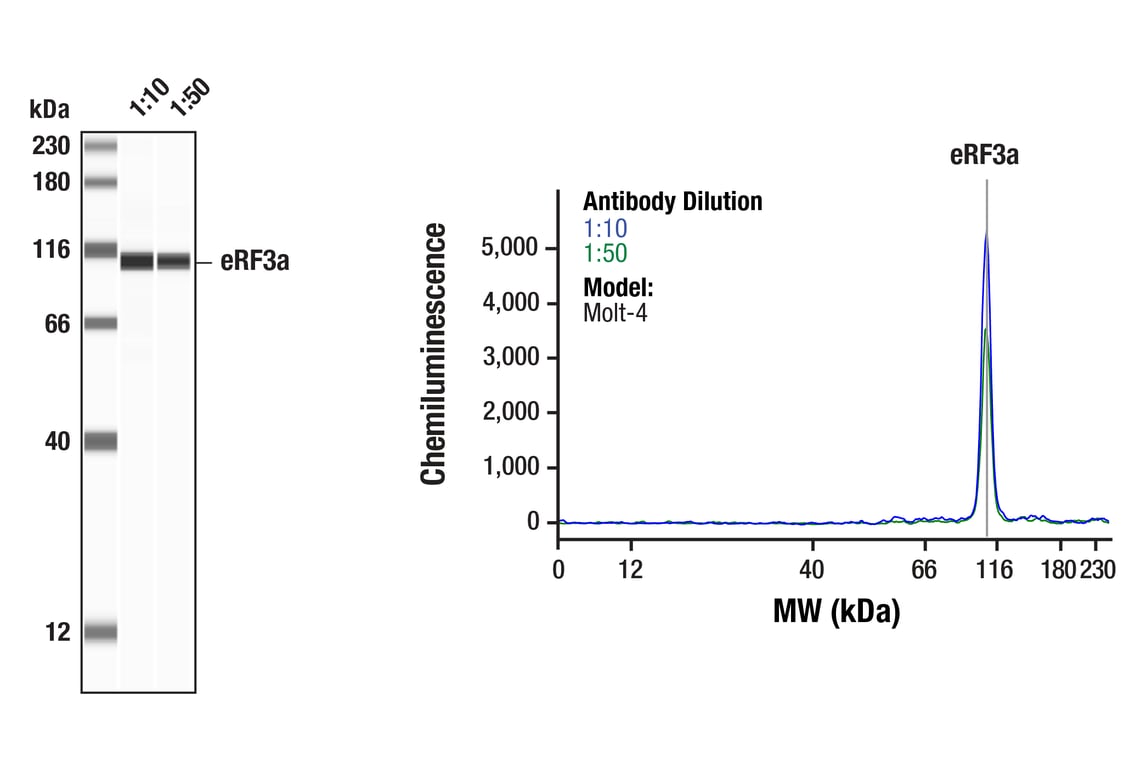


1/4


 用小程序,查商品更便捷





产品介绍
产品介绍
产品信息
荧光素标记
Unconjugated

来源纯化
Monoclonal antibody is produced by immunizing animals with a synthetic peptide corresponding to residues surrounding Pro180 of human eRF3a protein, isoform 3.
宿主
Rabbit
商品描述
Product Usage Information
| Application | Dilution |
|---|---|
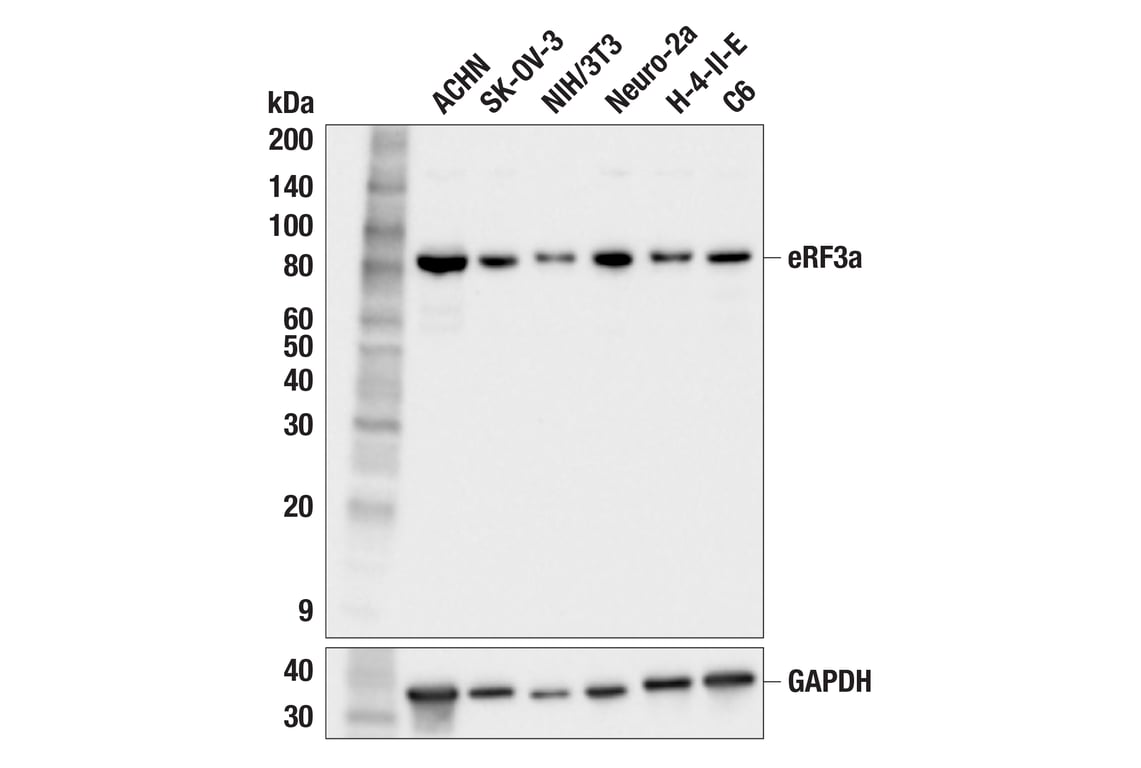
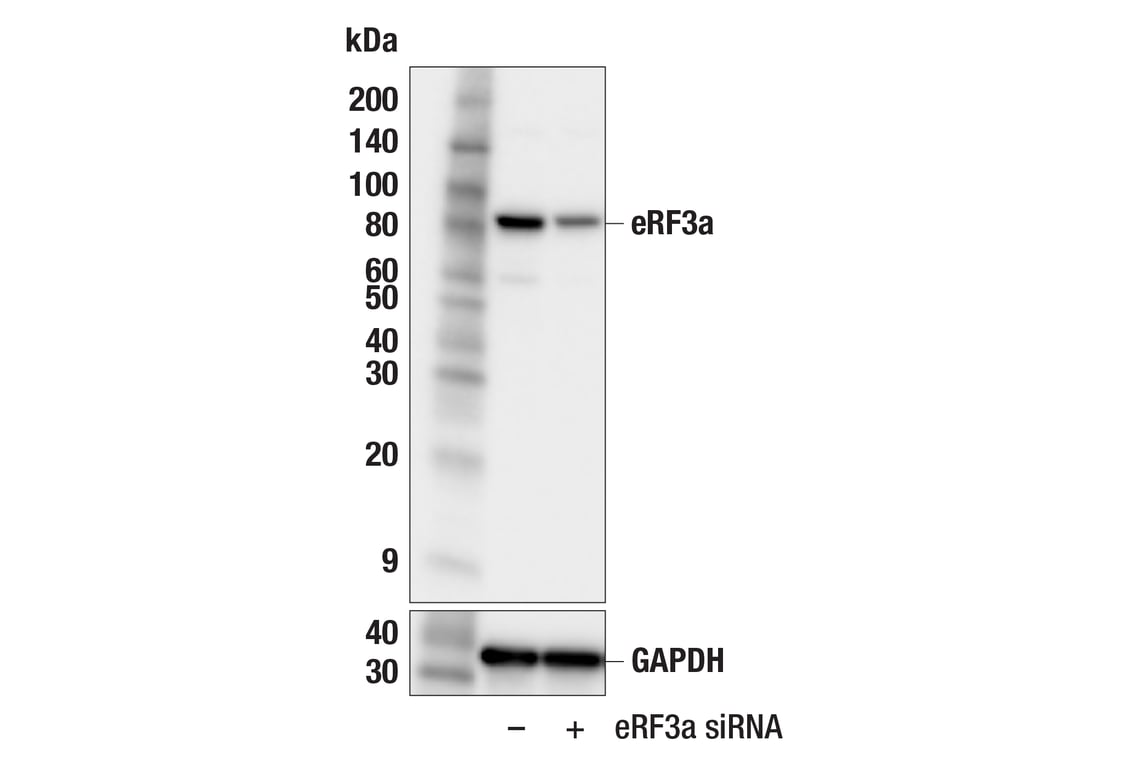
| Western Blotting | 1:1000 |
| Simple Western™ | 1:10 - 1:50 |
同种型
Rabbit IgG
分子量
80
应用
目标/特异性
Specificity/Sensitivity
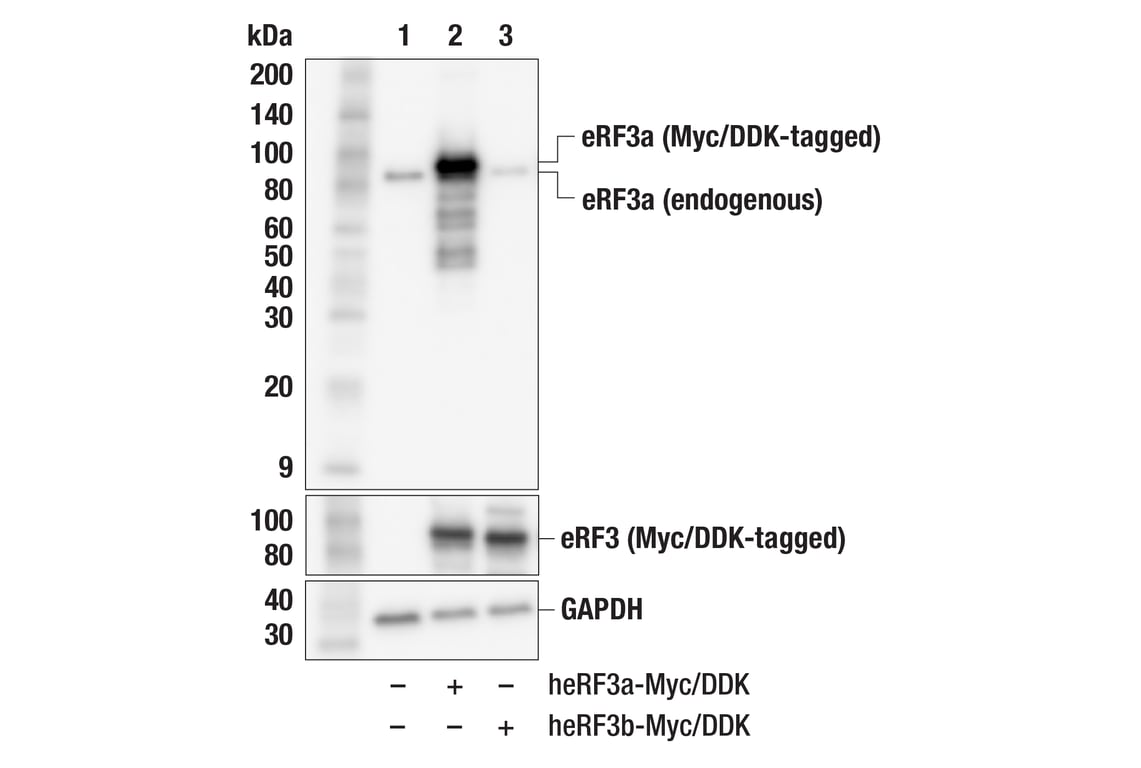
eRF3a (F9H3X) Rabbit mAb recognizes endogenous levels of total eRF3a protein. This antibody does not cross-react with eRF3b. This antibody detects a 170 kDa band of unknown origin in some samples.
Species Reactivity:
Human, Mouse, Rat, Monkey
敏感性
Endogenous
背景
背景
Eukaryotic release factor 3 (eRF3, GSPT) is an evolutionarily conserved class II release factor and member of the GTPase superfamily that cooperates with eRF1 in polypeptide translation termination (1). Paralogous genes encode a pair of eRF3 proteins (eRF3a/GSPT1, eRF3b/GSPT2) that share a conserved carboxy-terminal GTPase/eRF1-binding domain and a non-conserved amino-terminal PABP1 binding site (2). The eRF3 carboxy-terminal region is involved in translation termination through binding and activation of the eRF1 release factor (1). The amino-terminal region of eRF3 is not required for eRF1 binding and activation, but is implicated in control of mRNA stability (3,4). Expression of eRF3 proteins vary, with eRF3a ubiquitously expressed and proliferation-dependent, while eRF3b expression is more restricted to brain tissue (2,5,6). Research studies demonstrate that eRF3 undergoes caspase-mediated cleavage and degradation related to reduced protein synthesis during DNA damage-induced apoptosis (7). Additional studies indicate that polyglycine expansion of the eRF3a amino terminus is associated with an increased susceptibility to breast and gastric cancer (8,9). It is likely that the polyglycine expansions of amino-terminal eRF3a may affect the ability of eRF3a to undergo caspase-mediated cleavage (9).
1.Zhouravleva, G. et al. (1995) EMBO J 14, 4065-72.
2.Hoshino, S. et al. (1998) J Biol Chem 273, 22254-9.
3.Hoshino, S. et al. (1999) J Biol Chem 274, 16677-80.
4.Amrani, N. et al. (2008) Nature 453, 1276-80.
5.Chauvin, C. et al. (2005) Mol Cell Biol 25, 5801-11.
6.Hoshino, S. et al. (1989) EMBO J 8, 3807-14.
7.Hashimoto, Y. et al. (2012) Apoptosis 17, 1287-99.
8.Malta-Vacas, J. et al. (2009) Oncol Rep 21, 1551-8.
9.Brito, M. et al. (2005) Carcinogenesis 26, 2046-9.
翻译后修饰
unmodified
制备和贮存
保存方式
Supplied in 10 mM sodium HEPES (pH 7.5), 150 mM NaCl, 100 µg/mL BSA, 50% glycerol, and less than 0.02% sodium azide. Store at –20°C. Do not aliquot the antibody.
数据库链接
Entrez-Gene ID
2935
UniProt ID
P15170-3
声明 :本官网所有报价均为常温或者蓝冰运输价格,如有产品需要干冰运输,需另外加收干冰运输费。