



 全部商品分类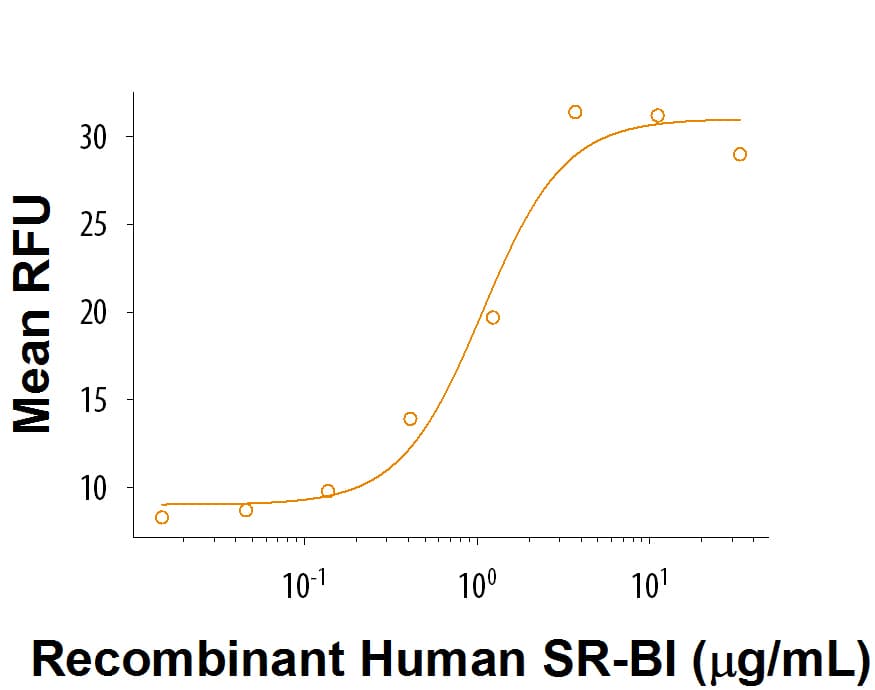


Recombinant Human SR-BI Fc Chimera Protein, CF (50 UG)


 用小程序,查商品更便捷



 收藏
收藏
 对比
对比 咨询
咨询Recombinant Human SR-BI Fc Chimera Protein, CF Summary
- R&D Systems HEK293-derived Recombinant Human SR-BI Fc Chimera Protein (8114-SRB)
- Quality control testing to verify active proteins with lot specific assays by in-house scientists
- All R&D Systems proteins are covered with a 100% guarantee
Product Specifications
| Human
SR-BI (Pro33-Tyr443) Accession # CAA80277 | IEGRMD | Human
IgG1 (Pro100-Lys330) |
| N-terminus | C-terminus | |
Analysis
Product Datasheets
8114-SRB
Carrier Free
CF stands for Carrier Free (CF). We typically add Bovine Serum Albumin (BSA) as a carrier protein to our recombinant proteins. Adding a carrier protein enhances protein stability, increases shelf-life, and allows the recombinant protein to be stored at a more dilute concentration. The carrier free version does not contain BSA.
In general, we advise purchasing the recombinant protein with BSA for use in cell or tissue culture, or as an ELISA standard. In contrast, the carrier free protein is recommended for applications, in which the presence of BSA could interfere.
8114-SRB
| Formulation | Lyophilized from a 0.2 μm filtered solution in PBS. |
| Reconstitution | Reconstitute at 500 μg/mL in PBS. |
| Shipping | The product is shipped at ambient temperature. Upon receipt, store it immediately at the temperature recommended below. |
| Stability & Storage: | Use a manual defrost freezer and avoid repeated freeze-thaw cycles.
|
Scientific Data
 View Larger
Recombinant Human SR-BI Fc Chimera (Catalog # 8114-SRB) binds to fluorescein-conjugatedS. aureusBioparticles with an ED50 of 0.4-2 μg/mL.
Reconstitution Calculator
Background: SR-BI
Scavenger Receptor, class B, member 1 (SR-BI), gene name SCARB1, is also known as CD36L1 (CD36-like 1) or CLA-1 (CD36 and LIMPII analogous 1) (1-5). SR-BI is a transmembrane glycoprotein found on macrophages, liver cells and other steroidogenic cells as a lipoprotein receptor. The 552 amino acid (aa) human SR-BI contains a central extracellular domain (ECD), flanked by N- and C-terminal transmembrane domains. Human splice variants differ at the N-terminal cytoplasmic and transmembrane domains (SR-BIII, 474 aa), the N-terminal end of the ECD (SR-BII, 409 aa), or the C-terminal cytoplasmic domain (isoform 3, 552 aa) (2). The human SR-BI ECD shares 80%, 80%, 89%, 86% and 84% aa sequence identity with mouse, rat, porcine, rabbit, and bovine SR-BI, respectively. SR-BI functions in reverse cholesterol transport (RCT), which is thought to be anti-atherogenic by facilitating transport of cholesteryl esters from macrophages back to the liver for degradation (3). In rodent hepatocytes, SR-BI is the main receptor mediating RCT, while human hepatocytes also express a second mediator, CETP (cholesteryl ester transfer protein) (3-5). The importance of SR-BI in humans is shown by human SR-BI genetic variants that alter lipid metabolism (3-7). For example, the P297S polymorphism lowers uptake of high-density lipoprotein (HDL) cholesterol in the liver and increases plasma HDL cholesterol (3-5). On endothelial cells, signaling through SR-BI activates nitric oxide production, which attenuates monocyte adhesion (6). On adrenocortical cells, SR-BI mediates uptake of cholesteryl esters from HDL for the synthesis of glucocorticoid hormones such as cortisol (3-5). On platelets, HDL binding to surface SR-BI inhibits aggregation and increases platelet survival time (3-5). On human ovarian granulosa cells, deficiency of SR-BI correlates with low fertility (3). SR-BI and its SR-BII isoform also bind bacterial lipopolysaccharides, facilitating uptake of various bacteria by cells such as peritoneal macrophages (8, 9). This uptake enhances inflammatory responses which, unless properly controlled, can result in sepsis (9-11).
- Calvo, D. and M. A. Vega (1993) J. Biol. Chem. 268:18929.
- Swiss-Prot accession Q8WTV0
- Chadwick, A.C. and D. Sahoo (2013) Curr. Opin. Endocrinol. Diabetes Obes. 20:124.
- Hoekstra, M. et al. (2012) Curr. Opin. Lipidol. 23:127.
- Vergeer, M. et al. (2011) N. Engl. J. Med. 364:136.
- Guo, L. et al. (2011) J. Lipid Res. 52:2272.
- Saddar, S. et al. (2012) Circ. Res. 112:140.
- Vishnyakova, T.G. et al. (2006) Proc. Natl. Acad. Sci. USA 103:16888.
- Baranova, I.N. et al. (2012) J. Immunol. 188:1371.
- Leelahavanichkul, A. et al. (2012) J. Immunol. 188:2749.
- Guo, L. et al. (2009) J. Biol. Chem. 284:19826.

Background: SR-BI
Scavenger Receptor, class B, member 1 (SR-BI), gene name SCARB1, is also known as CD36L1 (CD36-like 1) or CLA-1 (CD36 and LIMPII analogous 1) (1-5). SR-BI is a transmembrane glycoprotein found on macrophages, liver cells and other steroidogenic cells as a lipoprotein receptor. The 552 amino acid (aa) human SR-BI contains a central extracellular domain (ECD), flanked by N- and C-terminal transmembrane domains. Human splice variants differ at the N-terminal cytoplasmic and transmembrane domains (SR-BIII, 474 aa), the N-terminal end of the ECD (SR-BII, 409 aa), or the C-terminal cytoplasmic domain (isoform 3, 552 aa) (2). The human SR-BI ECD shares 80%, 80%, 89%, 86% and 84% aa sequence identity with mouse, rat, porcine, rabbit, and bovine SR-BI, respectively. SR-BI functions in reverse cholesterol transport (RCT), which is thought to be anti-atherogenic by facilitating transport of cholesteryl esters from macrophages back to the liver for degradation (3). In rodent hepatocytes, SR-BI is the main receptor mediating RCT, while human hepatocytes also express a second mediator, CETP (cholesteryl ester transfer protein) (3-5). The importance of SR-BI in humans is shown by human SR-BI genetic variants that alter lipid metabolism (3-7). For example, the P297S polymorphism lowers uptake of high-density lipoprotein (HDL) cholesterol in the liver and increases plasma HDL cholesterol (3-5). On endothelial cells, signaling through SR-BI activates nitric oxide production, which attenuates monocyte adhesion (6). On adrenocortical cells, SR-BI mediates uptake of cholesteryl esters from HDL for the synthesis of glucocorticoid hormones such as cortisol (3-5). On platelets, HDL binding to surface SR-BI inhibits aggregation and increases platelet survival time (3-5). On human ovarian granulosa cells, deficiency of SR-BI correlates with low fertility (3). SR-BI and its SR-BII isoform also bind bacterial lipopolysaccharides, facilitating uptake of various bacteria by cells such as peritoneal macrophages (8, 9). This uptake enhances inflammatory responses which, unless properly controlled, can result in sepsis (9-11).
- Calvo, D. and M. A. Vega (1993) J. Biol. Chem. 268:18929.
- Swiss-Prot accession Q8WTV0
- Chadwick, A.C. and D. Sahoo (2013) Curr. Opin. Endocrinol. Diabetes Obes. 20:124.
- Hoekstra, M. et al. (2012) Curr. Opin. Lipidol. 23:127.
- Vergeer, M. et al. (2011) N. Engl. J. Med. 364:136.
- Guo, L. et al. (2011) J. Lipid Res. 52:2272.
- Saddar, S. et al. (2012) Circ. Res. 112:140.
- Vishnyakova, T.G. et al. (2006) Proc. Natl. Acad. Sci. USA 103:16888.
- Baranova, I.N. et al. (2012) J. Immunol. 188:1371.
- Leelahavanichkul, A. et al. (2012) J. Immunol. 188:2749.
- Guo, L. et al. (2009) J. Biol. Chem. 284:19826.