




 全部商品分类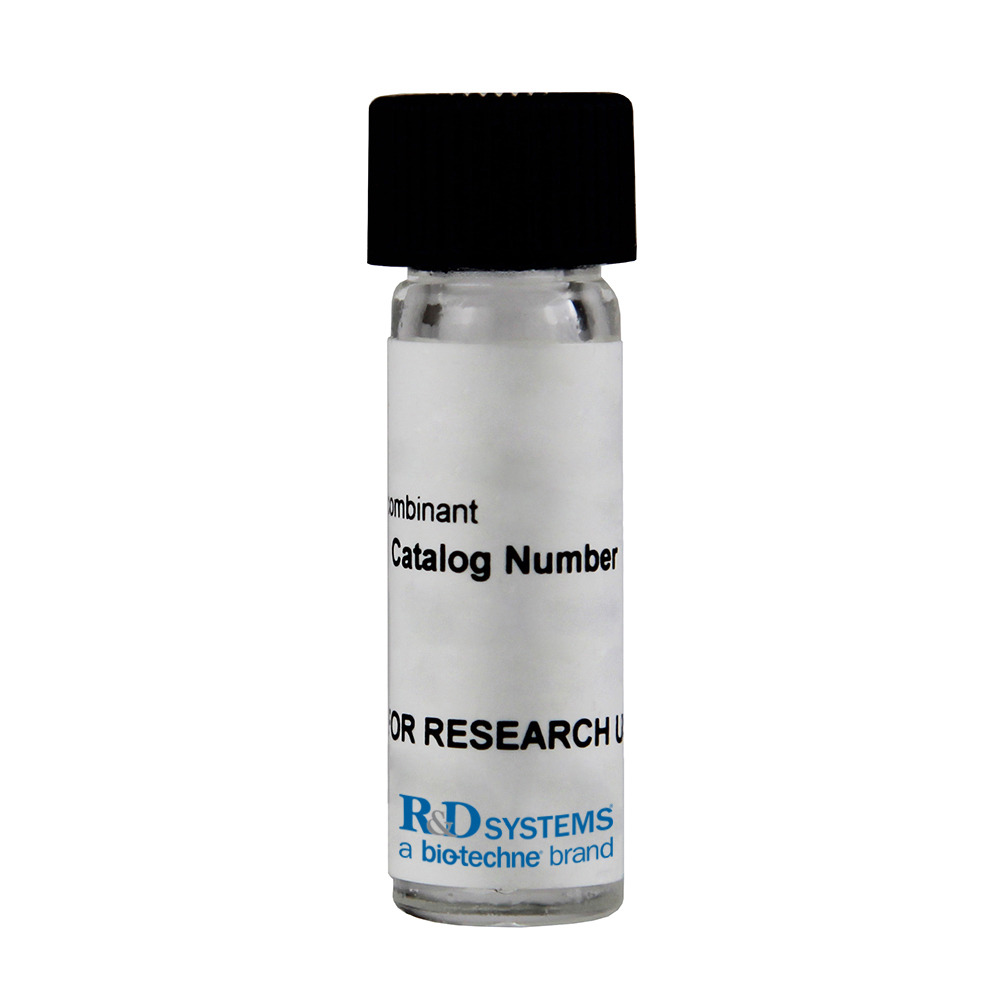


Recombinant Mouse Epimorphin/Syntaxin 2 Protein, CF (25 ug)


 用小程序,查商品更便捷



 收藏
收藏
 对比
对比 咨询
咨询Recombinant Mouse Epimorphin/Syntaxin 2 Protein, CF Summary
- R&D Systems E. coli-derived Recombinant Mouse Epimorphin/Syntaxin 2 Protein (2568-EP)
- Quality control testing to verify active proteins with lot specific assays by in-house scientists
- All R&D Systems proteins are covered with a 100% guarantee
Product Specifications
Met1-Arg189
Analysis
Product Datasheets
2568-EP
Carrier Free
CF stands for Carrier Free (CF). We typically add Bovine Serum Albumin (BSA) as a carrier protein to our recombinant proteins. Adding a carrier protein enhances protein stability, increases shelf-life, and allows the recombinant protein to be stored at a more dilute concentration. The carrier free version does not contain BSA.
In general, we advise purchasing the recombinant protein with BSA for use in cell or tissue culture, or as an ELISA standard. In contrast, the carrier free protein is recommended for applications, in which the presence of BSA could interfere.
2568-EP
| Formulation | Lyophilized from a 0.2 μm filtered solution in PBS and DTT. |
| Reconstitution | Reconstitute at 250 μg/mL in PBS. |
| Shipping | The product is shipped at ambient temperature. Upon receipt, store it immediately at the temperature recommended below. |
| Stability & Storage: | Use a manual defrost freezer and avoid repeated freeze-thaw cycles.
|
Reconstitution Calculator
Background: Epimorphin/Syntaxin 2
Epimorphin (EPIM), also known as Syntaxin 2 (STX2), is a type IV transmembrane protein that is a member of the syntaxin family of t‑SNARE (target‑Soluble NSF Attachment REceptor) membrane fusion proteins (1 ‑ 4). Intracellular Epimorphin functions as a vesicle fusion protein, but extracellular forms that are active in morphogenesis are also found. Mouse Epimorphin cDNA encodes 289 amino acids (aa) including a coiled‑coil domain (aa 68 ‑ 101), a potential cell‑recognition sequence (aa 105 ‑ 123), a sequence important for membrane transduction (aa 141 ‑ 150), a t‑SNARE domain (aa 192 ‑ 254), and a C‑terminal transmembrane domain (aa 266 ‑ 289) (1 ‑ 4). Within aa 1 ‑ 189, mouse Epimorphin shares 89%, 95%, 89% and 90% aa sequence homology with human, rat, bovine and porcine Epimorphin, respectively. Epimorphin has no signal sequence, but cell stress or Ca2+ influx induces plasma membrane crossing, with the assistance of annexin A2 and synaptotagmin‑1 (5). A soluble, extracellular 30 kDa form of Epimorphin is produced from the membrane–associated 34 kDa form by cleavage at H246 (2, 5 ‑ 7). Complexes of 70 kDa and 150 kDa are presumed to be dimers and tetramers, respectively (1, 2, 6). Epimorphin produced by mesenchymal cells influences morphogenesis of epithelia in the breast, kidney, intestine, lung, pancreas, liver, skin and intestines (2, 4, 5). For cells such as lung, mammary or pancreatic epithelia, soluble Epimorphin promotes tubulogenesis or hollow sphere formation in vitro, while epithelia plated on Epimorphin or epimorphin‑producing cells exhibit alpha v integrin‑dependent adhesion and branching morphogenesis (2 ‑ 8). Mice genetically lacking Epimorphin are sterile due to abnormal spermatogenesis and testicular development (9, 10). Both endogenous and exogenous Epimorphin are shown to protect cells from oxidative stress (11, 12).
- Hirai, Y. (1993) Biochem. Biophys. Res. Commun. 191:1332.
- Hirai, Y. et al. (1992) Cell 69:471.
- Koshida, S. and Y. Hirai (1997) Biochem. Biophys. Res. Commun. 234:522.
- Chen, C.S. et al. (2009) J. Biol. Chem. 284:6877.
- Hirai, Y. et al. (2007) J. Cell Sci. 120:2032.
- Lehnert, L. et al. (2001) J. Cell Biol. 152:911.
- Hirai, Y. et al. (1998) J. Cell Biol. 140:159.
- Fritsch, C. et al. (2002) J. Clin. Invest. 110:1629.
- Akiyama, K. et al. (2008) J. Reprod. Dev. 54:122.
- Wang, Y. et al. (2006) J. Clin. Invest. 116:1535.
- Kinoshita, N. et al. (2011) J. Gastroenterol. Hepatol. 26:201.
- Iizuka, M. et al. (2007) Am. J. Physiol. Gastrointest. Liver Physiol. 292:G39.

Background: Epimorphin/Syntaxin 2
Epimorphin (EPIM), also known as Syntaxin 2 (STX2), is a type IV transmembrane protein that is a member of the syntaxin family of t‑SNARE (target‑Soluble NSF Attachment REceptor) membrane fusion proteins (1 ‑ 4). Intracellular Epimorphin functions as a vesicle fusion protein, but extracellular forms that are active in morphogenesis are also found. Mouse Epimorphin cDNA encodes 289 amino acids (aa) including a coiled‑coil domain (aa 68 ‑ 101), a potential cell‑recognition sequence (aa 105 ‑ 123), a sequence important for membrane transduction (aa 141 ‑ 150), a t‑SNARE domain (aa 192 ‑ 254), and a C‑terminal transmembrane domain (aa 266 ‑ 289) (1 ‑ 4). Within aa 1 ‑ 189, mouse Epimorphin shares 89%, 95%, 89% and 90% aa sequence homology with human, rat, bovine and porcine Epimorphin, respectively. Epimorphin has no signal sequence, but cell stress or Ca2+ influx induces plasma membrane crossing, with the assistance of annexin A2 and synaptotagmin‑1 (5). A soluble, extracellular 30 kDa form of Epimorphin is produced from the membrane–associated 34 kDa form by cleavage at H246 (2, 5 ‑ 7). Complexes of 70 kDa and 150 kDa are presumed to be dimers and tetramers, respectively (1, 2, 6). Epimorphin produced by mesenchymal cells influences morphogenesis of epithelia in the breast, kidney, intestine, lung, pancreas, liver, skin and intestines (2, 4, 5). For cells such as lung, mammary or pancreatic epithelia, soluble Epimorphin promotes tubulogenesis or hollow sphere formation in vitro, while epithelia plated on Epimorphin or epimorphin‑producing cells exhibit alpha v integrin‑dependent adhesion and branching morphogenesis (2 ‑ 8). Mice genetically lacking Epimorphin are sterile due to abnormal spermatogenesis and testicular development (9, 10). Both endogenous and exogenous Epimorphin are shown to protect cells from oxidative stress (11, 12).
- Hirai, Y. (1993) Biochem. Biophys. Res. Commun. 191:1332.
- Hirai, Y. et al. (1992) Cell 69:471.
- Koshida, S. and Y. Hirai (1997) Biochem. Biophys. Res. Commun. 234:522.
- Chen, C.S. et al. (2009) J. Biol. Chem. 284:6877.
- Hirai, Y. et al. (2007) J. Cell Sci. 120:2032.
- Lehnert, L. et al. (2001) J. Cell Biol. 152:911.
- Hirai, Y. et al. (1998) J. Cell Biol. 140:159.
- Fritsch, C. et al. (2002) J. Clin. Invest. 110:1629.
- Akiyama, K. et al. (2008) J. Reprod. Dev. 54:122.
- Wang, Y. et al. (2006) J. Clin. Invest. 116:1535.
- Kinoshita, N. et al. (2011) J. Gastroenterol. Hepatol. 26:201.
- Iizuka, M. et al. (2007) Am. J. Physiol. Gastrointest. Liver Physiol. 292:G39.