



 全部商品分类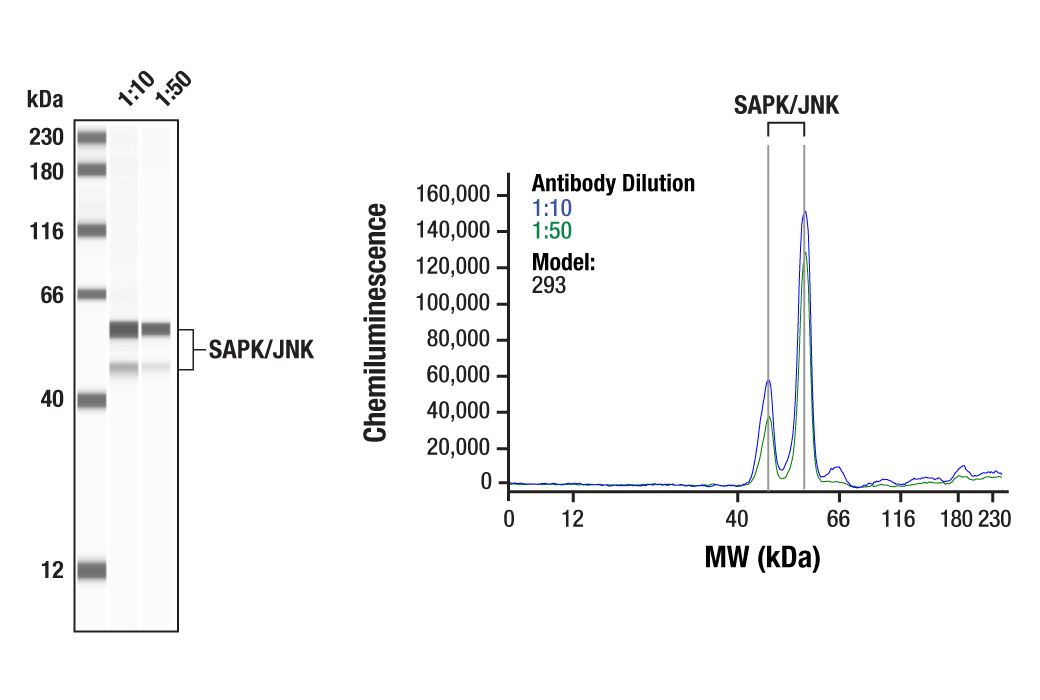


1/2
SAPK/JNK Antibody


品牌: CST
 用小程序,查商品更便捷



 收藏
收藏
 对比
对比 咨询
咨询分子量:
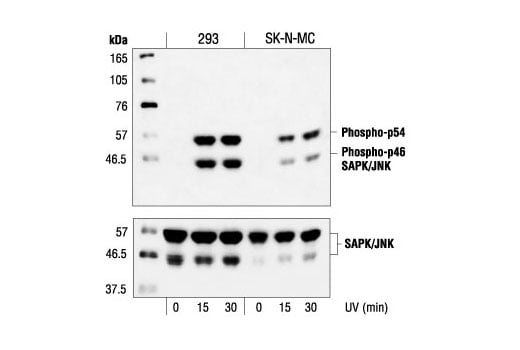
46, 54
反应种属:
Human,Mouse,Rat,Hamster,Monkey,Zebrafish,Bovine,S.cerevisiae,
产品介绍
产品介绍
产品信息
荧光素标记
Unconjugated

抗原名称
SAPKJNK
来源纯化
Polyclonal antibodies are produced by immunizing animals with a recombinant human JNK2 fusion protein. Antibodies are purified by protein A and peptide affinity chromatography.
宿主
Rabbit
商品描述
Product Usage Information
| Application | Dilution |
|---|---|
| Western Blotting | 1:1000 |
| Simple Western™ | 1:10 - 1:50 |
分子量
46, 54
研究领域
癌症,细胞生物学,神经科学
应用
反应种属
Human,Mouse,Rat,Hamster,Monkey,Zebrafish,Bovine,S.cerevisiae,
目标/特异性
Specificity/Sensitivity
SAPK/JNK Antibody detects endogenous levels of total JNK1, JNK2 or JNK3 protein.
Species Reactivity:
Human, Mouse, Rat, Hamster, Monkey, Zebrafish, Bovine, S. cerevisiae
敏感性
Endogenous
背景
背景
The stress-activated protein kinase/Jun-amino-terminal kinase SAPK/JNK is potently and preferentially activated by a variety of environmental stresses, including UV and gamma radiation, ceramides, inflammatory cytokines, and in some instances, growth factors and GPCR agonists (1-6). As with the other MAPKs, the core signaling unit is composed of a MAPKKK, typically MEKK1-MEKK4, or by one of the mixed lineage kinases (MLKs), which phosphorylate and activate MKK4/7. Upon activation, MKKs phosphorylate and activate the SAPK/JNK kinase (2). Stress signals are delivered to this cascade by small GTPases of the Rho family (Rac, Rho, cdc42) (3). Both Rac1 and cdc42 mediate the stimulation of MEKKs and MLKs (3). Alternatively, MKK4/7 can be activated in a GTPase-independent mechanism via stimulation of a germinal center kinase (GCK) family member (4). There are three SAPK/JNK genes each of which undergoes alternative splicing, resulting in numerous isoforms (3). SAPK/JNK, when active as a dimer, can translocate to the nucleus and regulate transcription through its effects on c-Jun, ATF-2, and other transcription factors (3,5).
1.Davis, R.J. (1999) Biochem Soc Symp 64, 1-12.
2.Ichijo, H. (1999) Oncogene 18, 6087-93.
3.Kyriakis, J.M. and Avruch, J. (2001) Physiol Rev 81, 807-69.
4.Kyriakis, J.M. (1999) J Biol Chem 274, 5259-62.
5.Leppä, S. and Bohmann, D. (1999) Oncogene 18, 6158-62.
6.Whitmarsh, A.J. and Davis, R.J. (1998) Trends Biochem Sci 23, 481-5.
研究领域
癌症,细胞生物学,神经科学
翻译后修饰
unmodified
制备和贮存
保存方式
Supplied in 10 mM sodium HEPES (pH 7.5), 150 mM NaCl, 100 µg/ml BSA and 50% glycerol. Store at –20°C. Do not aliquot the antibody.
数据库链接
Entrez-Gene ID
5599
UniProt ID
P45983
声明 :本官网所有报价均为常温或者蓝冰运输价格,如有产品需要干冰运输,需另外加收干冰运输费。