




 全部商品分类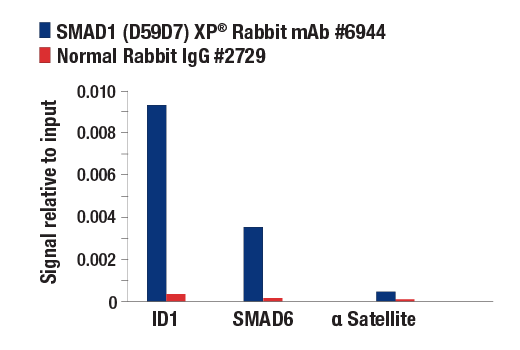


1/2


 用小程序,查商品更便捷





产品介绍
产品介绍
产品信息
荧光素标记
Unconjugated

抗原名称
Smad1
来源纯化
Monoclonal antibody is produced by immunizing animals with a synthetic peptide corresponding to residues surrounding Ser190 of human SMAD1 protein.
宿主
Rabbit
商品描述
Product Usage Information
For optimal ChIP results, use 5 μl of antibody and 10 μg of chromatin (approximately 4 x 10⁶ cells) per IP. This antibody has been validated using SimpleChIP® Enzymatic Chromatin IP Kits.
| Application | Dilution |
|---|---|
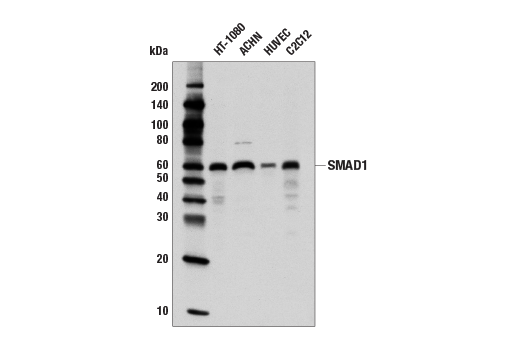
| Western Blotting | 1:1000 |
| Immunoprecipitation | 1:100 |
| Chromatin IP | 1:100 |
同种型
Rabbit IgG
分子量
60
内毒素水平
非洲爪蟾蜍, 牛
研究领域
癌症,发育生物学与干细胞研究,纤维化,神经科学,
应用
反应种属
Human,Mouse,Monkey,
预测反应种属
Xenopus,Bovine
目标/特异性
Specificity/Sensitivity
SMAD1 (D59D7) XP Rabbit mAb recognizes endogenous levels of total SMAD1 protein.
Species Reactivity:
Human, Mouse, Monkey
敏感性
Endogenous
背景
背景
Bone morphogenetic proteins (BMPs) constitute a large family of signaling molecules that regulate a wide range of critical processes including morphogenesis, cell-fate determination, proliferation, differentiation, and apoptosis (1,2). BMP receptors are members of the TGF-β superfamily of Ser/Thr kinase receptors. Ligand binding induces multimerization, autophosphorylation, and activation of these receptors (3-5). They subsequently phosphorylate SMAD1 at Ser463 and Ser465 in the carboxy-terminal motif SSXS, as well as SMAD5 and SMAD9 (SMAD8) at their corresponding sites. These phosphorylated SMADs dimerize with the coactivating SMAD4 and translocate to the nucleus, where they regulate the transcription of target genes (5). MAP kinases and CDKs 8 and 9 are also reported to phosphorylate residues in the linker region of SMAD1, including Ser206. Phosphorylation of SMAD1 at Ser206 recruits Smurf1 to the linker region and leads to the degradation of SMAD1 (6). Phosphorylation at this site also promotes SMAD1 transcriptional activity by recruiting YAP to the linker region (7).
1.Hogan, B.L. (1996) Genes Dev 10, 1580-94.
2.Hoodless, P.A. et al. (1996) Cell 85, 489-500.
3.Klemm, J.D. et al. (1998) Annu Rev Immunol 16, 569-92.
4.Kretzschmar, M. et al. (1997) Genes Dev 11, 984-95.
5.Whitman, M. (1998) Genes Dev 12, 2445-62.
6.Sapkota, G. et al. (2007) Mol Cell 25, 441-54.
7.Alarcón, C. et al. (2009) Cell 139, 757-69.
研究领域
癌症,发育生物学与干细胞研究,纤维化,神经科学,
翻译后修饰
unmodified
制备和贮存
保存方式
Supplied in 10 mM sodium HEPES (pH 7.5), 150 mM NaCl, 100 µg/ml BSA, 50% glycerol and less than 0.02% sodium azide. Store at –20°C. Do not aliquot the antibody.
数据库链接
Entrez-Gene ID
4086
UniProt ID
Q15797
声明 :本官网所有报价均为常温或者蓝冰运输价格,如有产品需要干冰运输,需另外加收干冰运输费。