




 全部商品分类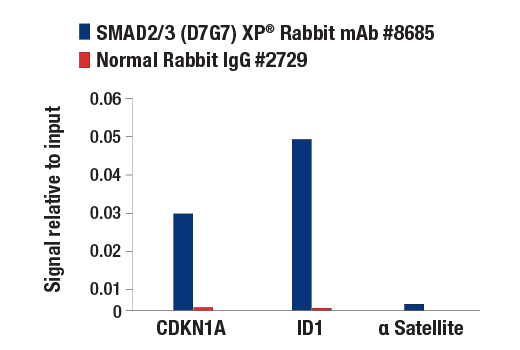


1/7


 用小程序,查商品更便捷





产品介绍
产品介绍
产品信息
荧光素标记
Unconjugated

抗原名称
Smad23
来源纯化
Monoclonal antibody is produced by immunizing animals with a synthetic peptide corresponding to residues surrounding His198 of human SMAD2/3 protein.
宿主
Rabbit
商品描述
Product Usage Information
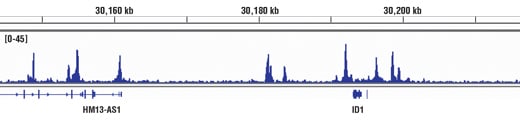
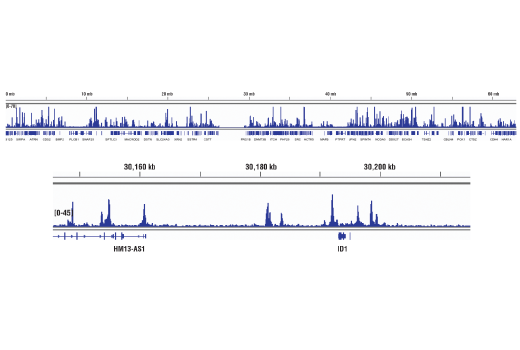
For optimal ChIP and ChIP-seq results, use 5 μl of antibody and 10 μg of chromatin (approximately 4 x 10⁶ cells) per IP. This antibody has been validated using SimpleChIP® Enzymatic Chromatin IP Kits.
| Application | Dilution |
|---|---|
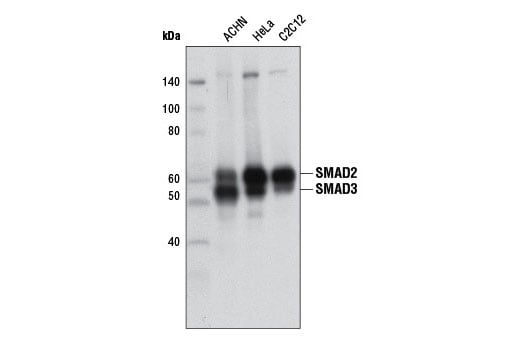
| Western Blotting | 1:1000 |
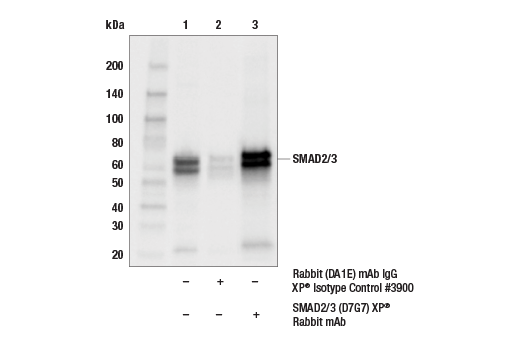
| Immunoprecipitation | 1:100 |
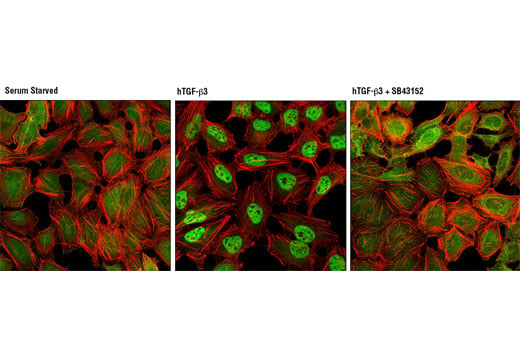
| Immunofluorescence (Immunocytochemistry) | 1:400 - 1:800 |
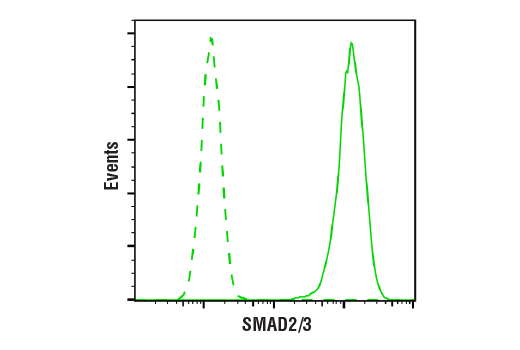
| Flow Cytometry (Fixed/Permeabilized) | 1:100 - 1:400 |
| Chromatin IP | 1:100 |
| Chromatin IP-seq | 1:100 |
同种型
Rabbit IgG
分子量
52, 60
研究领域
癌症,发育生物学与干细胞研究,纤维化,神经科学,
应用
反应种属
Human,Mouse,Rat,Monkey,
目标/特异性
Specificity/Sensitivity
SMAD2/3 (D7G7) XP Rabbit mAb recognizes endogenous levels of total SMAD2/3 protein.
Species Reactivity:
Human, Mouse, Rat, Monkey
敏感性
Endogenous
背景
背景
Members of the SMAD family of signal transduction molecules are components of a critical intracellular pathway that transmit TGF-β signals from the cell surface into the nucleus. Three distinct classes of SMADs have been defined: the receptor-regulated SMADs (R-SMADs), which include SMAD1, 2, 3, 5, and 9; the common-mediator SMAD (co-SMAD), SMAD4; and the antagonistic or inhibitory SMADs (I-SMADs), SMAD6 and 7 (1-5). Activated type I receptors associate with specific R-SMADs and phosphorylate them on a conserved carboxy-terminal SSXS motif. The phosphorylated R-SMADs dissociate from the receptor and form a heteromeric complex with SMAD4, initiating translocation of the heteromeric SMAD complex to the nucleus. Once in the nucleus, SMADs recruit a variety of DNA binding proteins that function to regulate transcriptional activity (6-8).
1.Heldin, C.H. et al. (1997) Nature 390, 465-71.
2.Attisano, L. and Wrana, J.L. (1998) Curr Opin Cell Biol 10, 188-94.
3.Derynck, R. et al. (1998) Cell 95, 737-40.
4.Massagué, J. (1998) Annu Rev Biochem 67, 753-91.
5.Whitman, M. (1998) Genes Dev 12, 2445-62.
6.Wrana, J.L. (2000) Sci STKE 2000, re1.
7.Attisano, L. and Wrana, J.L. (2002) Science 296, 1646-7.
8.Moustakas, A. et al. (2001) J Cell Sci 114, 4359-69.
研究领域
癌症,发育生物学与干细胞研究,纤维化,神经科学,
翻译后修饰
unmodified
制备和贮存
保存方式
Supplied in 10 mM sodium HEPES (pH 7.5), 150 mM NaCl, 100 µg/ml BSA, 50% glycerol and less than 0.02% sodium azide. Store at –20°C. Do not aliquot the antibody.
For a carrier free (BSA and azide free) version of this product see product #55607.
数据库链接
Entrez-Gene ID
4088,4087
UniProt ID
P84022,Q15796
声明 :本官网所有报价均为常温或者蓝冰运输价格,如有产品需要干冰运输,需另外加收干冰运输费。