




 全部商品分类


1/3


 用小程序,查商品更便捷





产品介绍
产品介绍
产品信息
荧光素标记
Unconjugated

抗原名称
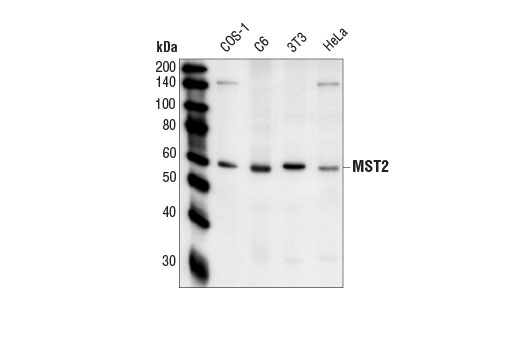
MST2
来源纯化
Polyclonal antibodies are produced by immunizing animals with a synthetic peptide corresponding to the amino-terminal residues of human MST2 protein. Antibodies are purified by protein A and peptide affinity chromatography.
宿主
Rabbit
商品描述
Product Usage Information
| Application | Dilution |
|---|---|
| Western Blotting | 1:1000 |
| Immunoprecipitation | 1:25 |
分子量
60
研究领域
癌症,发育生物学与干细胞研究,纤维化,神经科学,
应用
反应种属
Human,Mouse,Rat,Monkey,Bovine,
目标/特异性
Specificity/Sensitivity
MST2 Antibody recognizes endogenous levels of total MST2 protein. This antibody does not cross-react with MST1, MST3, or MST4 proteins.
Species Reactivity:
Human, Mouse, Rat, Monkey, Bovine
敏感性
Endogenous
背景
背景
Mammalian sterile-20-like (MST) kinases are upstream regulators of mitogen-activated protein kinase (MAPK) signaling pathways that regulate multiple cellular processes, including proliferation, apoptosis, migration, and cytoskeletal rearrangement (1). This family of serine/threonine kinases includes MST1 (STK4) and MST2 (STK3), two functionally related proteins with conserved amino-terminal kinase domains and carboxy-terminal regulatory domains that contain nuclear export signals (1-3). During apoptosis, caspase-mediated cleavage of MST1/2 removes the inhibitory regulatory domain, triggering autophosphorylation and activation of the kinase domain, which is translocated to the nucleus. Nuclear translocation of the active kinase induces chromatin condensation and other events associated with apoptotic progression (4).Research studies indicate that MST1/2 are orthologous to Drosophila Hippo (Hpo), one of the core regulatory proteins in the Hippo signaling pathway. This evolutionarily conserved program controls tissue growth and organ size by regulating cell proliferation, apoptosis, and stem cell self-renewal. The mammalian Hippo signaling pathway involves a kinase cascade, where the MST1/2 kinases and the SAV1 scaffold protein form a complex that leads to phosphorylation and activation of LATS1/2. The LATS1/2 kinases phosphorylate YAP and TAZ, promoting cytoplasmic sequestration and inhibition of these transcription coactivators (5).
1.Dan, I. et al. (2001) Trends Cell Biol 11, 220-30.
2.Creasy, C.L. et al. (1996) J Biol Chem 271, 21049-53.
3.Lee, K.K. and Yonehara, S. (2002) J Biol Chem 277, 12351-8.
4.Ura, S. et al. (2001) Proc Natl Acad Sci U S A 98, 10148-53.
5.Zhao, B. et al. (2011) Nat Cell Biol 13, 877-83.
研究领域
癌症,发育生物学与干细胞研究,纤维化,神经科学,
翻译后修饰
unmodified
制备和贮存
保存方式
Supplied in 10 mM sodium HEPES (pH 7.5), 150 mM NaCl, 100 µg/ml BSA and 50% glycerol. Store at –20°C. Do not aliquot the antibody.
数据库链接
Entrez-Gene ID
6788
UniProt ID
Q13188
声明 :本官网所有报价均为常温或者蓝冰运输价格,如有产品需要干冰运输,需另外加收干冰运输费。