




 全部商品分类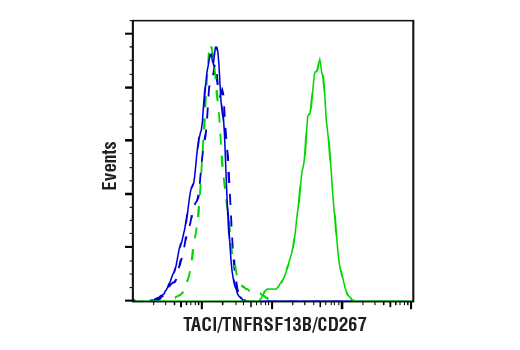


1/6


 用小程序,查商品更便捷





产品介绍
产品介绍
产品信息
荧光素标记
Unconjugated

来源纯化
Monoclonal antibody is produced by immunizing animals with recombinant protein specific to the amino terminus of human TACI/TNFRSF13B/CD267 protein.
宿主
Rabbit
商品描述
Product Usage Information
| Application | Dilution |
|---|---|
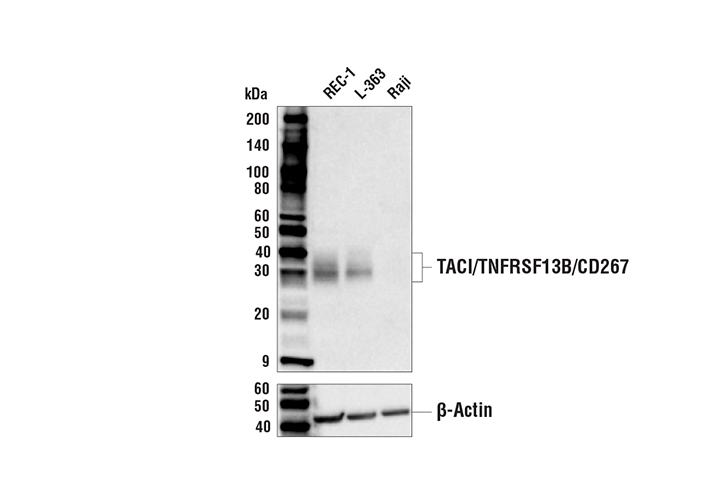
| Western Blotting | 1:1000 |
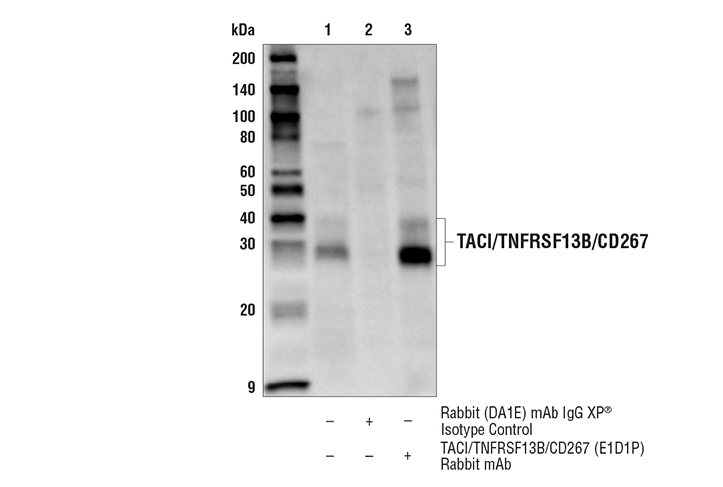
| Immunoprecipitation | 1:100 |
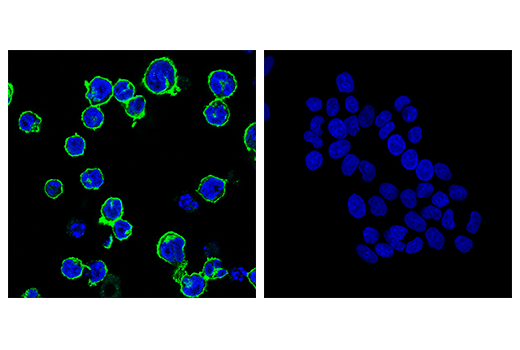
| Immunofluorescence (Immunocytochemistry) | 1:800 - 1:3200 |
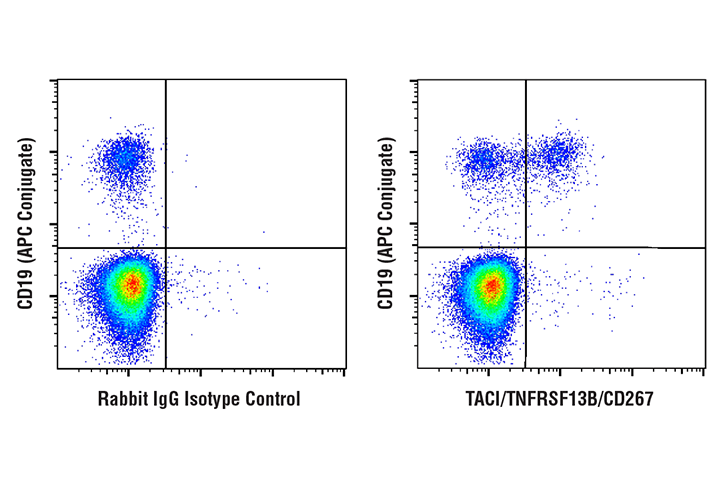
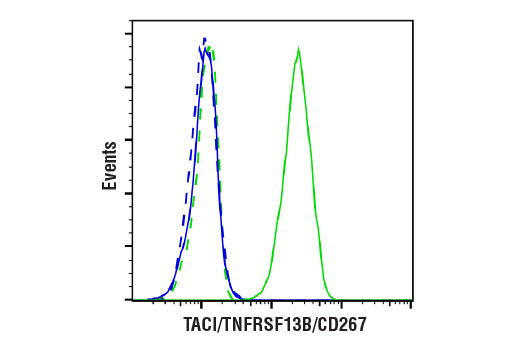
| Flow Cytometry (Fixed/Permeabilized) | 1:50 - 1:200 |
| Flow Cytometry (Live) | 1:50 - 1:200 |
同种型
Rabbit IgG
分子量
30-40
应用
目标/特异性
Specificity/Sensitivity
TACI/TNFRSF13B/CD267 (E1D1P) Rabbit mAb recognizes endogenous levels of total TACI/TNFRSF13B/CD267 protein.
Species Reactivity:
Human
敏感性
Endogenous
背景
背景
Transmembrane activator and calcium-modulating cyclophilin ligand interactor (TACI), also known as tumor necrosis factor receptor superfamily member 13B (TNFRSF13B) and cluster of differentiation 267 (CD267), is a single-pass type III membrane receptor that is highly expressed on the surface of mature innate-like B cells, such as marginal zone and B-1 B cells in mice, and memory B cells in humans (1-3). TACI/TNFRSF13B/CD267 is also expressed on the surface of activated T cells (4), while monocytes and dendritic cells express lower levels of TACI/TNFRSF13B/CD267 primarily intracellularly (5,6). TACI/TNFRSF13B/CD267 is the receptor for soluble ligands BAFF/TNFSF13B and APRIL/TNFSF13 (7,8). Upon ligation, TACI/TNFRSF13B/CD267 recruits tumor necrosis factor receptor–associated factor (TRAF) family members and calcium signal-modulating cyclophilin ligand (CAMLG) in order to activate NFAT, NF-κB, and AP-1 transcriptional programs (9-11). TACI/TNFRSF13B/CD267 is necessary for T cell-independent type II and type I responses (1,12), negative regulation of B cell and T follicular helper cell numbers (13,14), and promotion of class switch recombination in B cells (15). Mutations and aberrant regulation of TACI/TNFRSF13B/CD267 has been associated with cancer, autoimmune diseases, and immunodeficiency disorders (16-18). Multiple isoforms produced by alternative splicing have been identified.
1.von Bülow, G.U. et al. (2000) Mamm Genome 11, 628-32.
2.Mantchev, G.T. et al. (2007) J Immunol 179, 2282-8.
3.Tsuji, S. et al. (2011) Blood 118, 5832-9.
4.Wang, H. et al. (2001) Nat Immunol 2, 632-7.
5.Chang, S.K. et al. (2006) Blood 108, 2687-94.
6.Chang, S.K. et al. (2008) J Immunol 180, 7394-403.
7.Wu, Y. et al. (2000) J Biol Chem 275, 35478-85.
8.Yu, G. et al. (2000) Nat Immunol 1, 252-6.
9.Hymowitz, S.G. et al. (2005) J Biol Chem 280, 7218-27.
10.Xia, X.Z. et al. (2000) J Exp Med 192, 137-43.
11.von Bülow, G.U. and Bram, R.J. (1997) Science 278, 138-41.
12.Ozcan, E. et al. (2009) J Allergy Clin Immunol 123, 1277-86.e5.
13.Seshasayee, D. et al. (2003) Immunity 18, 279-88.
14.Ou, X. et al. (2012) Proc Natl Acad Sci U S A 109, 15401-6.
15.He, B. et al. (2010) Nat Immunol 11, 836-45.
16.Castigli, E. et al. (2005) Nat Genet 37, 829-34.
17.Moura, R.A. et al. (2013) J Rheumatol 40, 1293-302.
18.Abo-Elfadl, M.T. et al. (2020) Cytokine 125, 154790.
研究领域
纤维化,免疫学和肿瘤学,神经科学
翻译后修饰
unmodified
制备和贮存
保存方式
Supplied in 10 mM sodium HEPES (pH 7.5), 150 mM NaCl, 100 µg/ml BSA, 50% glycerol and less than 0.02% sodium azide. Store at –20°C. Do not aliquot the antibody.
数据库链接
Entrez-Gene ID
23495
UniProt ID
O14836
声明 :本官网所有报价均为常温或者蓝冰运输价格,如有产品需要干冰运输,需另外加收干冰运输费。