




 全部商品分类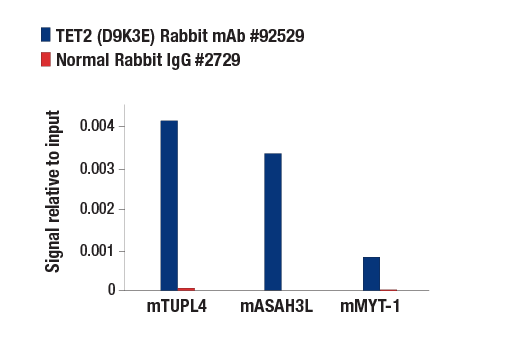


1/4


 用小程序,查商品更便捷





产品介绍
产品介绍
产品信息
荧光素标记
Unconjugated

来源纯化
Monoclonal antibody is produced by immunizing animals with recombinant protein surrounding Ala1580 of mouse TET2 protein.
宿主
Rabbit
商品描述
Product Usage Information
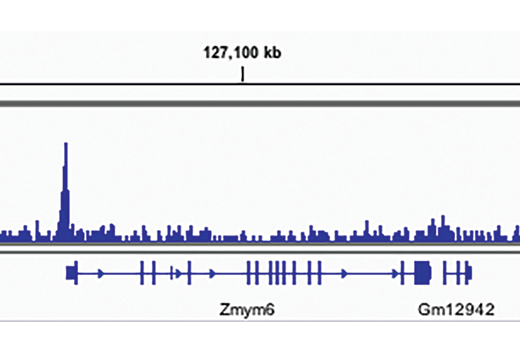
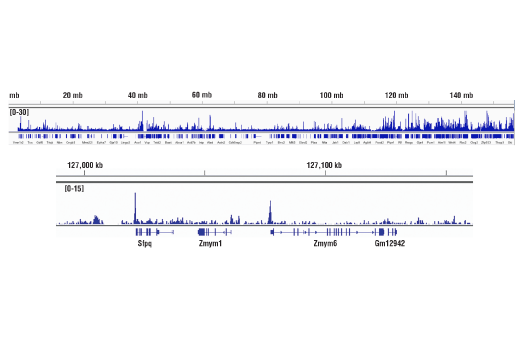
For optimal ChIP and ChIP-seq results, use 10 μl of antibody and 10 μg of chromatin (approximately 4 x 10⁶ cells) per IP. This antibody has been validated using SimpleChIP® Enzymatic Chromatin IP Kits.
| Application | Dilution |
|---|---|
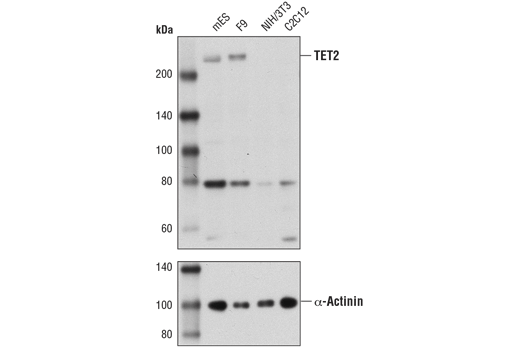
| Western Blotting | 1:1000 |
| Chromatin IP | 1:50 |
| Chromatin IP-seq | 1:50 |
同种型
Rabbit IgG
分子量
280
应用
目标/特异性
Specificity/Sensitivity
TET2 (D9K3E) Rabbit mAb recognizes endogenous levels of total mouse TET2 protein.
Species Reactivity:
Mouse
敏感性
Endogenous
背景
背景
Methylation of DNA at cytosine residues is a heritable, epigenetic modification that is critical for proper regulation of gene expression, genomic imprinting, and mammalian development (1,2). 5-methylcytosine is a repressive epigenetic mark established de novo by two enzymes, DNMT3a and DNMT3b, and is maintained by DNMT1 (3, 4). 5-methylcytosine was originally thought to be passively depleted during DNA replication. However, subsequent studies have shown that Ten-Eleven Translocation (TET) proteins TET1, TET2, and TET3 can catalyze the oxidation of methylated cytosine to 5-hydroxymethylcytosine (5-hmC) (5). Additionally, TET proteins can further oxidize 5-hmC to form 5-formylcytosine (5-fC) and 5-carboxylcytosine (5-caC), both of which are excised by thymine-DNA glycosylase (TDG), effectively linking cytosine oxidation to the base excision repair pathway and supporting active cytosine demethylation (6,7). TET2 is the most frequently mutated gene in myeloid dysplastic syndrome (MDS), a dysplasia of myeloid, megakaryocytic, and/or erythroid cell lineages, of which 30% progress to acute myeloid leukemia (AML) (8, 9). It is also mutated in diffuse large B-cell lymphoma (10). TET2 protein expression is often reduced in solid tumors such as prostate cancer, melanoma, and oral squamous cell carcinoma (11-13).
1.Hermann, A. et al. (2004) Cell Mol Life Sci 61, 2571-87.
2.Turek-Plewa, J. and Jagodziński, P.P. (2005) Cell Mol Biol Lett 10, 631-47.
3.Okano, M. et al. (1999) Cell 99, 247-57.
4.Li, E. et al. (1992) Cell 69, 915-26.
5.Tahiliani, M. et al. (2009) Science 324, 930-5.
6.He, Y.F. et al. (2011) Science 333, 1303-7.
7.Ito, S. et al. (2011) Science 333, 1300-3.
8.Langemeijer, S.M. et al. (2009) Nat Genet 41, 838-42.
9.Yamazaki, J. et al. (2012) Epigenetics 7, 201-7.
10.Asmar, F. et al. (2013) Haematologica 98, 1912-20.
11.Nickerson, M.L. et al. (2013) Hum Mutat 34, 1231-41.
12.Lian, C.G. et al. (2012) Cell 150, 1135-46.
13.Jäwert, F. et al. (2013) Anticancer Res 33, 4325-8.
研究领域
癌症,发育生物学与干细胞研究,表观遗传学,神经科学,
翻译后修饰
unmodified
制备和贮存
保存方式
Supplied in 10 mM sodium HEPES (pH 7.5), 150 mM NaCl, 100 µg/ml BSA, 50% glycerol and less than 0.02% sodium azide. Store at –20°C. Do not aliquot the antibody.
数据库链接
Entrez-Gene ID
214133
UniProt ID
Q4JK59
声明 :本官网所有报价均为常温或者蓝冰运输价格,如有产品需要干冰运输,需另外加收干冰运输费。