Summary
Precision
Recovery
Linearity
Data Examples
Product Datasheets
Preparation and Storage
Background
Related Research Areas
Human TNF-alpha Quantikine ELISA Kit Summary
Sample Type & Volume Required Per Well
Cell Culture Supernates (50 uL), Serum (50 uL), EDTA Plasma (50 uL), Heparin Plasma (50 uL)
Assay Range
15.6 - 1,000 pg/mL (Cell Culture Supernates, Serum, EDTA Plasma, Heparin Plasma)
Specificity
Natural and recombinant human TNF-alpha.
Cross-reactivity
< 0.5% cross-reactivity observed with available related molecules.< 50% cross-species reactivity observed with species tested.
Interference
No significant interference observed with available related molecules.
Product Summary
The Quantikine Human TNF-alpha Immunoassay is a 4.5 hour solid phase ELISA designed to measure human TNF-alpha in cell culture supernates, serum, and plasma. It contains E. coli-derived recombinant human TNF-alpha and antibodies raised against this protein. It has been shown to accurately quantitate the recombinant factor. Results obtained with naturally occurring TNF-alpha samples showed linear curves that were parallel to the standard curves obtained using the Quantikine kit standards. These results indicate that this kit can be used to determine relative mass values for natural human TNF-alpha.
Precision
Intra-Assay Precision (Precision within an assay) Three samples of known concentration were tested twenty times on one plate to assess intra-assay precision
Inter-Assay Precision (Precision between assays) Three samples of known concentration were tested in twenty separate assays to assess inter-assay precision. Assays were performed by at least three technicians using two lots of components
Cell Culture Supernates, Serum, EDTA Plasma, Heparin Plasma
|
Intra-Assay Precision |
Inter-Assay Precision |
| Sample |
1 |
2 |
3 |
1 |
2 |
3 |
| n |
20 |
20 |
20 |
20 |
20 |
20 |
| Mean (pg/mL) |
155 |
304 |
606 |
155 |
298 |
592 |
| Standard Deviation |
4.08 |
6.62 |
18.3 |
11.3 |
21.8 |
49.9 |
| CV% |
2.6 |
2.2 |
3 |
7.3 |
7.3 |
8.4 |
Recovery
The recovery of human TNF-alpha spiked to three different levels in samples throughout the range of the assay in various matrices was evaluated.
| Sample Type |
Average % Recovery |
Range % |
| Cell Culture Media (n=4) |
103 |
98-110 |
| EDTA Plasma (n=4) |
90 |
75-101 |
| Heparin Plasma (n=4) |
90 |
82-95 |
| Serum (n=4) |
88 |
79-98 |
Linearity
To assess linearity of the assay, samples containing and/or spiked with high concentrations of human TNF-alpha in various matrices were diluted with the calibrator diluent to produce samples with values within the dynamic range of the assay.
Scientific Data
N/A
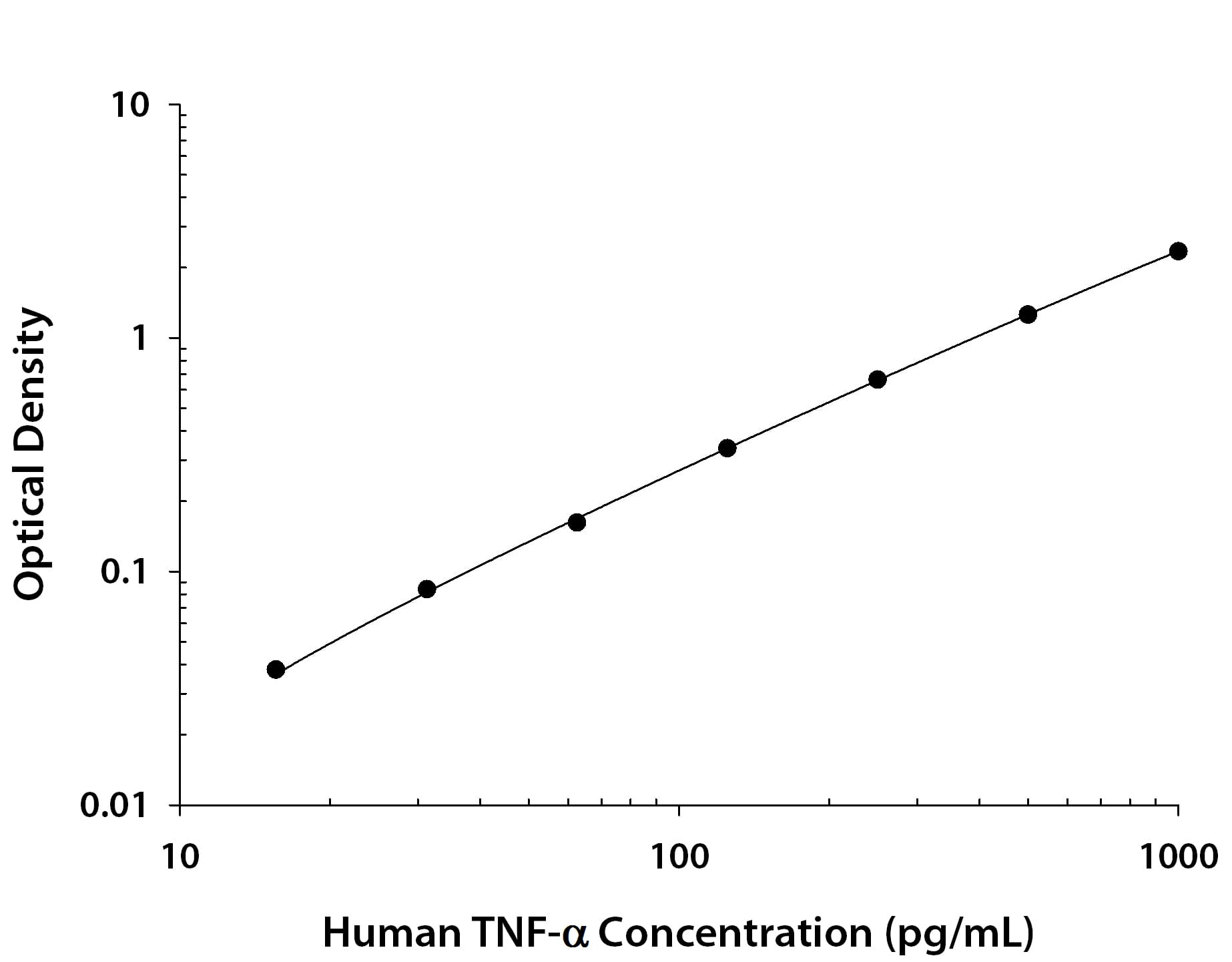 View Larger
Human TNF-alpha ELISA Standard Curve
Product Datasheets
You must select a language.
x
Product Datasheet
SDS
Preparation and Storage
Shipping
The product is shipped at ambient temperature. Upon receipt, store it immediately at the temperature recommended below.
Storage
Store the unopened product at 2 - 8 °C. Do not use past expiration date.
Background: IL-19
Tumor Necrosis Factor alpha (TNF-alpha ), also known as cachectin
and TNFSF1A, is the prototypic ligand of the TNF superfamily (1). It is a
pleiotropic molecule that plays a central role in inflammation, immune system
development, apoptosis, and lipid metabolism (2-5). TNF-alpha is also involved in a
number of pathological conditions including asthma, Crohn's disease, rheumatoid
arthritis, neuropathic pain, obesity, type 2 diabetes, septic shock,
autoimmunity, and cancer (5-11).
Human TNF-alpha is synthesized as a 26 kDa type II transmembrane
protein that consists of a 35 amino acid (aa) cytoplasmic domain, a 21 aa transmembrane
segment, and a 177 aa extracellular domain (ECD) (12, 13). Within the ECD,
human TNF-alpha shares 97% aa sequence identity with rhesus monkey, and 71%-92% aa
identity with bovine, canine, cotton rat, equine, feline, mouse, porcine, and
rat TNF-alpha. It is produced by a wide variety of immune, epithelial, endothelial,
and tumor cells. TNF-alpha is assembled intracellularly to form a noncovalently
linked homotrimer which is expressed on the cell surface (14). Cell surface
TNF-alpha can both induce the lysis of tumor cells and virus infected cells, and
generate its own downstream cell signaling following ligation by soluble TNF RI
(15, 16). Shedding of membrane bound TNF-alpha by TACE/ ADAM17 releases the
bioactive cytokine, a 55 kDa soluble trimer of the TNF-alpha extracellular domain
(17-19).
TNF-alpha binds the ubiquitous 55-60 kDa TNF RI (20, 21) and the
hematopoietic cell-restricted 78-80 kDa TNF RII (22, 23), both of which are
also expressed as homotrimers (1, 24). Both type I and type II receptors bind
TNF-alpha with comparable affinity and can promote NF kappa B activation (25-28). Only
TNF RI, however, contains a cytoplasmic death domain which triggers the
activation of apoptosis (3, 29). Soluble forms of both types of receptors are
released into human serum and urine and can neutralize the biological activity
of TNF-alpha (30-32).
Long Name:
Interleukin 19
Entrez Gene IDs:
29949 (Human); 329244 (Mouse)
Alternate Names:
IL-10C; IL19; IL-19; interleukin 19; MDA1; melanoma differentiation associated protein-like protein; NG.1Melanoma differentiation-associated protein-like protein; ZMDA1interleukin-19
⚠ WARNING: This product can expose you to chemicals including N,N-Dimethylforamide, which is known to the State of California to cause cancer. For more information, go to www.P65Warnings.ca.gov.





 全部商品分类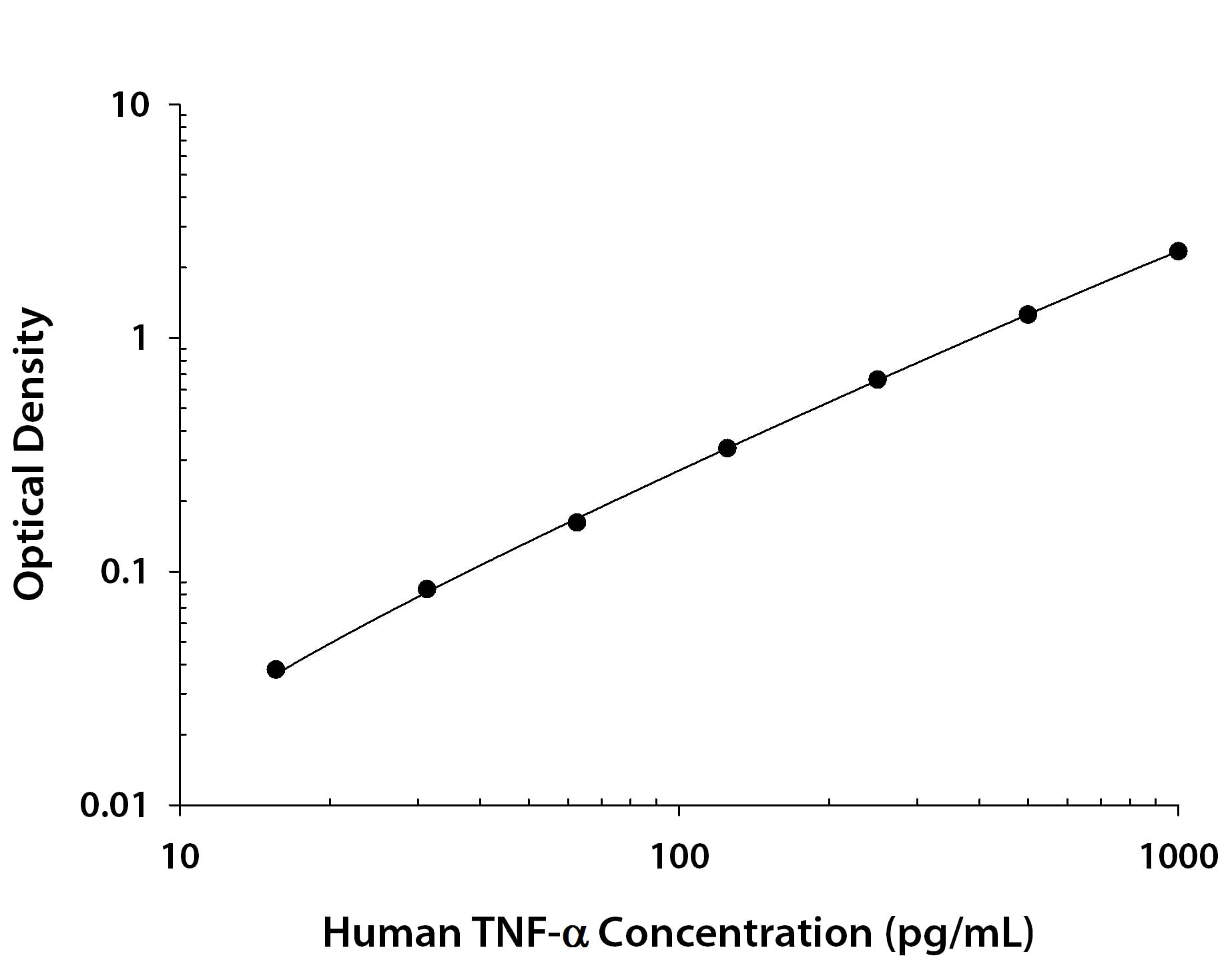


 用小程序,查商品更便捷



 收藏
收藏
 对比
对比 咨询
咨询
