


老带新
Mouse TNF-alpha Quantikine SixPak (6 Plates) (1 PACK)
1/5

Mouse TNF-alpha Quantikine SixPak (6 Plates) (1 PACK)

分享
品牌: R&D Systems
用小程序,查商品更便捷
收藏
对比对比
咨询咨询
产品介绍
产品介绍
产品信息
产品详情

Product Summary

The Quantikine Mouse TNF-alpha Immunoassay is a 4.5 hour solid phase ELISA designed to measure mouse TNF-alpha levels in cell culture supernates, serum, and plasma. It contains E. coli-expressed recombinant mouse TNF-alpha and antibodies raised against the recombinant factor. This immunoassay has been shown to quantitate the recombinant mouse TNF-alpha accurately. Results obtained using natural mouse TNF-alpha showed dose-response curves that were parallel to the standard curves obtained using the recombinant kit standards. These results indicate that this kit can be used to determine relative mass values for natural mouse TNF-alpha.
Summary Precision Recovery Linearity Data Examples Product Datasheets Preparation and Storage Background Related Research Areas

Mouse TNF-alpha Quantikine ELISA Kit Summary

Assay Length
4.5 hours
Sample Type & Volume Required Per Well
Cell Culture Supernates (50 uL), Serum (50 uL), EDTA Plasma (50 uL), Heparin Plasma (50 uL)
Sensitivity
7.21 pg/mL
Assay Range
10.9 - 700 pg/mL (Cell Culture Supernates, Serum, EDTA Plasma, Heparin Plasma)
Specificity
Natural and recombinant mouse TNF-alpha.
Cross-reactivity
< 0.5% cross-reactivity observed with available related molecules.< 50% cross-species reactivity observed with species tested.
Interference
Interference observed with 1 or more available related molecules.

Product Summary

The Quantikine Mouse TNF-alpha Immunoassay is a 4.5 hour solid phase ELISA designed to measure mouse TNF-alpha levels in cell culture supernates, serum, and plasma. It contains E. coli-expressed recombinant mouse TNF-alpha and antibodies raised against the recombinant factor. This immunoassay has been shown to quantitate the recombinant mouse TNF-alpha accurately. Results obtained using natural mouse TNF-alpha showed dose-response curves that were parallel to the standard curves obtained using the recombinant kit standards. These results indicate that this kit can be used to determine relative mass values for natural mouse TNF-alpha.

Precision

Intra-Assay Precision (Precision within an assay)
Inter-Assay Precision (Precision between assays)

Cell Culture Supernates

Intra-Assay Precision Inter-Assay Precision
Sample 1 2 3 1 2 3
n 20 20 20 20 20 20
Mean (pg/mL) 54.6 116 405 52.6 138 373
Standard Deviation 1.5 4.51 12.5 4.61 8.49 29.7
CV% 2.7 3.9 3.1 8.8 6.2 8

Serum, EDTA Plasma, Heparin Plasma

Intra-Assay Precision Inter-Assay Precision
Sample 1 2 3 1 2 3
n 20 20 20 20 20 20
Mean (pg/mL) 50.5 134 375 53 146 388
Standard Deviation 1.91 4.95 11.5 3.69 8.42 29.7
CV% 3.8 3.7 3.1 7 5.8 7.7

Recovery

The recovery of mouse TNF-alpha spiked to three levels throughout the range of the assay in various matrices was evaluated.

Sample Type Average % Recovery Range %
Cell Culture Supernates (n=6) 104 94-111
EDTA Plasma (n=4) 95 85-103
Heparin Plasma (n=4) 92 86-98
Serum (n=4) 94 88-106

Linearity

To assess the linearity of the assay, samples were spiked with various concentrations of mouse TNF-alpha in each matrix, diluted with the appropriate Calibrator Diluent and then assayed.
Mouse TNF-alpha  ELISA Linearity

Scientific Data

N/A Mouse TNF-alpha  ELISA Cell Culture Supernate Standard Curve View Larger

Mouse TNF-alpha ELISA Cell Culture Supernate Standard Curve

N/A Mouse TNF-alpha  ELISA Serum/Plasma Standard Curve View Larger

Mouse TNF-alpha ELISA Serum/Plasma Standard Curve

N/A Mouse TNF-alpha ELISA Kit - Quantikine View Larger

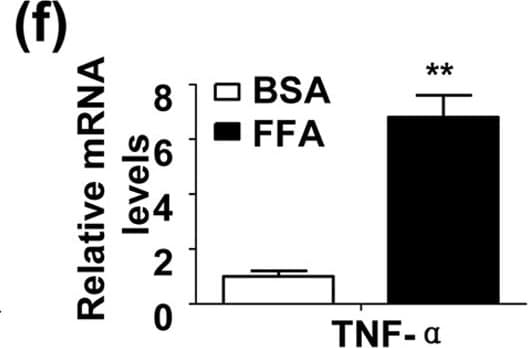
Mouse TNF-alpha ELISA Kit - Quantikine HFD-induced plasma saturated free fatty acid (FFA) and lactate trigger production of proinflammatory cytokines and VEGF in mouse chondrocytes.(a~d) Relative mRNA levels of IL-6 (a), TNF-alpha (b), IL-1 beta (c) and VEGF (d) in the mouse primary chondrocytes treated with full or fractionated (>3 KD or <3 KD) serum from the 8-week ND or HFD-feeding mice. (n = 3, *P < 0.05, **P < 0.01 and ***P < 0.005). (e~h) Relative mRNA levels of IL-6 (e), TNF-alpha (f), IL-1 beta (g) and VEGF (h) in the mouse primary chondrocytes treated with BSA (5%) or BSA-linked FFA (18:0, 200 μM) for 24 h. (n = 3, *P < 0.05 and **P < 0.01). (i~l) Relative mRNA expression of IL-6 (i), TNF-alpha (j), IL-1 beta (k) and VEGF (l) in the mouse primary chondrocytes treated with lactate (25 mM) or vehicle control for 24 h. (n = 3, *P < 0.05 and **P < 0.01). Image collected and cropped by CiteAb from the following open publication (https://pubmed.ncbi.nlm.nih.gov/26271607), licensed under a CC-BY license. Not internally tested by R&D Systems.

ELISA Detection of Mouse Mouse TNF-alpha Quantikine ELISA Kit by ELISA View Larger

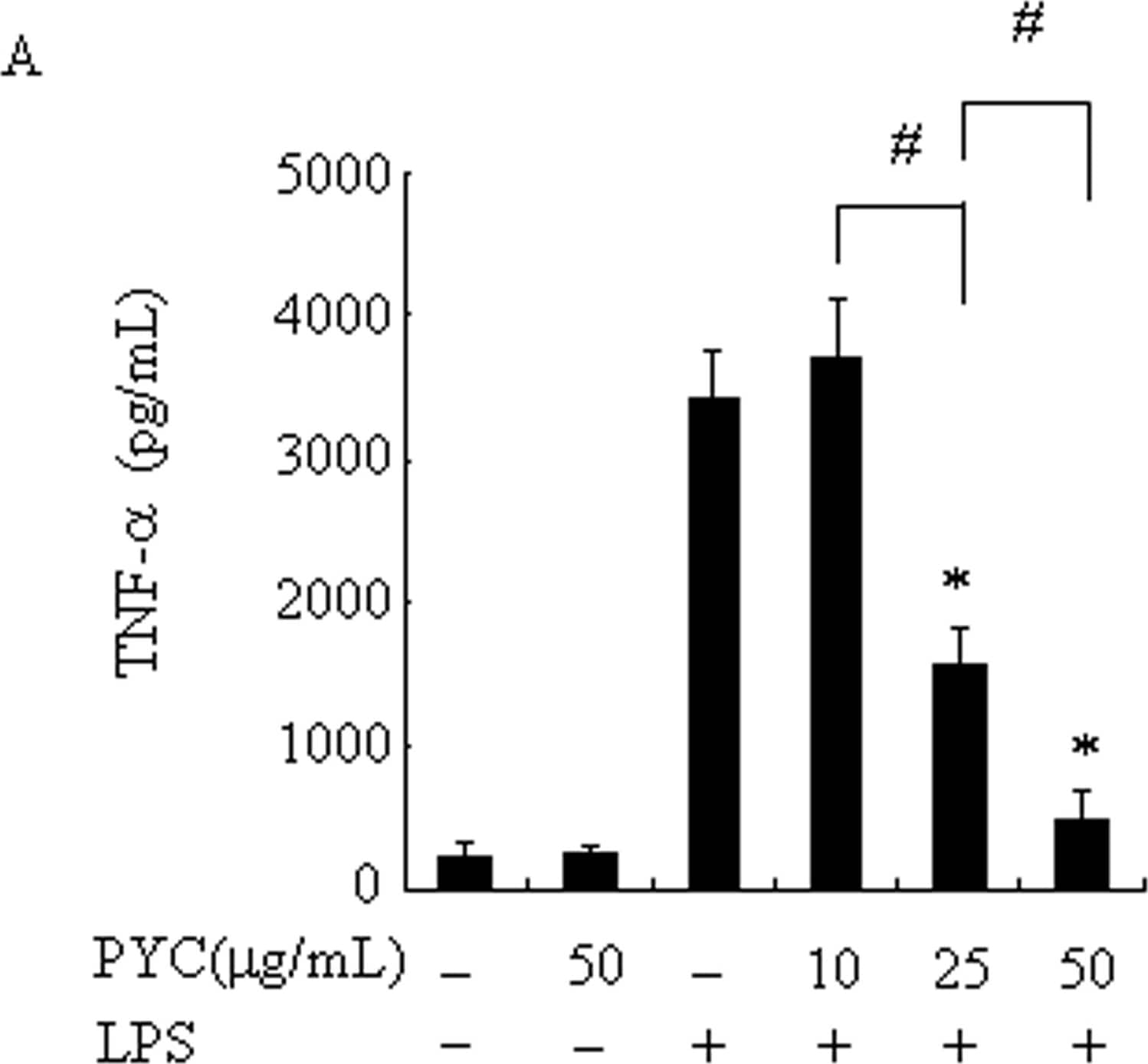
Detection of Mouse Mouse TNF-alpha Quantikine ELISA Kit by ELISA PYC suppressed LPS-induced proinflammatory cytokine production in BV2 microglia.Cells were incubated with the indicated concentrations of PYC or vehicle for 1h before LPS treatment (500ng/mL). After 24 h incubation, the culture supernatants were collected, and the amount of TNF-alpha, IL-6, IL-1 beta and IL-10 were measured by ELISA (A-D). Data are represented as mean ± SD from at least 3 independent experiments. *P< 0.05 compared with LPS alone. #P< 0.05. Image collected and cropped by CiteAb from the following publication (https://pubmed.ncbi.nlm.nih.gov/26367267), licensed under a CC-BY license. Not internally tested by R&D Systems.

Product Datasheets

You must select a language.

x
Product Datasheet
COA

Preparation and Storage

Shipping
The product is shipped at ambient temperature. Upon receipt, store it immediately at the temperature recommended below.
Storage
Store the unopened product at 2 - 8 °C. Do not use past expiration date.

Background: TNF-alpha

Tumor necrosis factor alpha (TNF-alpha ), also known as cachectin and TNFSF1A, is the prototypic ligand of the TNF superfamily (1). It is a pleiotropic molecule that plays a central role in inflammation, immune system development, apoptosis, and lipid metabolism (2-5). TNF-alpha is also involved in a number of pathological conditions including asthma, Crohn's disease, rheumatoid arthritis, neuropathic pain, obesity, type 2 diabetes, septic shock, autoimmunity, and cancer (5-11).   

Mouse TNF-alpha is synthesized as a 26 kDa type II transmembrane protein that consists of a 35 amino acid (aa) cytoplasmic domain, a 21 aa transmembrane segment, and a 179 aa extracellular domain (ECD) (12). Within the ECD, mouse TNF-alpha shares 95% aa identity with rat, and 80% aa identity with canine, equine, feline, human, rabbit, and porcine TNF-alpha. It is produced by a wide variety of immune, epithelial, endothelial, and tumor cells. TNF-alpha is assembled intracellularly to form a noncovalently linked homotrimer which is expressed on the cell surface (13). Cell surface TNF-alpha can both induce the lysis of tumor cells and virus infected cells, and generate its own downstream cell signaling following ligation by soluble TNF RI (14, 15). Shedding of membrane bound TNF-alpha by TACE/ADAM17 releases the bioactive cytokine, a 55 kDa soluble trimer containing the TNF-alpha extracellular domain (16-18).    
TNF-alpha binds the ubiquitous 55-60 kDa TNF RI (19, 20) and the hematopoietic cell-restricted 78-80 kDa TNF RII (21, 22), both of which are also expressed as homotrimers (1, 23). Both type I and type II receptors bind TNF-alpha with comparable affinity and can promote NFkB activation (24-27). Only TNF RI, however, contains a cytoplasmic death domain which triggers the activation of apoptosis (3, 28). Soluble forms of both types of receptors are released into human serum and urine, and can neutralize the biological activity of TNF (29-31).
Long Name:
Tumor Necrosis Factor alpha
Entrez Gene IDs:
7124 (Human); 21926 (Mouse); 24835 (Rat); 397086 (Porcine); 280943 (Bovine); 403922 (Canine); 102139631 (Cynomolgus Monkey); 100033834 (Equine); 493755 (Feline); 100009088 (Rabbit)
Alternate Names:
APC1 protein; Cachectin; Cachetin; DIF; TNF; TNF, monocyte-derived; TNFA; TNF-A; TNFalpha; TNF-alpha; TNF-alphacachectin; TNFATNF, macrophage-derived; TNFG1F; TNFSF1A; TNFSF2; TNFSF2TNF superfamily, member 2; tumor necrosis factor (TNF superfamily, member 2); tumor necrosis factor alpha; Tumor necrosis factor ligand superfamily member 2; tumor necrosis factor; tumor necrosis factor-alpha
&#9888; WARNING: This product can expose you to chemicals including N,N-Dimethylforamide, which is known to the State of California to cause cancer. For more information, go to www.P65Warnings.ca.gov.
背景
别名
APC1 protein,Cachectin,Cachetin,DIF,TNF,TNF, monocyte-derived,TNFA,TNF-A,TNFalpha,TNF-alpha,TNF-alphacachectin,TNFATNF, macrophage-derived,TNFG1F,TNFSF1A,TNFSF2,TNFSF2TNF superfamily, member 2,tumor necrosis factor (TNF superfamily, member 2),tumor necrosis factor alpha,Tumor necrosis factor ligand superfamily member 2,tumor necrosis factor,tumor necrosis factor-alpha,Tumor Necrosis Factor alpha
背景

Background: TNF-alpha

Tumor necrosis factor alpha (TNF-alpha ), also known as cachectin and TNFSF1A, is the prototypic ligand of the TNF superfamily (1). It is a pleiotropic molecule that plays a central role in inflammation, immune system development, apoptosis, and lipid metabolism (2-5). TNF-alpha is also involved in a number of pathological conditions including asthma, Crohn's disease, rheumatoid arthritis, neuropathic pain, obesity, type 2 diabetes, septic shock, autoimmunity, and cancer (5-11).   

Mouse TNF-alpha is synthesized as a 26 kDa type II transmembrane protein that consists of a 35 amino acid (aa) cytoplasmic domain, a 21 aa transmembrane segment, and a 179 aa extracellular domain (ECD) (12). Within the ECD, mouse TNF-alpha shares 95% aa identity with rat, and 80% aa identity with canine, equine, feline, human, rabbit, and porcine TNF-alpha. It is produced by a wide variety of immune, epithelial, endothelial, and tumor cells. TNF-alpha is assembled intracellularly to form a noncovalently linked homotrimer which is expressed on the cell surface (13). Cell surface TNF-alpha can both induce the lysis of tumor cells and virus infected cells, and generate its own downstream cell signaling following ligation by soluble TNF RI (14, 15). Shedding of membrane bound TNF-alpha by TACE/ADAM17 releases the bioactive cytokine, a 55 kDa soluble trimer containing the TNF-alpha extracellular domain (16-18).    
TNF-alpha binds the ubiquitous 55-60 kDa TNF RI (19, 20) and the hematopoietic cell-restricted 78-80 kDa TNF RII (21, 22), both of which are also expressed as homotrimers (1, 23). Both type I and type II receptors bind TNF-alpha with comparable affinity and can promote NFkB activation (24-27). Only TNF RI, however, contains a cytoplasmic death domain which triggers the activation of apoptosis (3, 28). Soluble forms of both types of receptors are released into human serum and urine, and can neutralize the biological activity of TNF (29-31).
Long Name:
Tumor Necrosis Factor alpha
Entrez Gene IDs:
7124 (Human); 21926 (Mouse); 24835 (Rat); 397086 (Porcine); 280943 (Bovine); 403922 (Canine); 102139631 (Cynomolgus Monkey); 100033834 (Equine); 493755 (Feline); 100009088 (Rabbit)
Alternate Names:
APC1 protein; Cachectin; Cachetin; DIF; TNF; TNF, monocyte-derived; TNFA; TNF-A; TNFalpha; TNF-alpha; TNF-alphacachectin; TNFATNF, macrophage-derived; TNFG1F; TNFSF1A; TNFSF2; TNFSF2TNF superfamily, member 2; tumor necrosis factor (TNF superfamily, member 2); tumor necrosis factor alpha; Tumor necrosis factor ligand superfamily member 2; tumor necrosis factor; tumor necrosis factor-alpha
研究领域
制备和贮存
保存方式

Preparation and Storage

Shipping
The product is shipped at ambient temperature. Upon receipt, store it immediately at the temperature recommended below.
Storage
Store the unopened product at 2 - 8 °C. Do not use past expiration date.
声明 :本官网所有报价均为常温或者蓝冰运输价格,如有产品需要干冰运输,需另外加收干冰运输费。
货号:
SMTA00B
一键复制
询价
1 PACK
1 PACK
1 Kit
选择数量
当前规格1件起购 
配送至
预计2-3周送达,快递: 免运费,若需干冰额外收费