




 全部商品分类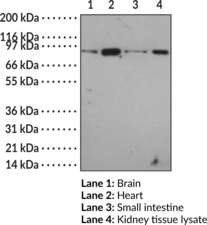


Toll-Like Receptor 12 Polyclonal Antibody


品牌: Cayman
 用小程序,查商品更便捷



 收藏
收藏
 对比
对比 咨询
咨询反应种属:
(+) Mouse TLR12
(+) Rat TLR12
来源宿主:
Rabbit
产品介绍
产品介绍
产品信息
宿主
Rabbit

免疫原
mouse TLR12 amino acids 911-926
简单描述
The toll-like receptors (TLRs) in mammals comprise a family of transmembrane proteins characterized by multiple copies of leucine rich repeats in the extracellular domain and an interleukin-1 (IL-1) receptor motif in the cytoplasmic domain. Like its counterparts in Drosophila, TLRs signal through adaptor molecules.1 The TLR family is a phylogenetically conserved mediator of innate immunity that is essential for microbial recognition.2 Most mammalian species have between ten and fifteen types of TLRs. Ten functional TLRs (TLR1-1) have been identified in human. Humans also encode a TLR11 gene but it contains several stop codons and protein is not expressed. However, mouse and rat TLR11 are functional, and it is thought that human TLR11 function was lost during evolution. Historically speaking, TLR expression has been most extensively studied in the immune system. Overall, TLRs are highly expressed in immune competent cells, including macrophages, dendritic cells, neutrophils, mucosal epithelial cells and dermal endothelial cells. However, TLRs have also been identified in many other cell types and anatomical tissue locations where they are expressed either constitutively or induced during infection. TLR12 displays a distinct pattern of expression in macrophages, liver, kidney, and bladder epithelial cells. TLR12 does not respond to known TLR ligands.WARNING This product is not for human or veterinary use.
商品描述
For immunochemical analysis of TLR12
产品类型
Antibodies/Primary Antibodies/Polyclonal Antibodies
应用
实验应用
Flow Cytometry,Western Blot
反应种属
(+) Mouse TLR12
(+) Rat TLR12
背景
别名
Synonyms:TLR12
研究领域
Immunology & Inflammation/Innate Immunity/Pattern Recognition
制备和贮存
保存
≥ 1 year
保存方式
-2°C
文献
文献
1.Srivastava, M.D., and Srivastava, B.I.S. Expression of mRNA and proteins for toll-like receptors, associated molecules, defensins and LL-37 by SRIK-NKL, a CD8+ NK/T cell line. Leukemia Research 7, 813-820 (2005).
2.Gibson, F.C.,Hong, C.,Chou, H.H., et al. Innate immune recognition of invasive bacteria accelerates atherosclerosis in apolipoprotein E-deficient mice. Circulation 109, 2801-2806 (2004).
2.Gibson, F.C.,Hong, C.,Chou, H.H., et al. Innate immune recognition of invasive bacteria accelerates atherosclerosis in apolipoprotein E-deficient mice. Circulation 109, 2801-2806 (2004).
声明 :本官网所有报价均为常温或者蓝冰运输价格,如有产品需要干冰运输,需另外加收干冰运输费。