




 全部商品分类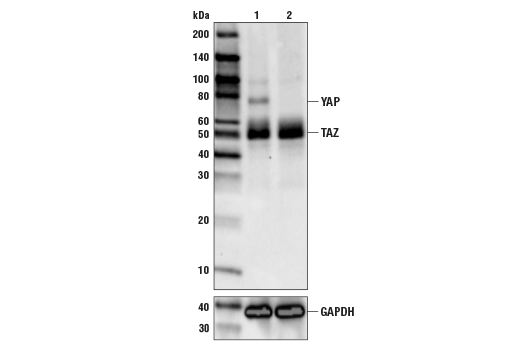


1/2


 用小程序,查商品更便捷





产品介绍
产品介绍
产品信息
荧光素标记
Unconjugated

来源纯化
Monoclonal antibody is produced by immunizing animals with a synthetic peptide corresponding to residues surrounding Asp362 of human TAZ protein.
宿主
Rabbit
商品描述
Product Usage Information
| Application | Dilution |
|---|---|
| Western Blotting | 1:1000 |
| Immunoprecipitation | 1:50 |
同种型
Rabbit IgG
分子量
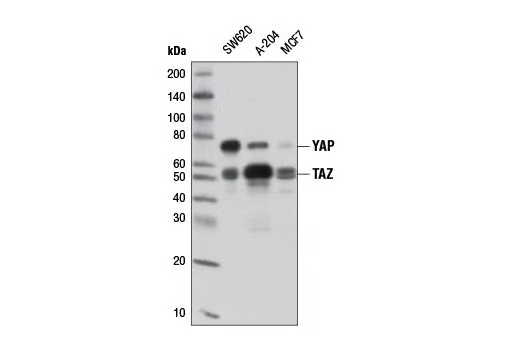
55, 78
应用
目标/特异性
Specificity/Sensitivity
YAP/TAZ (D24E4) Rabbit mAb recognizes endogenous levels of total YAP and TAZ proteins.
Species Reactivity:
Human, Mouse, Monkey
敏感性
Endogenous
背景
背景
YAP (Yes-associated protein, YAP65) was first identified based on its ability to associate with the SH3 domain of Yes. It also binds to other SH3 domain-containing proteins such as Nck, Crk, Src, and Abl (1). In addition to the SH3 binding motif, YAP contains a PDZ interaction motif, a coiled-coil domain, and WW domains (2-4). While initial studies of YAP all pointed towards a role in anchoring and targeting to specific subcellular compartments, subsequent studies showed that YAP is a transcriptional co-activator by virtue of its WW domain interacting with the PY motif (PPxY) of the transcription factor PEBP2 and other transcription factors (5). In its capacity as a transcriptional co-activator, YAP is now widely recognized as a central mediator of the Hippo Pathway, which plays a fundamental and widely conserved role in regulating tissue growth and organ size (6-8). Phosphorylation at multiple sites (e.g., Ser109, Ser127) by LATS kinases promotes YAP translocation from the nucleus to the cytoplasm, where it is sequestered through association with 14-3-3 proteins (7-9). These LATS-driven phosphorylation events serve to prime YAP for subsequent phosphorylation by CK1δ/ε in an adjacent phosphodegron, triggering proteosomal degradation of YAP (10).TAZ is a transcriptional co-activator with a PDZ-binding motif that is regulated by its interaction with 14-3-3 proteins (11). TAZ shares homology with the WW domain of Yes-associated protein (YAP) (11). TAZ is proposed to modulate the switch between proliferation and differentiation of mesenchymal stem cells (MSC) via interaction with transcription factors Runx2 and PPARγ. This process is critical to normal tissue development and the prevention of tumor formation. Due to its role in determination of MSC fate, TAZ may have clinical relevance to several human diseases caused by an imbalance of MSC differentiation (12,13). TAZ is negatively regulated via phosphorylation by LATS1/2, core kinases in the Hippo signaling pathway that controls stem cell development, tissue growth and tumor development (14).
1.Sudol, M. (1994) Oncogene 9, 2145-52.
2.Mohler, P.J. et al. (1999) J Cell Biol 147, 879-90.
3.Espanel, X. and Sudol, M. (2001) J Biol Chem 276, 14514-23.
4.Sudol, M. et al. (1995) FEBS Lett 369, 67-71.
5.Yagi, R. et al. (1999) EMBO J 18, 2551-62.
6.Dong, J. et al. (2007) Cell 130, 1120-33.
7.Zhao, B. et al. (2010) Genes Dev 24, 862-74.
8.Zhao, B. et al. (2007) Genes Dev 21, 2747-61.
9.Yu, F.X. et al. (2012) Cell 150, 780-91.
10.Zhao, B. et al. (2010) Genes Dev 24, 72-85.
11.Kanai, F. et al. (2000) EMBO J 19, 6778-91.
12.Hong, J.H. et al. (2005) Science 309, 1074-8.
13.Hong, J.H. and Yaffe, M.B. (2006) Cell Cycle 5, 176-9.
14.Lei, Q.Y. et al. (2008) Mol Cell Biol 28, 2426-36.
研究领域
癌症,发育生物学与干细胞研究,纤维化,神经科学,
翻译后修饰
unmodified
制备和贮存
保存方式
Supplied in 10 mM sodium HEPES (pH 7.5), 150 mM NaCl, 100 µg/ml BSA, 50% glycerol and less than 0.02% sodium azide. Store at –20°C. Do not aliquot the antibody.
数据库链接
Entrez-Gene ID
25937,10413
UniProt ID
Q9GZV5,P46937
声明 :本官网所有报价均为常温或者蓝冰运输价格,如有产品需要干冰运输,需另外加收干冰运输费。